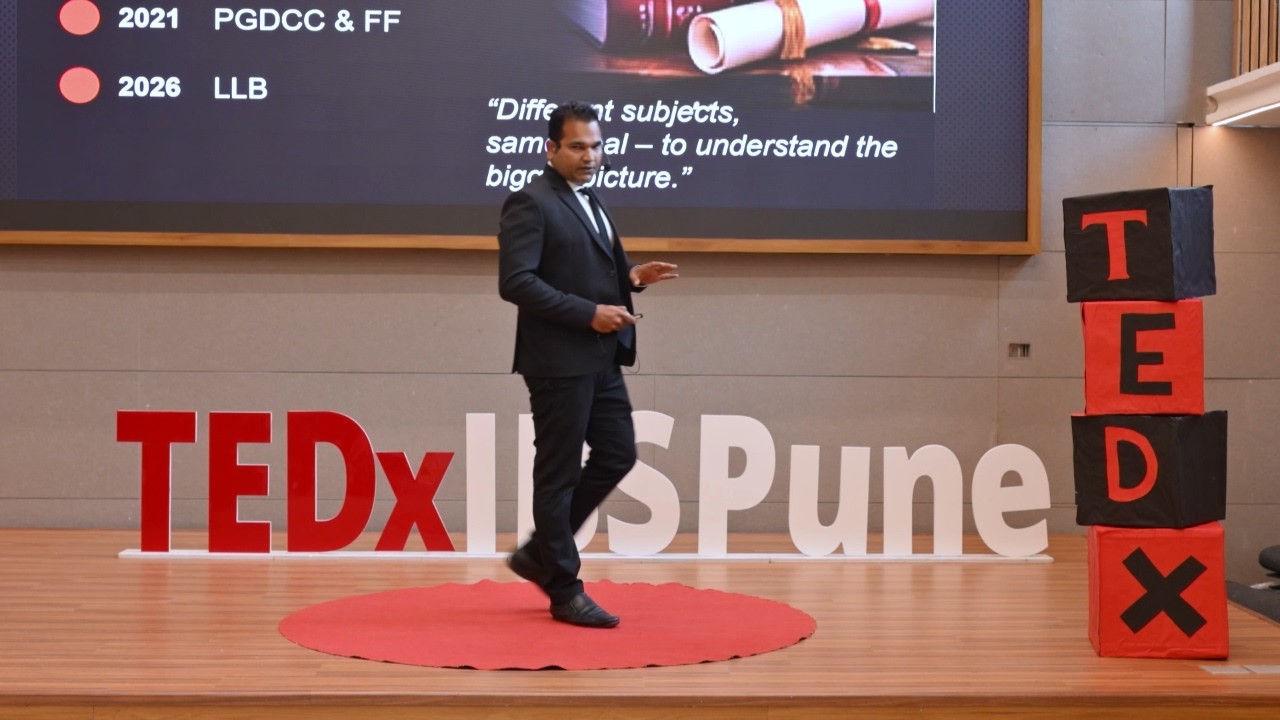
Your starting point does not determine your destination. | Atish Thali | TEDxIBS Pune
Title history
- Your starting point does not determine your destination. | Atish Thali | TEDxIBS Pune — observed on 20261106-0135 UTC (YouTube)
Keywords
Summary
144 words
Critical Evaluation
Value of the Information & Strength of the Argument
The value of the talk lies in its inspirational personal narrative, which can resonate with audiences facing similar challenges. However, the argumentation is primarily anecdotal, relying on pathos rather than empirical evidence. The speaker’s journey is presented as a series of steps, each reinforcing the theme of perseverance, but without substantial data or external validation. The logical structure is clear, yet the claims are not testable or generalizable, limiting the talk’s scientific value.
Scientific Rigor, Source Quality, Title Accuracy
The talk lacks scientific rigor; no references to research or established theories are provided, and the only source is a general TEDx link. The title is very apt, encapsulating the central message accurately. The content is a personal testimony, so traditional scientific standards do not apply, but the absence of citations makes verification impossible. The title does not promise scientific depth, and the talk delivers what it claims—a motivational story.
158 words
Title / Content Match
The title accurately reflects the core message: one's starting conditions do not predetermine future success. The speaker's story directly supports this theme.
Quality & Reliability
3/10
The talk is a personal anecdote with no external sources or scientific evidence. The claims are subjective and based on individual experience, making them unverifiable. Internal consistency is present, but the lack of references and reliance on testimony reduce reliability.
Key Moments
Markers derived by PSI from the transcript: the creator did not define chapters.
- Greeting and introduction; speaker emphasizes respect for educators and the lack of facilities in his village.
- Describes his first earning through newspaper selling and the start of his education journey, highlighting discipline and hard work.
- Recounts taking loans for six of seven degrees and the challenges of completing his MBA, including delivering tea to support himself.
- Mentions going abroad on a scholarship, repaying his loans, and gaining international experience.
- Details his current role as an NRI manager, his decision to study law, and his desire to help society.
- Shares his vision for the future, including short-term, mid-term, and long-term goals, and the three pillars of family, innovation, and impact.
- Delivers key takeaways: keep learning, start now, and view challenges as stepping stones.
Cited Sources
- TEDx Program — General TEDx platform mentioned in the video description, providing context for independently organized TED-like events.
Contribution & Novelties
The talk’s original contribution is the speaker’s personal story, illustrating how resilience and determination can overcome unfavorable starting conditions. While the narrative is not scientifically novel, it offers a tangible example of grit in practice. The talk does not introduce new concepts but reinforces existing ones.
Pour aller plus loin :
- Grit (personality trait) — Psychological research on perseverance and passion for long-term goals, directly relevant to the speaker’s message.
- Mindset — Includes fixed and growth mindsets, which underpin the idea that challenges can be seen as opportunities.
- Social mobility — Discusses the extent to which individuals can change their socio-economic status, contextualizing the speaker’s claim that starting point does not determine destination.
113 words
Radar Profile
The radar profile shows low scores in technical level and reliability, with moderate scores in information quantity and quality. This indicates a highly anecdotal and motivational talk rather than a rigorous scientific presentation. The high qualitative aspects come from the narrative's emotional resonance, but the lack of verifiable data and sources lowers its academic value.