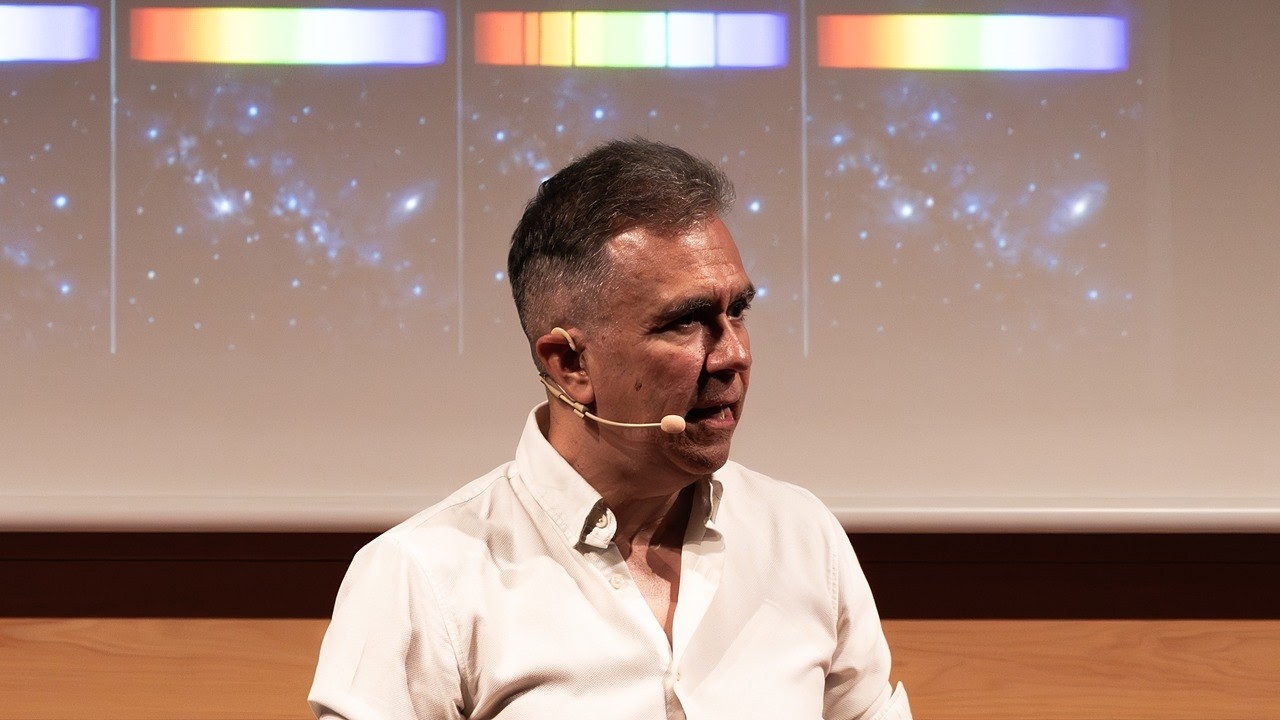
In this TEDx talk, astronomer Jesús Aceituno recounts his childhood experience of seeing Saturn through a small telescope, which ignited his lifelong passion for astronomy. He explains that more than 6,300 exoplanets have been discovered beyond our solar system, with many located in their stars’ habitable zones. Aceituno introduces CARMENES, an instrument at Calar Alto Observatory, which uses the radial velocity method to detect Earth-like planets around nearby stars. He discusses the challenges of distinguishing planetary signals from stellar activity and highlights CARMENES’s unique ability to observe simultaneously in visible and infrared light to overcome this issue. The talk also explores how atmospheric spectroscopy can reveal the chemical composition of exoplanet atmospheres, citing the detection of oxygen and carbon dioxide. Aceituno focuses on the potential biosignature DMS found in K2-18b, but cautions that extraordinary claims require rigorous verification. He emphasizes that discovering life beyond Earth would likely be subtle and require consensus within the scientific community. The speaker concludes by reflecting on the vast number of galaxies and the possibility that we are not alone, while acknowledging that current evidence remains inconclusive. He stresses the value of curiosity and intergenerational scientific efforts in answering fundamental questions about existence.
198 words
Critical Evaluation
Value of the Information & Strength of the Argument
The value of this talk lies in its accessible yet scientifically accurate presentation of exoplanet research and the search for life. Aceituno builds a clear argument starting from a personal anecdote, then systematically introduces key concepts such as the census of exoplanets, detection methods, and the importance of biosignatures. The argumentation is logically structured, moving from the reason why Earth-like planets are difficult to detect to the technical solution provided by CARMENES, and finally to a cautious interpretation of a specific discovery. The speaker effectively balances enthusiasm with scientific prudence, clearly stating that the presence of DMS in K2-18b is not yet confirmed and that further investigation is needed. This honest approach strengthens the credibility of the overall message, making it a valuable resource for general audiences interested in astrobiology.
139 words
Title / Content Match
The title asks a philosophical and scientific question that matches the talk's focus on the search for habitable exoplanets and potential signs of life.
Quality & Reliability
8/10
The talk is based on the professional expertise of an astronomer and presents accurate scientific information about exoplanet detection and characterization. However, it is a popular science talk, so some details are simplified, and no specific references are given.