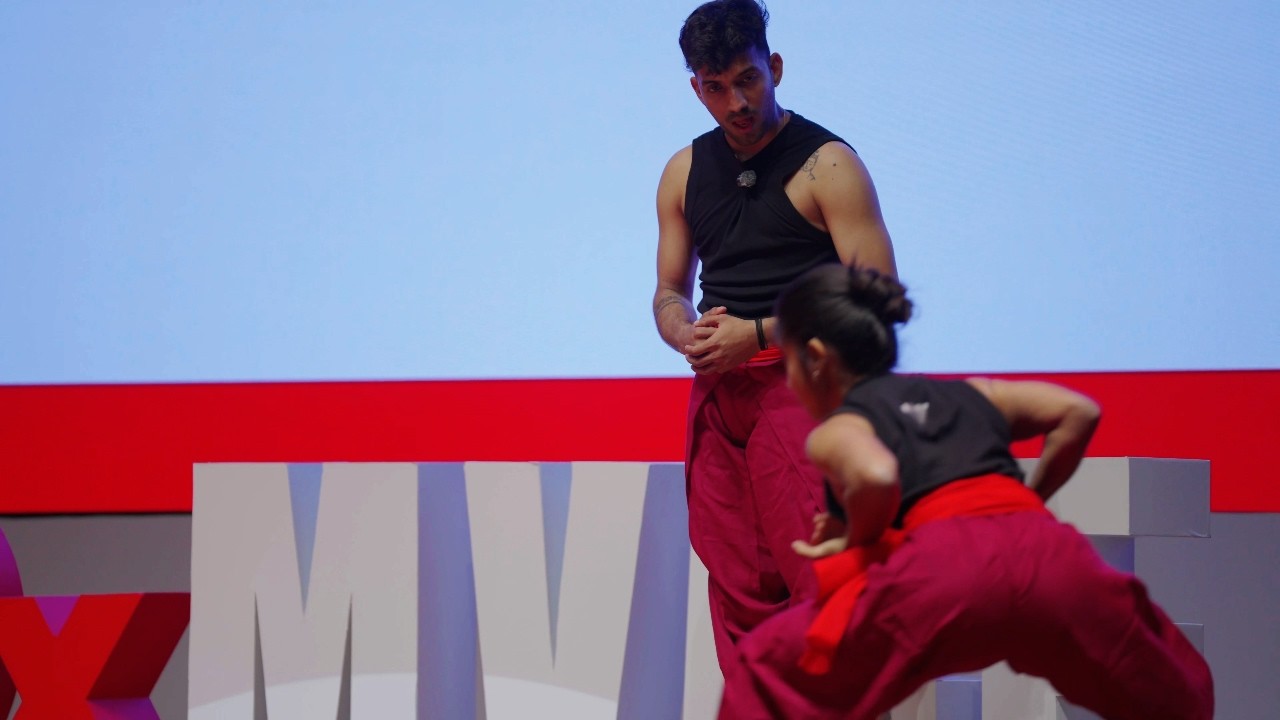
The Art Beneath the Weapon | Nithin K & Shradha Rajeevan | TEDxMVJCE
Title history
- The Art Beneath the Weapon | Nithin K & Shradha Rajeevan | TEDxMVJCE — observed on 20261105-2038 UTC (YouTube)
Keywords
Summary
154 words
Critical Evaluation
Value of the Information & Strength of the Argument
The value of the information lies in its first-hand demonstration of a less widely known martial art, offering insights into its progression from grounding movements to weapon mastery. The argumentation is clear and coherent, structured around the central thesis that the essence of Kalaripayattu is the foundational body awareness, not the weapons. The speakers support this by showing how animal postures recur across various training stages, visually reinforcing their claims. However, the talk is more illustrative than analytical; it lacks comparative context, historical data, or scientific validation of the training benefits. The argument is persuasive but rests on experiential authority rather than rigorous evidence.
Scientific Rigor, Source Quality, Title Accuracy
The talk does not cite specific academic or historical sources; its authority stems from the speakers’ long-term practice and teaching experience. The only external reference is the general TEDx link provided in the description. The title matches the content precisely, as the talk repeatedly returns to the ‘art beneath the weapon’ – the underlying movement principles. While the information is presented with conviction, the lack of verifiable citations limits its scientific rigor. The demonstrations are authentic, and the oral tradition is respected, but the talk would benefit from references to scholarly works on martial arts or movement science to enhance credibility.
220 words
Title / Content Match
The title accurately reflects the content, which emphasizes that the true essence of Kalaripayattu lies in the foundational body movements and animal postures rather than the weapons themselves.
Quality & Reliability
7/10
The talk is delivered by practitioners with over 18 years of experience, providing a firsthand account of Kalaripayattu. The content is descriptive and demonstrative rather than analytical, with no external citations or empirical evidence, but the expertise is credible. The video primarily serves as an introduction to the art's philosophy and movement foundations.
Key Moments
Markers derived by PSI from the transcript: the creator did not define chapters.
- Introduction: What you witnessed was not a fight but a salutation, introducing the theme of grounding.
- Explanation of the eight animal postures (Ashtavadham) and their origin from observing nature.
- Demonstration of the eight animal postures in a continuous sequence.
- Introduction to Meipayattu, the body conditioning stage, with live demonstration.
- Transition to sword and shield (Angathari) while emphasizing the continuation of animal forms.
- Performance of the long stick (Ketakari) and observation of underlying animal stances.
- Conclusion: the importance of carrying foundations forward in any art form.
Cited Sources
- TEDx Program — Official TEDx page providing context on the independently organized TEDx event.
Contribution & Novelties
The talk offers a unique experiential perspective on Kalaripayattu, emphasizing the philosophical and movement foundations over combat applications. It bridges martial arts and performing arts, showing how the same principles apply. The live demonstrations provide tangible evidence of the continuity of animal postures across training stages.
Pour aller plus loin :
- Kalaripayattu (Wikipedia) — Comprehensive background on the martial art’s history, styles, and regional variations.
- Attakkalari Centre for Movement Arts — Institution where Nithin K teaches; offers resources on movement and contemporary dance.
- Proprioception (Wikipedia) — Scientific concept related to body awareness, which underpins the training philosophy discussed.
98 words
Radar Profile
The radar profile shows balanced scores across quantity and quality, with slightly lower technical depth. The talk is accessible yet rooted in practical expertise, making it strong in communication but weaker in academic rigor.