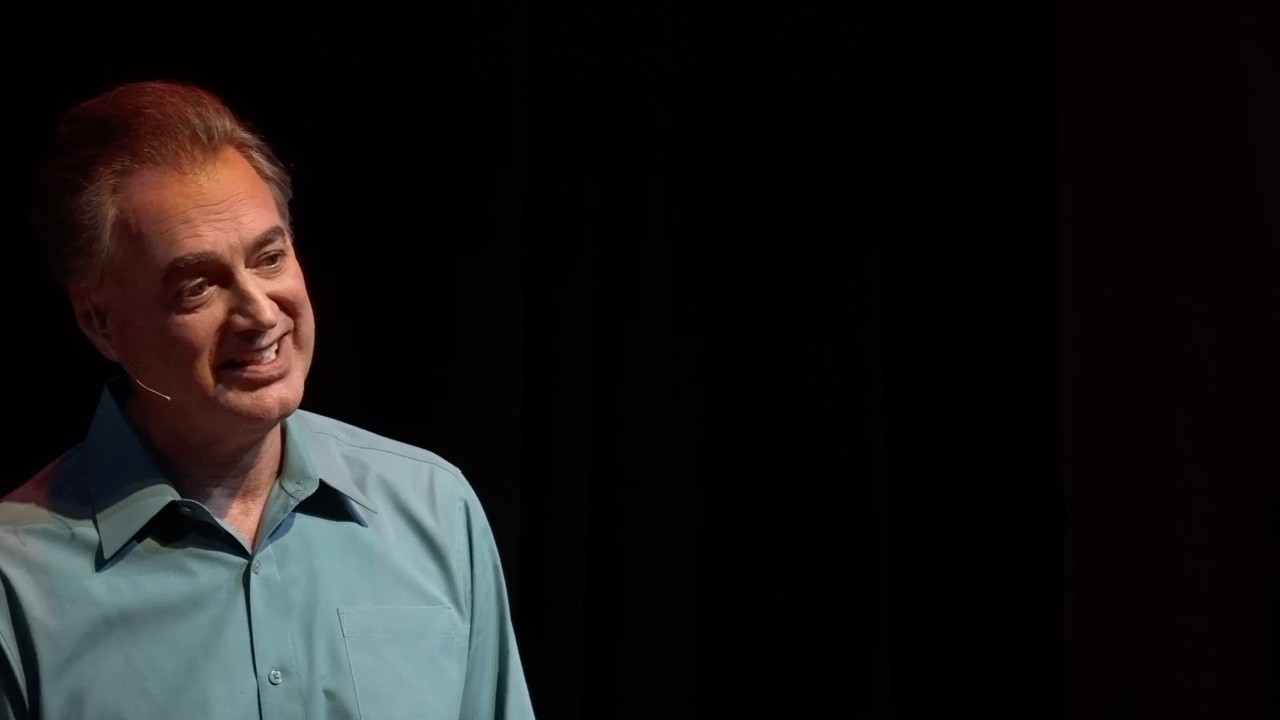
Why You Feel Stuck, and How to Change It | Michael Davis | TEDxColumbiana
Title history
- Why You Feel Stuck, and How to Change It | Michael Davis | TEDxColumbiana — observed on 20261106-0126 UTC (YouTube)
Keywords
Summary
204 words
Critical Evaluation
Value of the Information & Strength of the Argument
The talk’s value lies in its reframing of chronic stagnation from a personal deficit (‘stuck’) to a learned pattern (‘scripted’) that can be rewritten. Davis offers a memorable practical technique: gather concrete evidence that contradicts the limiting belief, rather than relying on positive thinking. The argumentation is compelling because it’s grounded in personal vulnerability and a relatable narrative arc—from painful childhood incident to professional and personal revelations. However, the reasoning is largely anecdotal; the neuroscience reference is vague and uncredited, and the proposed method lacks empirical validation. The emotional storytelling is persuasive but not scientifically rigorous, and the leap from one individual’s experience to a universal prescription is under-supported.
Scientific Rigor, Source Quality, Title Accuracy
The talk cites only a generic mention of ‘Neuroscience at New York University’ without specifics, and the only external source provided in the description is the TEDx program link. The speaker’s credentials as a storytelling coach and TEDx coach add credibility in the domain of communication, but not in psychological research. The title–content alignment is strong, and the message is clear. The scientific rigor is low due to reliance on personal testimony and lack of verifiable references; however, the conceptual framework aligns with established ideas in cognitive-behavioral therapy (e.g., cognitive restructuring) and narrative therapy, though these are not directly acknowledged.
224 words
Title / Content Match
The title accurately reflects the talk's core message: why we feel stuck (due to internalized scripts) and how to change that (by finding proof against them).
Quality & Reliability
7/10
The talk offers a coherent personal narrative with a psychological reframing ('stuck' vs 'scripted') and a practical method, but relies heavily on anecdotal evidence and lacks rigorous scientific citations.
Key Moments
Markers derived by PSI from the transcript: the creator did not define chapters.
- Childhood desk story: Michael is made to stand on a desk, vowing never to be the center of attention.
- Introduces the concept of being 'scripted' rather than 'stuck'.
- Encounter with boss Joe that reinforces his fear of public speaking.
- Revelation with son Shawn: realizes deeper script 'I'm not worth sticking around for'.
- Advice from Doc Diego: find proof that the script is false.
- Conclusion: ask 'What script is running?' and 'What's the proof it's false?'
Cited Sources
- TEDx Program — Official TEDx information page mentioned in the video description.
Contribution & Novelties
The talk’s original contribution is the catchy, actionable reframing ‘You’re not stuck, you’re scripted,’ combined with a simple, concrete strategy: seek irrefutable evidence against the limiting belief. While the idea that childhood experiences shape adult behavior is not new, the emphasis on actively compiling proof (rather than just self-awareness) offers a pragmatic angle. The personal story makes it relatable but limits generalizability.
Pour aller plus loin :
- Cognitive restructuring — This CBT technique aligns with Davis’s advice to challenge and change distorted beliefs by examining evidence.
- Narrative therapy — Externalizing the problem (‘script’) and re-authoring one’s story parallels Davis’s approach.
- Self-efficacy — Bandura’s concept of belief in one’s ability to succeed relates to overcoming limiting scripts.
116 words
Radar Profile
The radar profile shows moderately balanced scores, with quality of information and fiabilité slightly higher than technical depth and quantity, reflecting the talk's strong narrative but thin empirical grounding. The overall scores suggest an engaging but not highly technical or rigorously sourced presentation.