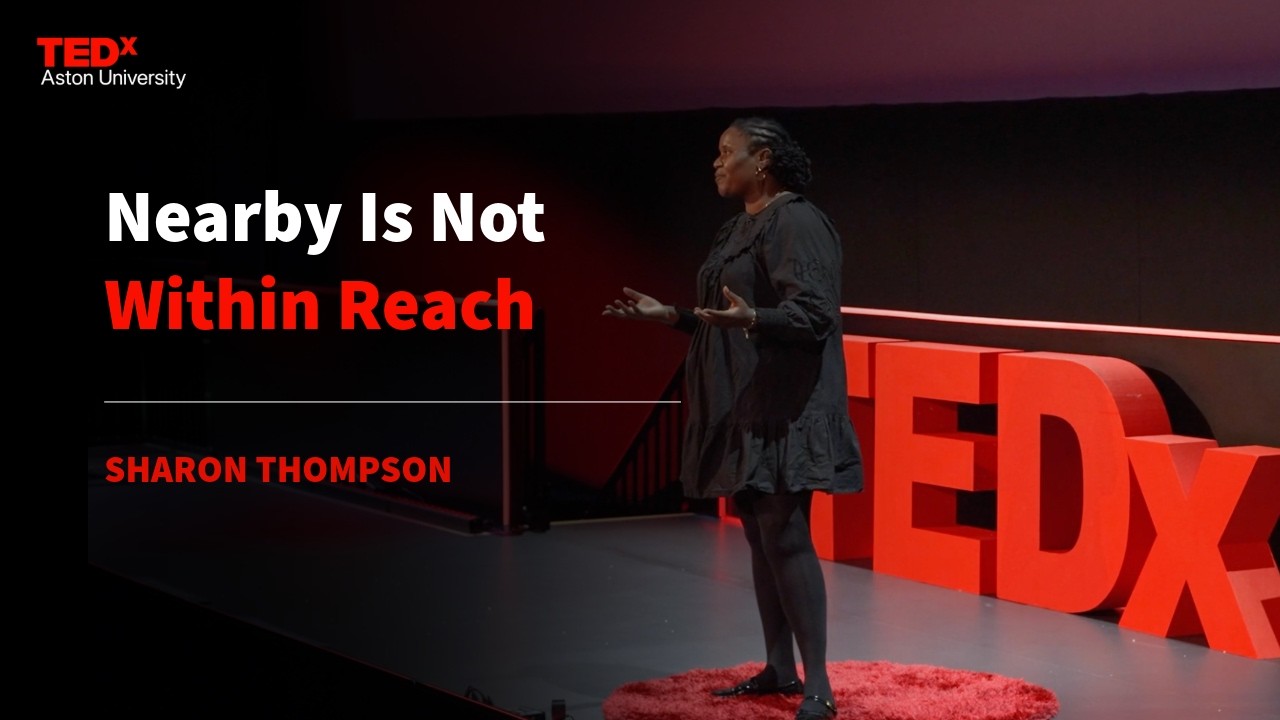
Why is community support so hard to find? | Sharon Thompson JP FIoL | TEDxAston University
Keywords
Summary
147 words
Critical Evaluation
Value of the Information & Strength of the Argument
The talk’s value lies in its personal authenticity and the compelling illustration of how community support can transform lives. The argument is built on narrative and anecdote, making it relatable but not scientifically rigorous. She effectively contrasts the output-focused approach with outcome-focused planning, using the Vienna example to show a different model. However, the lack of empirical evidence and the reliance on a single case study weaken the strength of the argument. The concept of ‘places of choice’ is engaging but not deeply developed. Overall, the argument is persuasive on an emotional level but lacks the analytical depth expected in a formal study.
Scientific Rigor, Source Quality, Title Accuracy
Scientifically, the talk is not grounded in formal research; it relies on personal testimony and one international example. No specific studies or data are cited. The only link provided is the general TEDx page, which does not offer supporting references. The title promises an explanation of why community support is hard to find, but the talk primarily narrates how it was found in one case, leaving the ‘why’ implicitly addressed through systemic observations. There is a substantial gap between the title’s implication and the content, yet the underlying message about accessibility is clear. The absence of corroborating sources reduces its scientific reliability, though as a public talk it serves to raise awareness.
230 words
Title / Content Match
The title is somewhat broad; the talk recounts the speaker's personal journey and advocates for 'places of choice', touching on the difficulty of community support rather than systematically answering why it is hard to find.
Quality & Reliability
6/10
The talk is grounded in personal lived experience and anecdotal evidence, offering a compelling narrative but lacking empirical data or cited research. The argument is plausible and aligns with known urban planning concepts, but reliability is limited by the absence of rigorous sourcing.
Key Moments
Markers derived by PSI from the transcript: the creator did not define chapters.
- Introduction and setting the scene
- Story of the knock on the door and signing the petition
- Volunteering and community changes in Lee Bank
- Meeting Venice and getting work experience
- First job and introduction of the concept of 'places of choice'
- Vienna visit and examples of outcome-focused regeneration
- Call to action and concept of economic leakage
Cited Sources
- TEDx Program — General information about TEDx events; provided in the video description.
Contribution & Novelties
The talk offers a firsthand perspective on how community support can catalyse personal transformation, introducing the term ‘places of choice’ and contrasting output-oriented with outcome-oriented regeneration. Its originality lies in combining personal narrative with a call to action for inclusive growth.
Pour aller plus loin:
- Social mobility — Discusses factors enabling individuals to improve their socio-economic status.
- Urban renewal — Overview of programs that address urban decay and their impacts.
- Placemaking — Approach to designing public spaces that foster community and wellbeing.
82 words
Radar Profile
The scores indicate a profile with moderate quantity but lower quality and technical depth, suggesting a talk oriented towards general audience with personal insights rather than hard data. The fiabilite_globale score reflects the lack of rigorous sourcing.