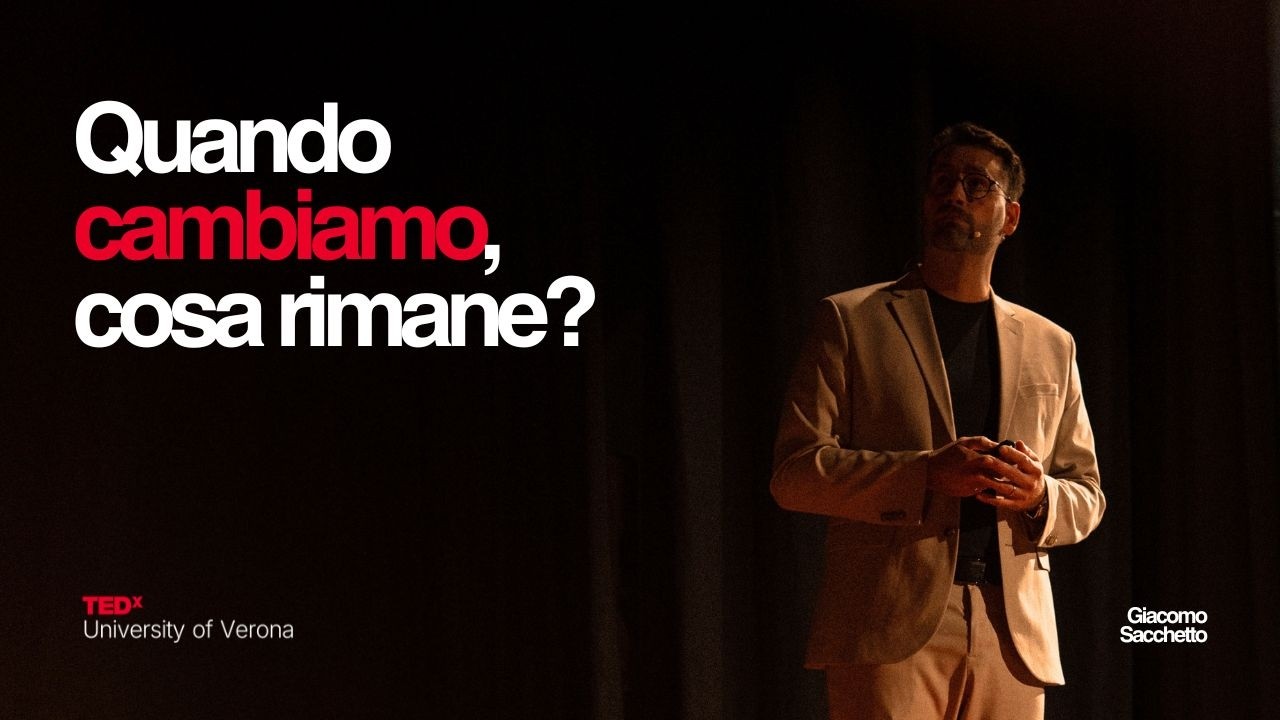
Quando cambiamo, cosa rimane? | Giacomo Sacchetto | TEDxUniversity of Verona
When we change, what remains? | Giacomo Sacchetto | TEDxUniversity of Verona
Title history
- Quando cambiamo, cosa rimane? | Giacomo Sacchetto | TEDxUniversity of Verona — observed on 20261026-1551 UTC (YouTube)
Keywords
Summary
167 words
Critical Evaluation
Value of the Information & Strength of the Argument
The talk’s value lies in its sincere and relatable perspective, connecting a specific craft (fine dining) to universal themes of personal growth and resilience. Sacchetto builds his argument through chronological narrative and concrete examples from his career, making his points tangible. However, the argumentation is largely associative and anecdotal rather than logical or evidence-based; he proposes paradoxes (technology vs. humanity, tradition vs. innovation) without deep analysis, but resolves them with a poetic synthesis. The emotional appeal is strong, but the intellectual depth is moderate, and the thesis would benefit from more structured support or comparative examples.
Scientific Rigor, Source Quality, Title Accuracy
The talk does not cite external sources, relying solely on personal experience, which limits its scientific rigor. The description lists only the generic TEDx link, providing no reference list or data. The title is directly relevant and well matched to the content, as the speaker consistently returns to the question ‘what remains after change.’ The lack of verifiable sources reduces the overall credibility but does not negate the experiential authority of the speaker. No comments were provided, so public reaction is not assessed.
194 words
Title / Content Match
The title accurately captures the core theme of transformation and continuity, and the talk consistently addresses what remains after change.
Quality & Reliability
5/10
The talk is a personal and reflective narrative without empirical data or scientific references, but the speaker's authenticity and professional background add credibility to his observations.
Key Moments
Markers derived by PSI from the transcript: the creator did not define chapters.
- Introduction: 'I am Giacomo Sacchetto and I cook' – sets the theme of cooking as a metaphor.
- Early career and learning from mistakes – 'I was put in a corner and told to watch for a week.'
- Paradox of technology and human factor – 'The more technology, the more we want human touch.'
- Tradition and innovation – 'The risino revisited in a modern key' and sustainability.
- Conclusion: 'After change, you don't go back; discipline becomes responsibility, errors become experience.'
Cited Sources
- TEDx Talks - Learn more — This is the official TEDx page, referenced in the video description as the format organizer.
Contribution & Novelties
The talk offers a fresh perspective by using fine dining as a lens to discuss personal transformation, emphasizing that change is a process of accumulation rather than replacement. It bridges culinary practices (fermentation, seasonal cooking) with broader life philosophy, and critiques technological trends by reaffirming the irreplaceable value of human touch. The concept of ‘beyond change’ as a stratification of past selves is original within this context.
Pour aller plus loin :
- Fermentation — Relevant to the contemporary techniques mentioned and their link to historical preservation methods.
- Michelin Guide — Provides background on the star system that frames the speaker’s career achievements.
- Farm-to-table — Related to the emphasis on local, seasonal ingredients and sustainable gastronomy.
115 words
Radar Profile
The radar profile shows moderate scores across most dimensions, with slightly higher on quality of information (6) and lower on technical level (3). This reflects a talk that is insightful but not deeply technical, and credible on an experiential basis but lacking in formal evidence.