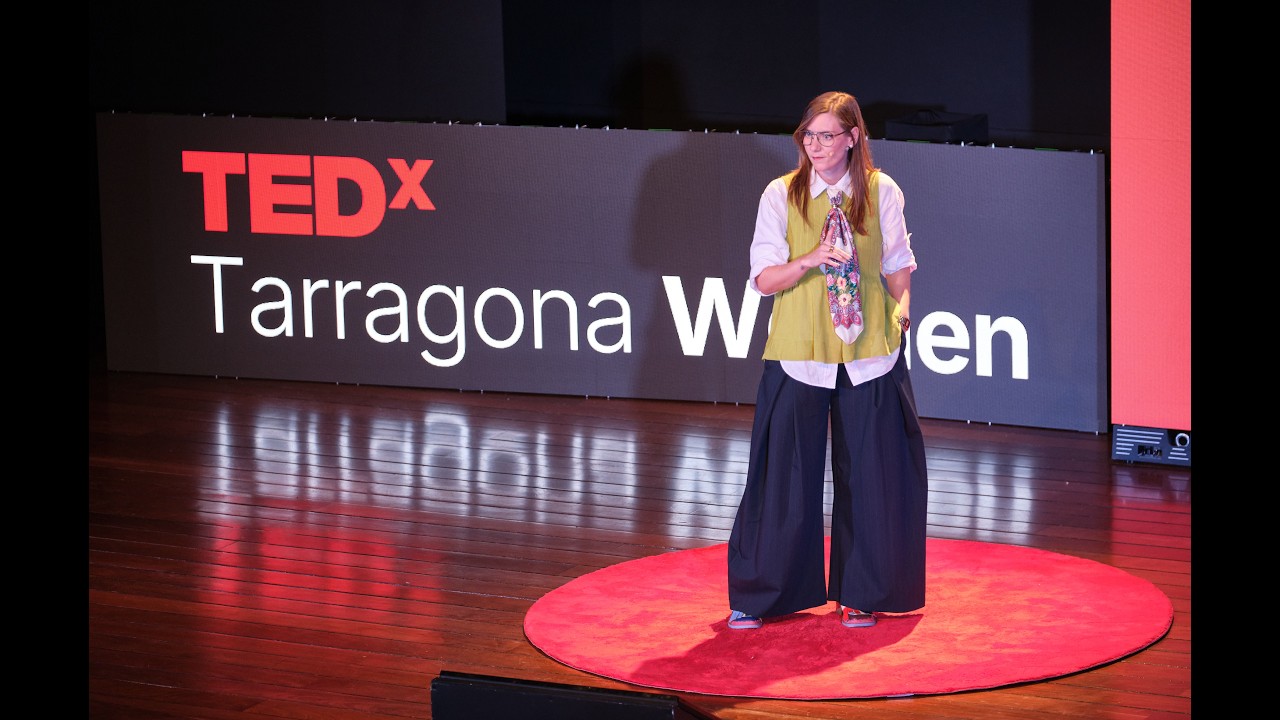
Cómo la publicidad te puede salvar de la desinformación | Clara Cervera | TEDxTarragona Women
How advertising can save you from misinformation | Clara Cervera | TEDxTarragona Women
Title history
- Cómo la publicidad te puede salvar de la desinformación | Clara Cervera | TEDxTarragona Women — observed on 20261104-2228 UTC (YouTube)
Keywords
Summary
231 words
Critical Evaluation
Value of the Information & Strength of the Argument
The value of the talk lies in its insider perspective: Cervera leverages her professional expertise to dissect the mechanics of persuasion and its overlap with political manipulation. She presents a compelling argument that personalized advertising and propaganda have become indistinguishable in digital feeds, leading to fragmented public spheres and heightened polarization. Her argumentation is solid in that it builds from concrete observations (the Instagram feeds of men vs. women) to broader societal implications. She introduces the useful concept of ‘desinformada’ as a distinct state from ‘infoxication,’ emphasizing the emotional disengagement that follows overwhelming misinformation. While some claims are anecdotal, her analysis is coherent and thought-provoking. She avoids reductive solutions, instead advocating a hands-on approach—immersing oneself in reality and developing critical habits. The conclusion that engagement itself can be repurposed as a political tool is a fresh and actionable idea, though it remains somewhat underdeveloped.
Scientific Rigor, Source Quality, Title Accuracy
The talk demonstrates moderate source rigor. Cervera makes a specific reference to a European Commission report on influencer labeling, which lends credibility to a key claim. However, other assertions—such as the precise content of male and female feeds—are presented as general observations without empirical backing. She does not provide direct citations or links to external sources, and the only reference given in the description is the generic TEDx page. The title accurately reflects the content: the speaker uses advertising as a lens to understand and counter disinformation. The speaker’s background as a branding creative qualifies her to talk about advertising techniques, though she does not present original research. The structure is engaging, with a clear narrative arc from problem to proposed mindset shift, but the absence of verifiable sources for many claims slightly diminishes the scientific weight. No comments were provided for analysis.
302 words
Title / Content Match
The title effectively encapsulates the core message: understanding advertising mechanisms can serve as a tool for recognizing and resisting manipulation. It matches the content well.
Quality & Reliability
7/10
The talk offers a professional insider perspective on advertising and propaganda, with a concrete reference to a European Commission finding on influencer labeling. However, many claims lack specific citations, relying on the speaker's experience and anecdotal evidence. Overall credible but not rigorously sourced.
Key Moments
Markers derived by PSI from the transcript: the creator did not define chapters.
- Introduction: Asks audience to look at their Instagram feeds, contrasting female and male content.
- Key premise: 'Your internet is not my internet'—algorithms create divergent realities.
- Personal background: Clarity about her decade in advertising and initial enthusiasm for brands with purpose.
- Defines advertising vs. propaganda, and notes the blurring of lines into hashtags.
- Mentions European Commission statistic on influencer labeling and rise of male radicalization.
- Defines disinformation as selected information with manipulative intent, and introduces 'desinformada'.
- Refuses to give 'three keys'; instead urges going outside and reconnecting with reality.
- Conclusion: Advocates using engagement as a political weapon and ends with personal commitment.
Cited Sources
- TEDx Official Page — Referenced as the standard TEDx event platform, where the talk was given.
Contribution & Novelties
This talk offers a distinct perspective by framing disinformation through the lens of an advertising professional. The core novelty lies in the proposition that the very mechanisms of engagement—typically used to sell products—can be repurposed for civic awareness. Cervera introduces the term ‘desinformada’ to describe a state of wilful disengagement, a concept not commonly discussed in mainstream discourse. She also draws a clear parallel between personalized advertising and political propaganda, showing how algorithms segment audiences and amplify specific narratives. The talk moves beyond general critiques of misinformation to propose an actionable, albeit unconventional, strategy: reclaiming engagement as a tool for informed participation.
Pour aller plus loin :
- Misinformation - Wikipedia — Directly relevant to the topic; provides definitions and research background.
- Filter bubble - Wikipedia — Explains the algorithmic isolation that Cervera describes as ‘your internet is not my internet’.
- Propaganda - Wikipedia — Helps clarify the distinction between advertising and propaganda that the talk explores.
156 words
Radar Profile
The profile shows high scores in quality of information and moderate technical depth, reflecting the speaker's professional but accessible approach. The relatively lower quantitative and source reliability scores indicate that while the talk is insightful, it relies more on anecdotal and professional experience than on rigorous citations. This balance suits a TEDx talk aimed at provoking reflection rather than delivering exhaustive data.