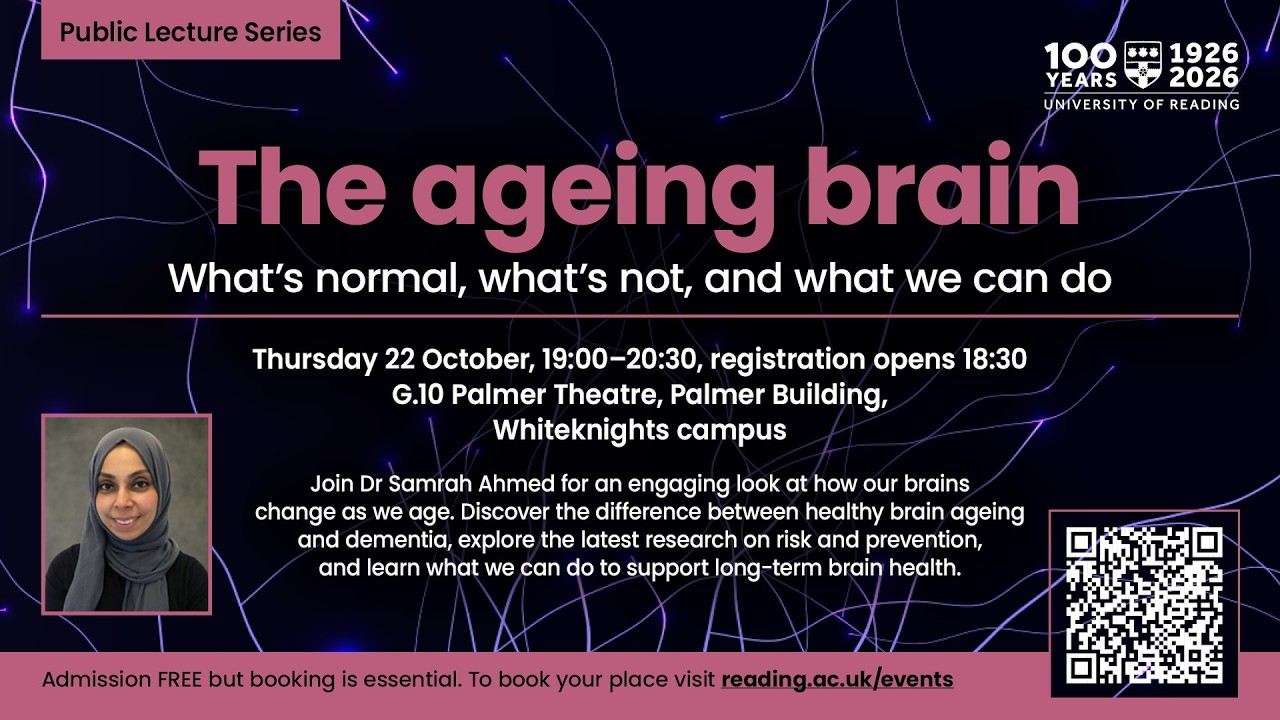
The Ageing Brain | University of Reading Public Lecture
Keywords
Summary
150 words
Critical Evaluation
Value of the Information & Strength of the Argument
The lecture provides valuable information for a broad audience, clarifying common misconceptions about aging and dementia. The argumentation is persuasive and grounded in scientific evidence, including brain imaging studies and cognitive assessments. The speaker systematically builds a case for distinguishing normal changes from those requiring clinical attention, while also highlighting actionable lifestyle factors that may mitigate risk. The inclusion of personal anecdotes and interactive audience engagement strengthens the delivery without compromising scientific accuracy.
Scientific Rigor, Source Quality, Title Accuracy
The talk demonstrates strong scientific rigor, referencing well-established research (e.g., the Royal Lauren study on verbal working memory) and global statistics from the World Health Organization. The speaker also presents findings from her own lab, ensuring a blend of recognized literature and original research. The title of the lecture is appropriately matched to the content, which systematically addresses what is normal, what is not, and what can be done. No external sources were directly cited in the video description beyond WHO statistics and university social media links, but the content itself is consistent with current neuroscientific consensus.
185 words
Title / Content Match
The title accurately reflects the content, which covers normal brain aging, dementia symptoms, and preventive strategies.
Quality & Reliability
8/10
High-quality public lecture by a clinical neuroscientist, presenting research findings and expert knowledge, based on established scientific literature and her own research. The content is well-structured, evidence-based, and clearly distinguishes normal aging from pathology.
Key Moments
Markers derived by PSI from the transcript: the creator did not define chapters.
- Introduction to the lecture topic and speaker background
- Healthy aging: two main changes - structural and cognitive
- Structural changes in the brain: shrinkage and hippocampus volume
- Cognitive changes: processing speed and attention, with language preservation
- Interactive face recognition test illustrating age-related changes
- Compensatory mechanisms: bilateral activation in older adults
- Definition of dementia, prevalence, and types including young-onset
- Cognitive profiles of different dementia types and brain regions affected
Cited Sources
- World Health Organization - Dementia — Cited in the video description to highlight global prevalence of dementia.
Contribution & Novelties
This lecture synthesizes current research on brain aging and dementia for a public audience, clarifying common misconceptions and emphasizing the importance of early diagnosis. It presents original findings from the speaker’s lab on face recognition and young-onset dementia, offering a nuanced perspective on cognitive changes.
Pour aller plus loin :
- Super-ager — Concept of individuals who maintain high cognitive function in advanced age.
- Dementia prevention — Lifestyle and medical factors that may reduce dementia risk.
- Hippocampus — Brain region crucial for memory, highlighted in the lecture for its vulnerability.
89 words
Radar Profile
The radar profile shows high scores in information quantity, quality, and reliability, with a moderately high technical level, indicating a well-substantiated and informative talk that balances accessibility with scientific depth.