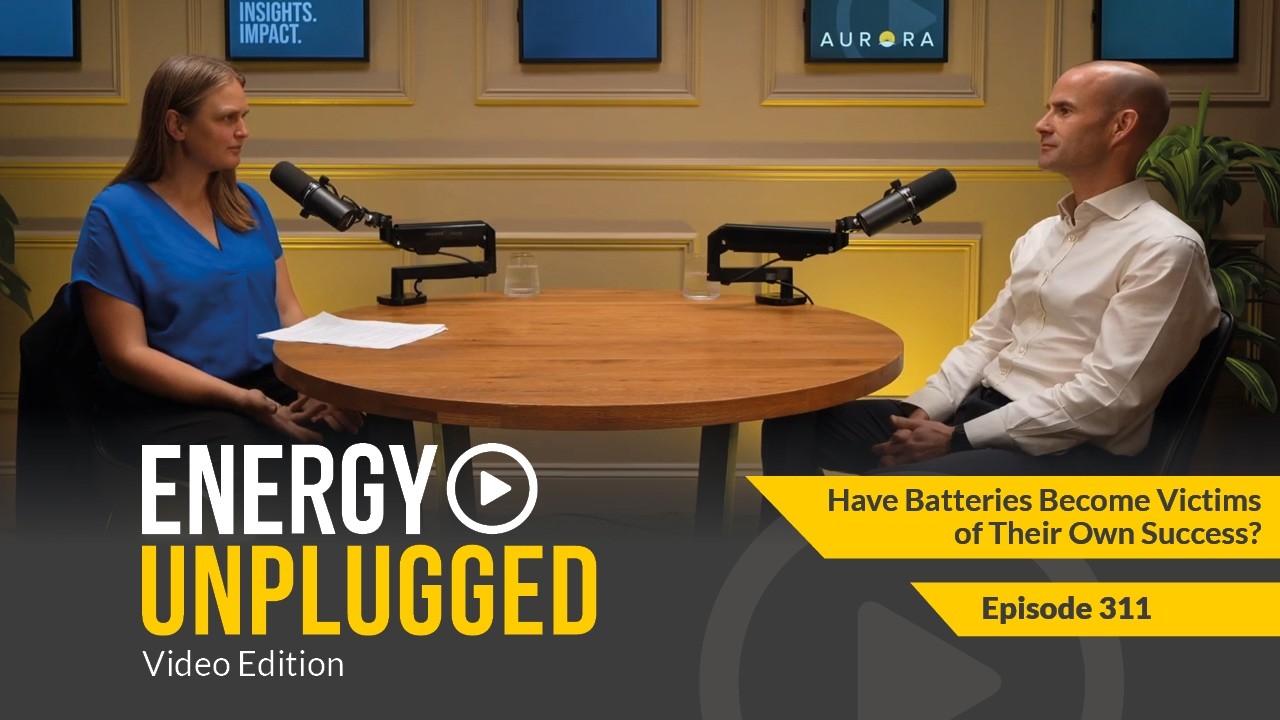
Have Batteries Become Victims of Their Own Success? EP.311
Keywords
Summary
168 words
Critical Evaluation
Value of the Information & Strength of the Argument
The value of the information lies in the firsthand perspective of a CEO who has built and operated a substantial battery portfolio across the UK and France. Concrete examples, such as the average revenue increase from £55k to £80k per MW within a year, illustrate merchant risk and reward. The argumentation is coherent and grounded in practical experience, particularly regarding the unfairness of subsidized LDES potentially cutting into unsubsidized battery revenues. However, the views are largely anecdotal and lack rigorous quantitative backing or references to external studies, making the subjective stance somewhat limiting. The argument that batteries are victims of their own success is compelling, but the discussion does not provide a balanced analysis of alternative perspectives, such as the need for LDES to achieve decarbonization targets.
Scientific Rigor, Source Quality, Title Accuracy
The video is an interview rather than a scientific presentation, so it offers no formal citations. The sources mentioned are entities like Aurora Energy Research, Harmony Energy, and Tesla AutoBidder, but no external documents or data sets are referenced. The title accurately captures the central theme, and the content stays on topic. There is no evidence of systematic research or verification of claims, though the speaker’s industry experience adds credibility. No comments were provided for analysis, so public reception cannot be assessed.
224 words
Title / Content Match
The title accurately reflects the central debate discussed: whether batteries' success leads to policy interventions like LDES subsidies that could distort the market they helped create.
Quality & Reliability
8/10
The discussion features a seasoned CEO sharing insights from direct experience in the battery storage market, but relies solely on anecdotal evidence and company perspectives without citing independent studies or data sources.
Key Moments
Markers derived by PSI from the transcript: the creator did not define chapters.
- Introduction and context setting
- Peter Kavanagh's background in wind and early battery business
- Debate on merchant vs contracted revenue for batteries
- Balancing mechanism skip rates and code change 166
- Planning and grid connection delays as key blockers
- Long-duration storage and cap-and-floor policy concerns
Contribution & Novelties
This podcast sheds light on the unintended consequences of policy support for long-duration storage in a market where batteries have thrived without subsidies. The discussion highlights the tension between commercial innovation and state intervention, offering a nuanced view from a prominent industry player. It also updates listeners on specific regulatory changes like GC0166 and the practical issues of grid queues and revenue volatility.
Pour aller plus loin :
- Battery energy storage system — Provides technical background and applications of battery storage, useful for understanding the technology discussed.
- National Grid Electricity System Operator — Explains the UK grid operator and the balancing mechanism, relevant to the skip rate discussions.
- Energy storage — General overview of storage types and grid benefits, helping to contextualize long-duration storage debates.
125 words
Radar Profile
The radar profile shows strong scores in information quantity and quality, indicating a content-rich and insightful discussion. The moderate technical level suggests accessibility to a broad audience, while the reliability score reflects a reliance on expert opinion rather than peer-reviewed data. The profile is balanced but leans towards practical insights rather than academic rigor.