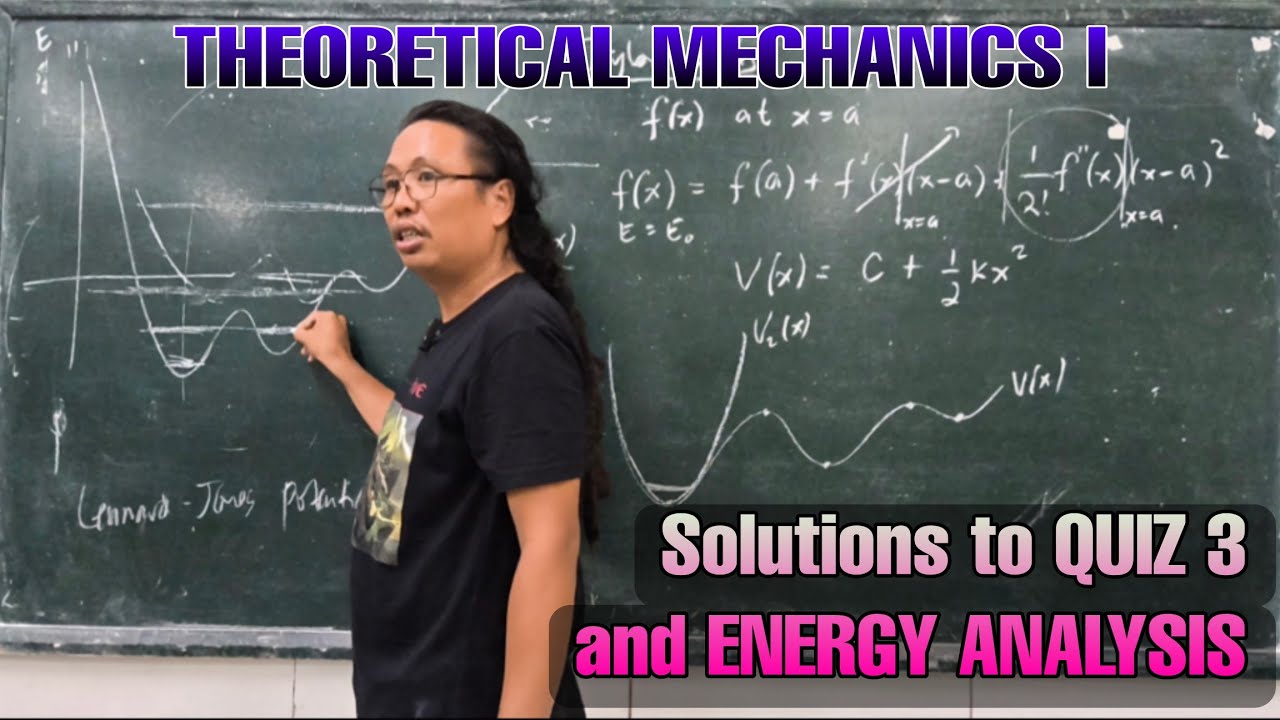
TheoMech-05.5: Energy Analysis and Quiz Solutions
Keywords
Summary
157 words
Critical Evaluation
Value of the Information & Strength of the Argument
The value of the content lies in its pedagogical approach to teaching qualitative dynamical analysis, which is fundamental for physics students. The argumentation is structured logically: starting from the potential derived from the force, establishing equilibrium points, and then using Taylor series to justify harmonic motion near minima. The discussion of turning points and forbidden regions is mathematically justified by the energy equation, and the connection to the Lennard-Jones potential provides a concrete physical application. The reasoning is coherent and builds step by step, though it occasionally relies on informal language and assumes the viewer is comfortable with mathematical expansions.
Scientific Rigor, Source Quality, Title Accuracy
The scientific rigor is high in terms of physical principles and mathematical derivations; the content aligns with standard classical mechanics. However, the lecture does not cite any external sources or references, and the description contains no links, limiting traceability. The title ‘Energy Analysis and Quiz Solutions’ is appropriate, as the video indeed covers energy analysis and likely addresses quiz problems, though the transcript does not explicitly highlight separate quiz sections. A minor discrepancy is the lack of clear delineation between theory and quiz solutions, but overall the title is accurate.
205 words
Title / Content Match
The title accurately reflects the content: the video focuses on energy analysis in conservative systems and includes solutions to related problems, though the specific 'quiz solutions' are not explicitly distinguished in the transcript.
Quality & Reliability
8/10
Clear and rigorous exposition of standard classical mechanics concepts, but no external sources or references are provided or cited.
Key Moments
Markers derived by PSI from the transcript: the creator did not define chapters.
- Introduction of the problem and derivation of potential from force.
- Plotting the potential and identifying equilibrium points.
- Discussion of stable and unstable equilibria and the second derivative test.
- Taylor series expansion and approximation of the potential as a harmonic oscillator.
- Energy diagram analysis: turning points and forbidden regions.
- Lennard-Jones potential and its relation to states of matter.
- Mention of quantum tunneling and conclusion.
Cited Sources
- Lennard-Jones potential — Referenced as a real-world example of a potential that allows qualitative analysis of states of matter.
- Taylor series — Used to expand the potential around an equilibrium point, leading to the harmonic approximation.
- Quantum tunnelling — Mentioned as a quantum-mechanical phenomenon contrasting with classical forbidden regions.
Contribution & Novelties
The lecture provides a clear pedagogical framework for analyzing mechanical systems without numerical integration, emphasizing the power of graphical and functional reasoning. It connects abstract concepts of equilibrium and Taylor expansion to physical intuition, using the Lennard-Jones potential to illustrate phase transitions. The novel contribution is its insistence on qualitative analysis as a primary tool, which is often underemphasized in standard textbooks.
Pour aller plus loin :
- Lennard-Jones potential — Key example of a realistic interatomic potential, relevant for molecular dynamics.
- Harmonic oscillator — The approximation near stable equilibrium; fundamental in many branches of physics.
- Quantum tunnelling — Explores the quantum deviation from the classical forbidden region, a natural follow-up.
110 words
Radar Profile
The radar profile shows a balanced lecture with strong scores in quantity and quality of information, moderate technical depth, and high reliability. The lack of cited sources is offset by the standard nature of the material.