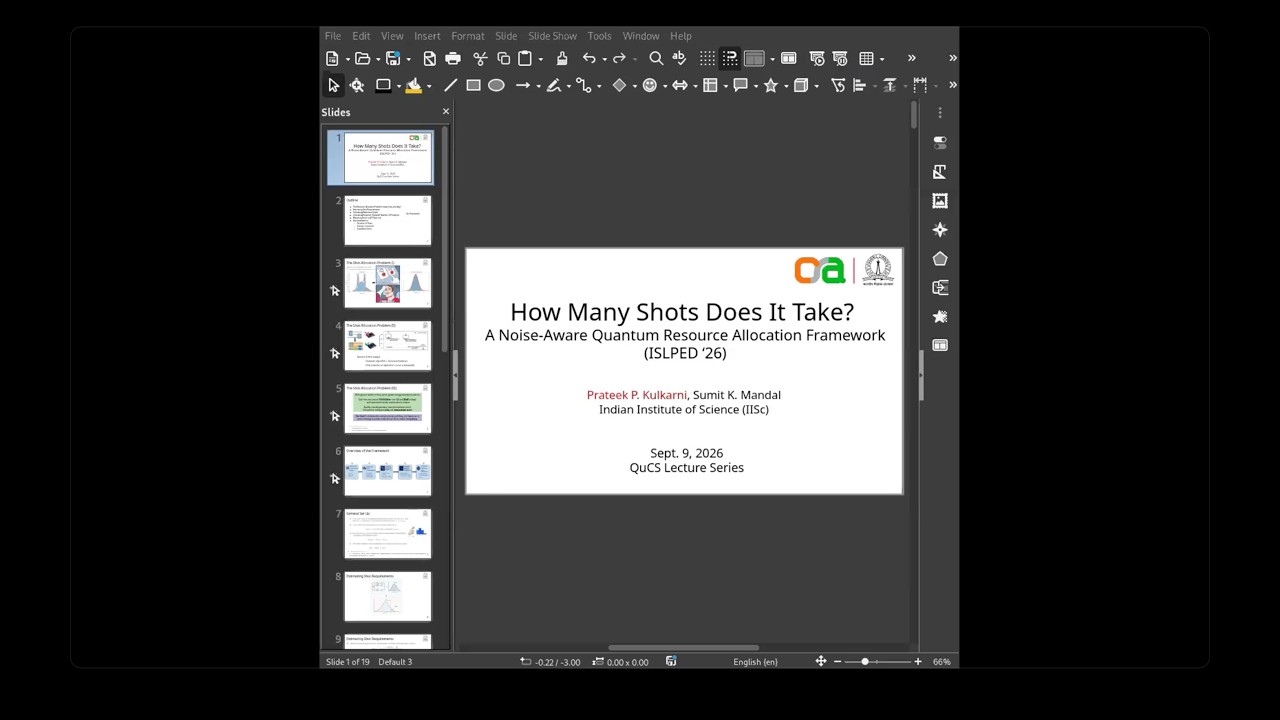
QuCS Lecture 84: Prateek Kulkarni(IISc) | Rethinking Resource Allocation on Noisy Quantum Computers
Keywords
Summary
152 words
Critical Evaluation
Value of the Information & Strength of the Argument
The talk provides significant value by addressing a practical and costly issue: overprovisioning of shots in quantum experiments. The derivation of a closed-form shot estimation from first principles, combined with hardware-aware noise modeling, is a strong contribution. The argumentation is solid: the analytical models are validated with low error margins on multiple IBM machines, and the benefits are quantified (60% energy reduction, 63% error reduction). The logical flow from problem definition to solution and validation is clear and persuasive.
Scientific Rigor, Source Quality, Title Accuracy
The presentation is rigorous: the methodology is transparent, and experimental validation is thorough. Sources are limited to the paper mentioned but not explicitly referenced in the video; however, the description provides the lecture website and signup link. The title accurately describes the content, exploring resource allocation with a focus on shot estimation, depth limits, and partitioning. The speaker refers to prior work and mentions the paper will be linked, but no explicit URLs are given in the talk itself. Overall, the work is credible and well-structured.
180 words
Title / Content Match
The title accurately reflects the content: rethinking resource allocation on noisy quantum computers, focusing on shot estimation, circuit depth, and optimal partitioning.
Quality & Reliability
8/10
The talk presents a rigorous analytical framework for resource estimation in noisy quantum computers, validated experimentally on IBM hardware with low error margins. The methodology is transparent, includes closed-form expressions, and the results are clearly explained, though some derivations are summarized.
Key Moments
Markers derived by PSI from the transcript: the creator did not define chapters.
- Outline of the talk: resource allocation problem, shot estimation, depth estimation, partitioning, and experiments.
- Motivation: noisy quantum computers require many shots; example of convergence and the dilemma of choosing the number of shots.
- Framework overview: inputs (hardware parameters) and steps (shot estimation, max depth, partitioning, shot allocation).
- Shot estimation analytical model: Bernoulli/binomial modeling, variance from noise, derivation of closed-form for required shots.
- Maximum circuit depth calculation: using derived expression to determine Dmax, which decreases for larger circuits and stricter targets.
- Partitioning strategy: minimum partitions as D_original/D_max; rationale and overview of the optimization problem.
- Experimental validation: benchmarks (QFT, Shor, QST, BQE, QA) on IBM hardware; errors under 2% for shots and 4% for depth.
- Results summary: 60% energy reduction, 63% error reduction with optimal allocation; conclusion and open discussion.
Cited Sources
- Signup for future weekly Zoom lectures — Provided in the video description as a way to join the QuCS lecture series.
- Quantum Computer Systems Lecture Series website — The official website for the lecture series, where further information and materials are available.
Contribution & Novelties
The talk presents a novel framework for resource allocation in noisy quantum computers, deriving closed-form expressions for shot requirements and maximum circuit depth that incorporate hardware noise parameters. The key innovation is the optimal shot allocation across circuit partitions, which significantly reduces overprovisioning and energy consumption while maintaining fidelity. This is validated with low error margins on real IBM hardware.
Pour aller plus loin :
- Measurement in quantum mechanics — Essential background for understanding how shots and measurement statistics work in quantum systems.
- Quantum decoherence — A core concept behind hardware noise, directly relevant to the noise parameters used in the framework.
- Qiskit SDK — The quantum computing framework used for experiments, including the AutoCut package for circuit cutting mentioned in the talk.
123 words
Radar Profile
The radar profile shows high scores in technical level and information quality, reflecting the advanced mathematical derivations and experimental validation. The quantity and reliability scores are slightly lower, indicating the condensed presentation of derivations and the lack of explicit source URLs in the talk itself, though the overall profile is strong.