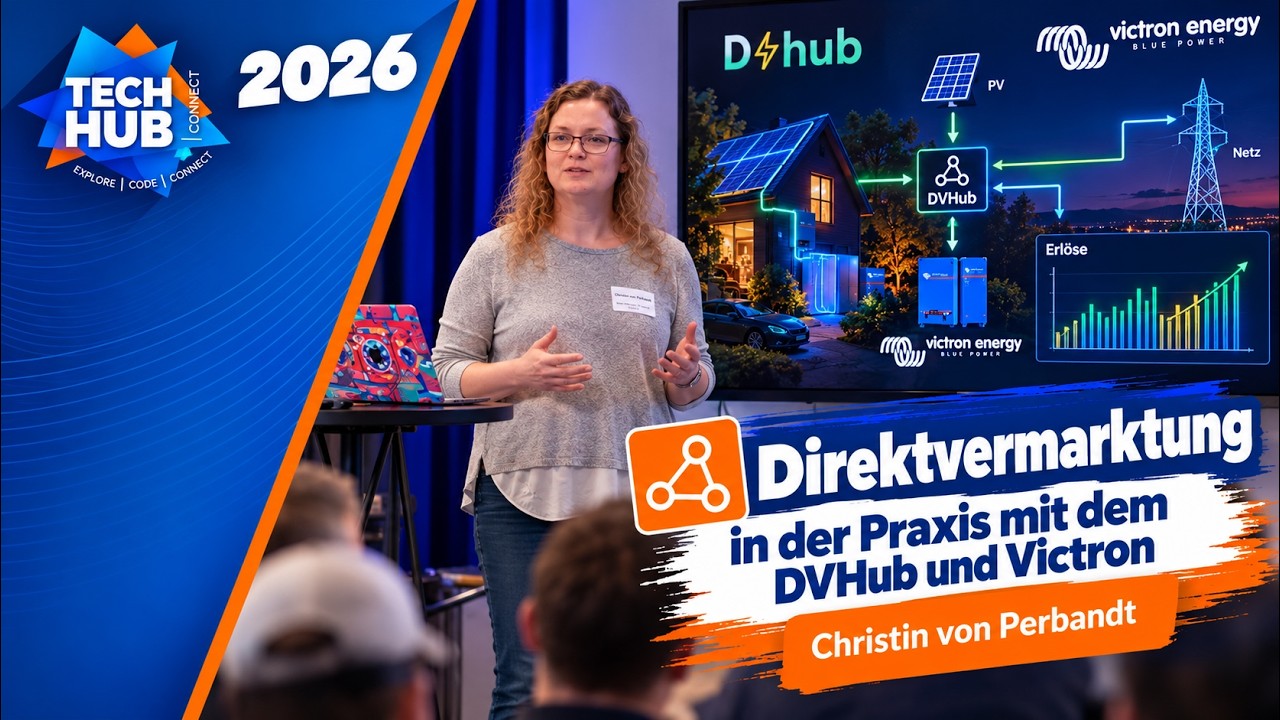
#Victron #Techhub 2026 - Vortrag: Direktvermarktung in der Praxis - Christin von Perbandt
#Victron #Techhub 2026 - Presentation: Direct Marketing in Practice - Christin von Perbandt
Title history
- #Victron #Techhub 2026 - Vortrag: Direktvermarktung in der Praxis - Christin von Perbandt — observed on 20261101-0209 UTC (YouTube)
Keywords
Summary
164 words
Critical Evaluation
Value of the Information & Strength of the Argument
The value lies in the practical, real-world insights into a niche aspect of solar energy economics. The speaker provides concrete numbers on market prices, her own feed-in tariffs, and storage strategies, making the information actionable for other PV owners considering direct marketing. The argumentation is based on her personal experience, which strengthens credibility but also limits generalizability. She logically connects regulatory structures (EEG) to technical requirements and economic outcomes, creating a coherent narrative. However, the lack of broader data or comparison with other systems reduces the scientific robustness.
Scientific Rigor, Source Quality, Title Accuracy
The talk is not a formal scientific study but a practitioner’s account. The speaker cites specific regulations (EEG 2020, paragraph 51a) and market values, which adds factual grounding. However, she does not provide external references or citations for her claims, and the information is largely anecdotal. No formal sources are mentioned in the video description aside from a Discord link for community discussion. The title accurately matches the content, focusing on direct marketing in practice. The technical explanations are plausible and align with common knowledge in the solar industry, though the lack of verifiable references lowers the scientific rigor.
202 words
Title / Content Match
The title accurately reflects the content, which focuses on the practical aspects of direct marketing for PV systems.
Quality & Reliability
7/10
The speaker shares practical experience from her own PV system, discussing regulatory frameworks and market mechanisms. While the information is anecdotal and not systematically verified, it aligns with known aspects of German energy policy and appears technically sound.
Chapters
Cited Sources
- Discord channel for PV enthusiasts — Provided in the video description as a community resource for further discussion.
Contribution & Novelties
The main contribution is a first-hand account of direct PV marketing from a small-scale system owner, detailing both technical setup and financial outcomes. It offers practical guidance for similar projects, including battery sizing, market timing, and fee structures. The talk bridges the gap between theoretical market mechanisms and everyday implementation.
Pour aller plus loin :
- German Renewable Energy Sources Act (EEG) — Legal framework governing feed-in tariffs and direct marketing.
- Electricity market — Explanation of spot markets, negative prices, and market premiums.
- Battery energy storage system — Technology for storing PV energy and shifting feed-in to high-price periods.
- Smart meter — Essential for real-time measurement and control in direct marketing.
110 words
Radar Profile
The scores show a balanced profile with slightly higher quantity than quality or reliability, reflecting a data-rich but anecdotal presentation. The technical level is moderate, indicating content accessible to informed amateurs.