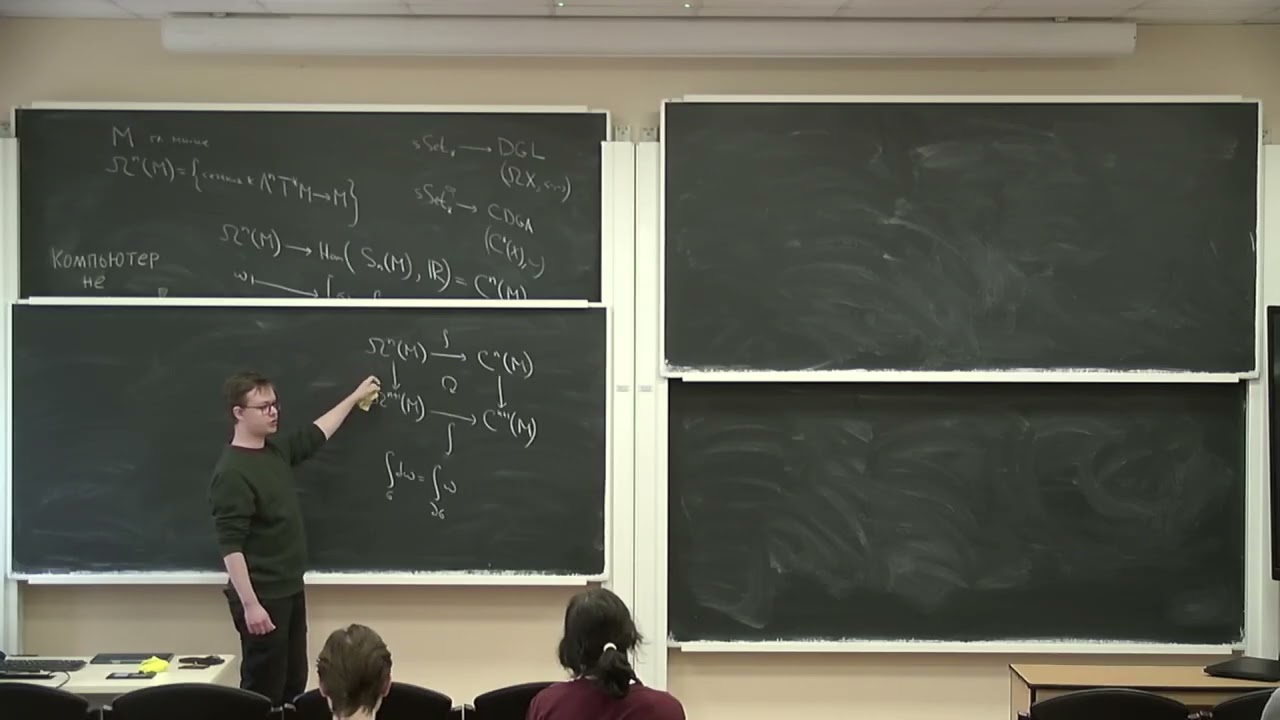
Лекция 6 | Рациональная теория гомотопий | Василий Ионин
Keywords
Summary
197 words
Critical Evaluation
Value of the Information & Strength of the Argument
The lecture provides a clear and rigorous introduction to the Sullivan model, a central object in rational homotopy theory. The argumentation is systematic: the speaker first identifies the problem (non-commutativity of cochains), then draws an analogy with differential forms, and proceeds to construct the CDGA model via simplicial sets. The use of category theory (adjunctions, Kan extensions) is well-motivated and serves to make the construction natural. The lecturer also addresses student questions, clarifying subtle points about projective objects and the interplay between simplicial and cochain structures. This interaction enhances the pedagogical value and helps solidify understanding. The content is high-quality and mathematically sound, offering a strong foundation for further study.
Scientific Rigor, Source Quality, Title Accuracy
The lecture is mathematically rigorous, with careful definitions and proofs. However, no specific sources are cited within the transcript, and the video description contains only the date. This limits external verification, but the content aligns with standard treatments of rational homotopy theory (e.g., texts by Yves Félix, Stephen Halperin, and Jean-Claude Thomas). The title ‘Лекция 6 | Рациональная теория гомотопий’ accurately describes the lecture’s content, which is indeed the sixth in a series on rational homotopy theory. The absence of chapter markers and external references is a minor weakness, but the lecturer’s clear exposition compensates. No audience comments were available for analysis.
227 words
Title / Content Match
The title accurately reflects the content: it is a lecture on rational homotopy theory, specifically focusing on the Sullivan model, as presented in the transcript.
Quality & Reliability
9/10
The lecture presents a rigorous mathematical construction, with detailed explanations and interactive Q&A, based on established theory in rational homotopy theory. The content is technically sound and well-structured, though no external sources are cited.
Key Moments
Markers derived by PSI from the transcript: the creator did not define chapters.
- Introduction and review of the Quillen model
- Motivation for the Sullivan model: cochains are not strictly commutative
- Definition of polynomial forms on simplices
- Construction of the simplicial object in differential graded algebras
- Adjunction between simplicial sets and DGA's via the co-Yoneda lemma
- Discussion of the analogy with differential forms and de Rham theorem
Contribution & Novelties
The lecture offers a detailed pedagogically oriented construction of the Sullivan model, emphasizing the role of simplicial sets and the co-Yoneda lemma. It clarifies why a strictly commutative DGA is needed and how it is built from polynomial forms. The original contribution lies in the careful explanation of the categorical framework and the connection between cosimplicial objects and adjunctions, which is not often presented in such an accessible manner.
Pour aller plus loin :
- Rational homotopy theory — Overview of the field and key concepts.
- Sullivan algebra — Definition and examples of Sullivan algebras.
- Differential graded algebra — General theory of DGA’s.
- Simplicial set — Basic definitions and properties.
- Kan extension — The categorical tool used for the construction.
119 words
Radar Profile
The radar profile shows very high scores in all dimensions, with technique level at maximum. This is a highly specialized and dense lecture, aimed at an audience with advanced mathematical background. The information quality and quantity are solid, while the reliability is slightly lower due to the lack of external sources, though the content itself is consistent with standard literature.