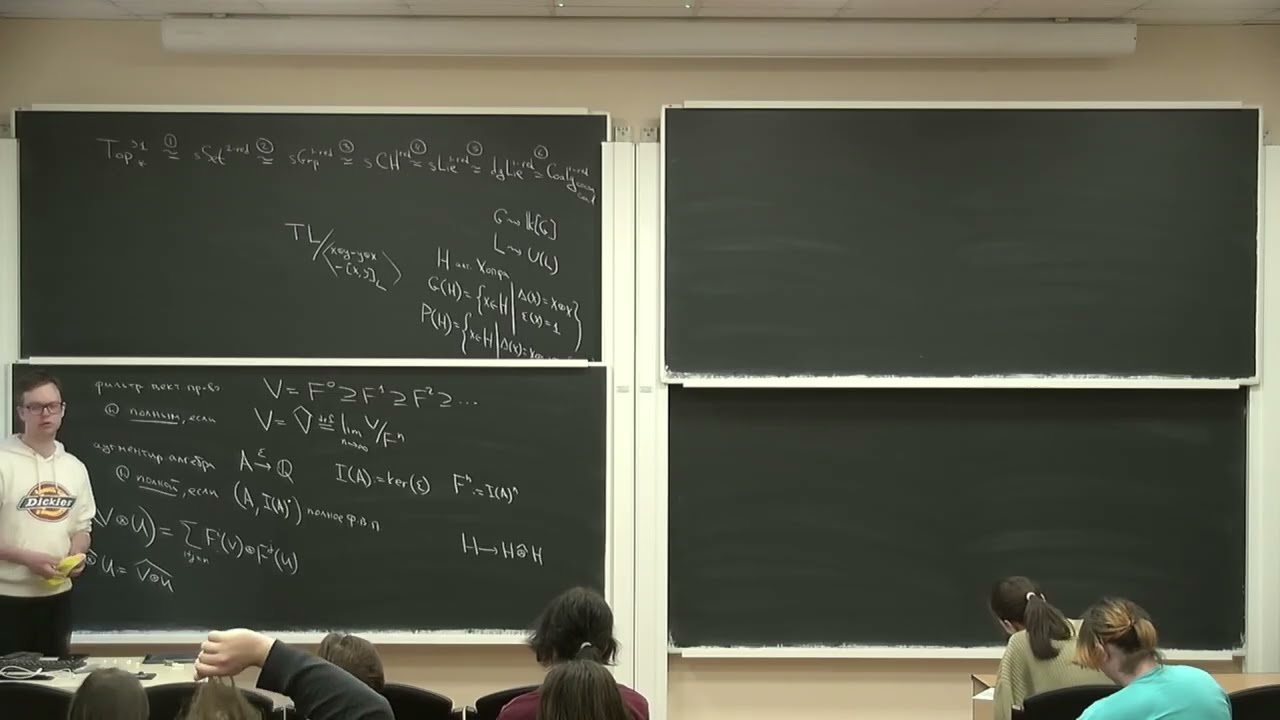
Лекция 5 | Рациональная теория гомотопий | Василий Ионин
Keywords
Summary
274 words
Critical Evaluation
Value of the Information & Strength of the Argument
The lecture offers substantial value by clarifying the delicate passage from groups to Lie algebras via complete Hopf algebras in the rational setting. The argumentation is rigorous and well-structured: definitions are given with explicit conditions (e.g., separatedness vs. completeness), and the key correspondence between primitive and group-like elements is proved by carefully checking convergence of formal power series in the complete algebra. The lecturer also engages in productive dialogue with students, addressing questions about the distinction between complete Hopf algebras and plain Hopf algebras, the nature of the completed tensor product, and the role of the augmentation ideal. The discussion of the Eckmann-Hilton argument provides a conceptual framework for understanding why the exponential correspondence holds. The proof of the bijection is complete and does not rely on hand-waving, which makes the lecture both informative and convincing.
Scientific Rigor, Source Quality, Title Accuracy
The lecture shows high scientific rigor: the lecturer is precise about hypotheses (characteristic zero, connectedness conditions, completeness), distinguishes carefully between ordinary and completed tensor products, and checks the well-definedness of the exponential and logarithm maps. No specific published sources are cited in the video or in the description, which is typical for a course lecture that presents standard material. The title accurately reflects the content: it is indeed the fifth lecture of a rational homotopy theory course, and the content matches the expected syllabus. The interactive format, with students asking questions and the lecturer correcting notation as needed, further reinforces the pedagogical quality.
254 words
Title / Content Match
Title exactly matches the content: it is indeed the fifth lecture of a rational homotopy theory course.
Quality & Reliability
8/10
Rigorous university-level lecture by an expert mathematician; precise definitions, careful treatment of completeness and monoidal structures, proofs of the exponential-logarithm correspondence, and interactive Q&A that clarifies conceptual subtleties. Standard mathematical content presented with academic rigor, though no explicit external citations are given.
Key Moments
Markers derived by PSI from the transcript: the creator did not define chapters.
- Introduction and recap of the previous lecture, including the diagram of Quillen's model categories and functors.
- Presentation of the plan for today: Hopf algebras as a bridge between groups and Lie algebras over Q.
- Construction of group algebras and universal enveloping algebras as Hopf algebras; definition of group-like and primitive elements.
- Definition of filtered vector spaces, completeness, and the completed tensor product.
- Definition of complete Hopf algebras and the distinction from ordinary Hopf algebras; the role of the augmentation ideal.
- Functors from groups and Lie algebras to complete Hopf algebras; adjoint relationships and weak equivalences in the simplicial setting.
- Construction of the exponential map from primitive elements to group-like elements; verification of well-definedness via completeness.
- The Baker-Campbell-Hausdorff formula and the Eckmann-Hilton argument; recovering group multiplication from the Lie bracket on group-like elements.
Cited Sources
- Quillen's model (rational homotopy theory) — The central framework of the lecture series, mentioned in the recap as the foundation for the course.
Concurring Sources
- Rational homotopy theory — Wikipedia — Provides a general overview consistent with the lecture's presentation of Quillen's model.
- Hopf algebra — Wikipedia — Standard reference for the algebraic structure central to the lecture.
Contribution & Novelties
The lecture provides a clear and rigorous exposition of the bridge between groups and Lie algebras through complete Hopf algebras in the context of rational homotopy theory. It carefully explains the construction of complete Hopf algebras, the completed tensor product, and proves the bijection between primitive and group-like elements via the exponential and logarithm maps, a key step in Quillen’s model.
Pour aller plus loin :
- Rational homotopy theory — Overview of the field, central to this lecture.
- Hopf algebra — The core algebraic structure discussed in the lecture.
- Baker-Campbell-Hausdorff formula — Underpins the multiplication law on group-like elements obtained from the Lie bracket.
- Simplicial set — Foundational object for the simplicial framework used throughout the course.
- Lie algebra — Mentioned without URL; relevant background for the universal enveloping algebra construction.
131 words
Radar Profile
The radar profile is strongly skewed toward quantity of information, quality of information, and technical level, reflecting an advanced lecture dense with precise definitions and constructions. The slightly lower fiabilite_globale score stems from the absence of explicit external citations, though the content is internally rigorous and consistent.