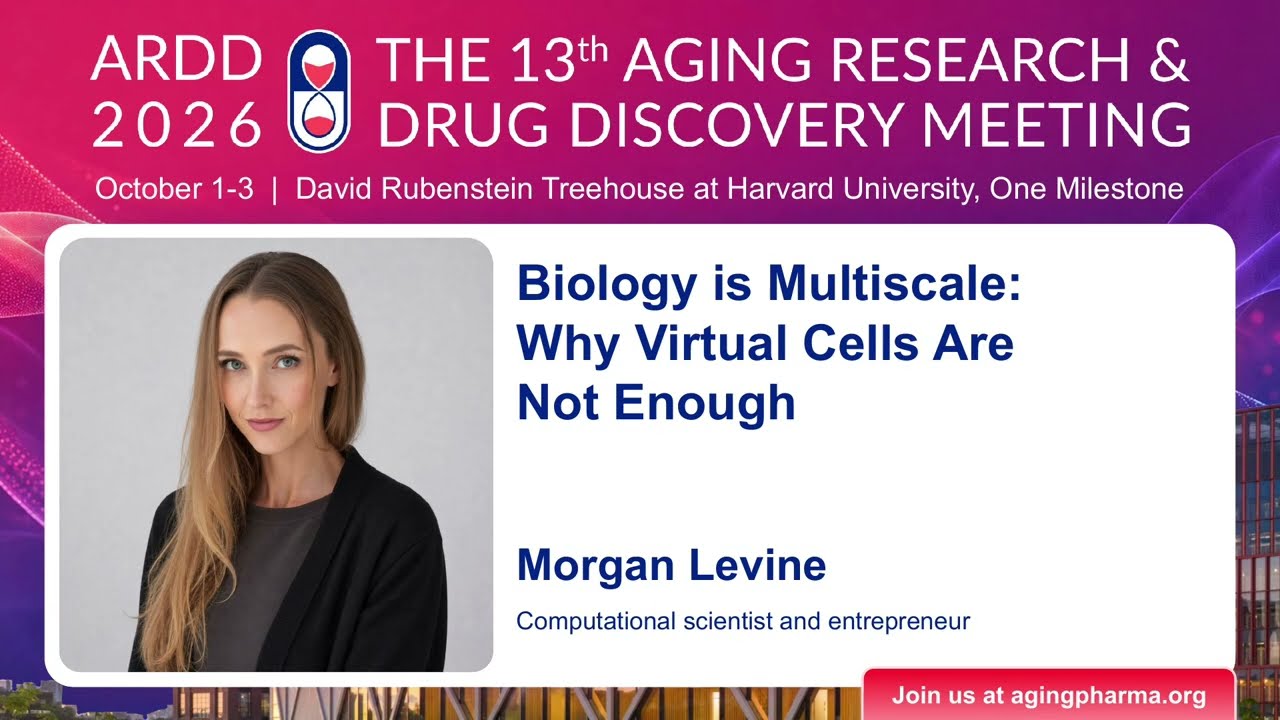
Morgan Levine at ARDD2026: Biology is Multiscale: Why Virtual Cells Are Not Enough
Title history
- Morgan Levine at ARDD2026: Biology is Multiscale: Why Virtual Cells Are Not Enough — observed on 20261105-2137 UTC (YouTube)
Keywords
Summary
165 words
Critical Evaluation
Value of the Information & Strength of the Argument
The talk provides valuable critical insights into the current state of virtual cell modeling, particularly the distinction between generating raw data and learning an interpretable latent state. Levine’s argument is well-structured: she illustrates the infeasibility of exploring the full perturbation space experimentally, explains the limitations of existing generative models (e.g., scale-sensitive benchmarks, failure out-of-distribution), and offers a forward-looking proposal for perception-driven models. The reasoning is logical, and she addresses counterpoints such as the need for multimodal data and benchmark design. However, the proposal is theoretical and lacks empirical evidence or preliminary results, which limits the immediate actionable value.
Scientific Rigor, Source Quality, Title Accuracy
The speaker references her own experience and the Virtual Cell Challenge organized by the ARC Institute, but provides no formal citations or links to specific papers. The description includes links to the ARDD website and LinkedIn, but these are general organizational pages, not directly supporting specific claims. The talk is based on expert opinion and personal experience, which is appropriate for a conference talk but limits verifiability. The title accurately matches the content: the multiscale nature of biology and the inadequacy of current virtual cells are consistently addressed. No significant discrepancy between title and content is observed.
210 words
Title / Content Match
The title accurately reflects the core thesis: the author argues that virtual cells, as currently conceived, are insufficient for addressing aging and that a multiscale, perception-based approach is needed.
Quality & Reliability
7/10
Expert talk by a former Altos Labs researcher with hands-on experience in computational biology and virtual cell modeling. The reasoning is coherent and practical, but the proposals are speculative and not backed by published empirical data. The speaker openly discusses limitations of current benchmarks and generative models, adding credibility.
Key Moments
Markers derived by PSI from the transcript: the creator did not define chapters.
- Introduction and speaker background at Altos Labs and departure to start a startup.
- Explains the combinatorial explosion of perturbation experiments, using examples of knocking down genes across cell types and conditions.
- Critique of current virtual cells: they predict RNA-seq matrices, fail out-of-distribution, and don't capture the latent state.
- Discussion of the Virtual Cell Challenge and leaderboard hacking via variance scaling; Altos won a generalist prize.
- Argues against generative AI for omics data, proposing instead to learn latent states via perception models.
- Advocates for general models of biology that capture multiple scales and modalities, and introduces their stealth startup.
- Q&A: discusses not overimposing human priors, data-driven approach, and the goal of building artificial sensors for biology.
Cited Sources
- Aging Pharma Conference Website — The official ARDD conference website, mentioned in the video description and likely referenced as the source of the event.
- ARDD LinkedIn Page — The official LinkedIn page for the conference, linked in the description for updates.
Contribution & Novelties
The talk offers a provocative shift from generating high-dimensional omics data to learning an internal latent state of biological systems, drawing an analogy with world models in AI. It critically evaluates the benchmark design in the field, exposing limitations of current virtual cell challenges. The author’s proposal to build perception models that reason and plan over latent states is novel and could guide future research directions, though it remains conceptual.
Pour aller plus loin :
- Single-cell transcriptomics — Relevant background on the data type used in virtual cell models.
- Latent variable — Conceptual foundation for the author’s proposed latent state approach.
- World model — The AI concept Levine explicitly references to model internal representations.
- Generative artificial intelligence — Discussion of the generative models she critiques.
125 words
Radar Profile
The profile shows high technicality and moderate information quality, with a stronger emphasis on conceptual innovation than empirical evidence. The author balances critique and forward-looking vision, resulting in a balanced but speculative profile.