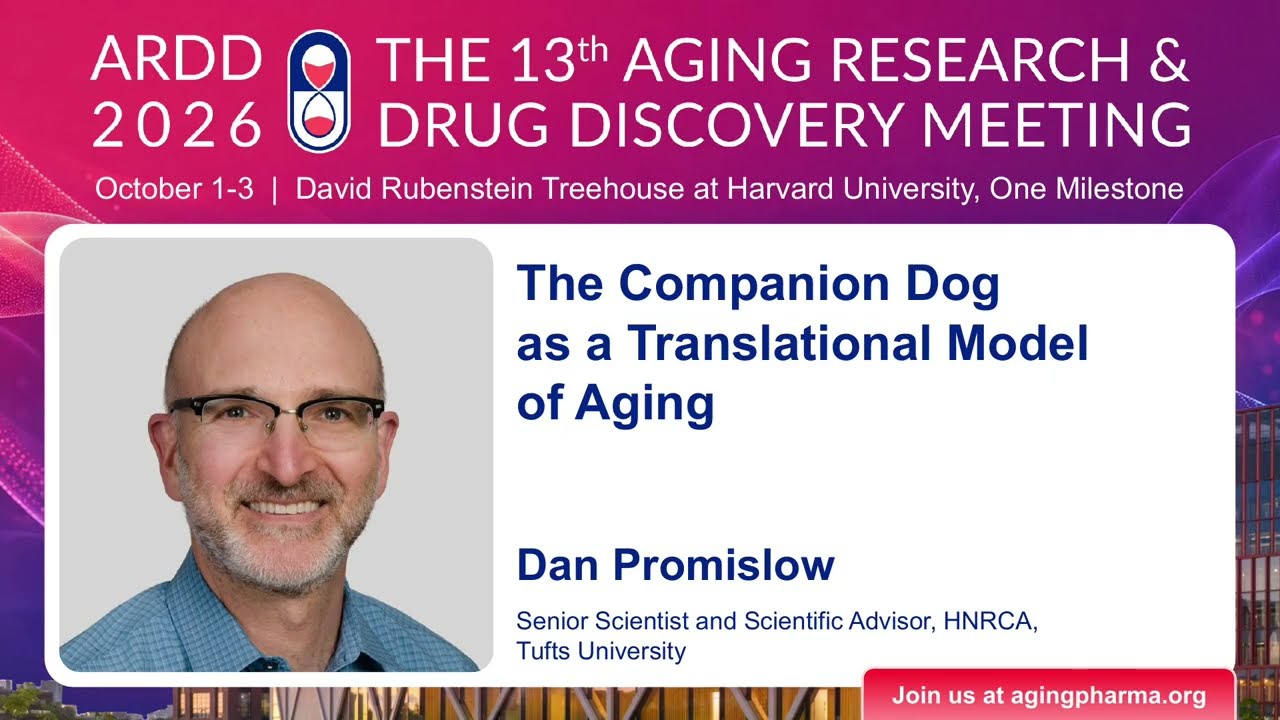
Dan Promislow at ARDD2026: The Companion Dog as a Translational Model of Aging
Title history
- Dan Promislow at ARDD2026: The Companion Dog as a Translational Model of Aging — observed on 20261026-2137 UTC (YouTube)
Keywords
Summary
177 words
Critical Evaluation
Value of the Information & Strength of the Argument
The presentation provides high-value, original data from a unique longitudinal cohort, filling a gap between traditional model organisms and human studies. The argumentation is solid: each finding is clearly presented with methodological context, and cross-validation with human data strengthens translational implications. The speaker is transparent about limitations (e.g., owner demographics, sterilization bias) and careful not to overclaim, especially regarding the TRIAD trial where blinding is maintained. The reasoning flows logically from project overview to specific results, integrating genetics, epigenetics, and metabolomics convincingly.
Scientific Rigor, Source Quality, Title Accuracy
The scientific rigor is high: the talk is based on a well-designed NIH-funded project with a large cohort, standardized biospecimen collection, and open data sharing. The upcoming Science paper (mentioned but not yet published) adds credibility. Sources cited include the Dog Aging Project’s own data, comparisons with human metabolomic studies (seven studies), and established biological pathways (e.g., tryptophan degradation). The title perfectly matches the content, and the description provided by the organizers aligns with the talk’s focus.
174 words
Title / Content Match
The title accurately reflects the content: a presentation on using companion dogs as a translational model for human aging, delivered at a major aging research conference.
Quality & Reliability
9/10
The talk is delivered by a leading researcher, presents rigorous findings from a large NIH-funded project with publicly available data, and includes multiple cross-validated observations (e.g., metabolite patterns matching human studies). The methodology and data handling are transparent, and the results are consistent with established scientific knowledge.
Key Moments
Markers derived by PSI from the transcript: the creator did not define chapters.
- Introduction: rationale for using companion dogs as a translational model of aging
- Overview of Dog Aging Project: cohort size, data types, and biobank
- Funding history, team structure, and future plans (phase two funding)
- Epigenetic clocks: findings on biological age and longevity, translational links to human gene expression
- Metabolomics: 25 metabolites predicting mortality, cross-species validation with human studies
- GWAS examples: kynurenic acid SNP and cystathionine association with hair furnishing genes
- TRIAD trial: design, enrollment status, safety, and expected timeline
- Q&A: cohort expansion, sterilized-dog bias, sleep/kynurenic acid, immune modulation, and TRIAD dosing
Cited Sources
- ARDD (Aging Research and Drug Discovery) official website — Main conference website; provides information about ARDD, organizers, and event history.
- ARDD LinkedIn page — Company LinkedIn page for ARDD, used for updates and networking.
Contribution & Novelties
The talk contributes original findings from a unique, large-scale companion dog cohort that bridges model organisms and human aging research. Notably, it presents longitudinal epigenetic clocks, metabolomic predictors of mortality with cross-species validation, and GWAS hits linking genetics to metabolite levels, all within a relatively short data collection period (2.6 years) compared to human studies. The TRIAD trial introduces the first real-world test of rapamycin in a large mammal. The open-data policy enhances reproducibility and collaboration.
Pour aller plus loin :
- Epigenetic clock — A key concept used in the study to measure biological age from DNA methylation.
- Metabolomics — The systematic study of metabolites, central to the mortality prediction findings.
- Rapamycin — The drug tested in the TRIAD trial for its potential lifespan/healthspan effects.
125 words
Radar Profile
The radar profile shows uniformly high scores across all dimensions (quantity, quality, technical level, reliability), reflecting a dense, rigorous, and well-presented scientific talk with substantial original data and clear translational significance.