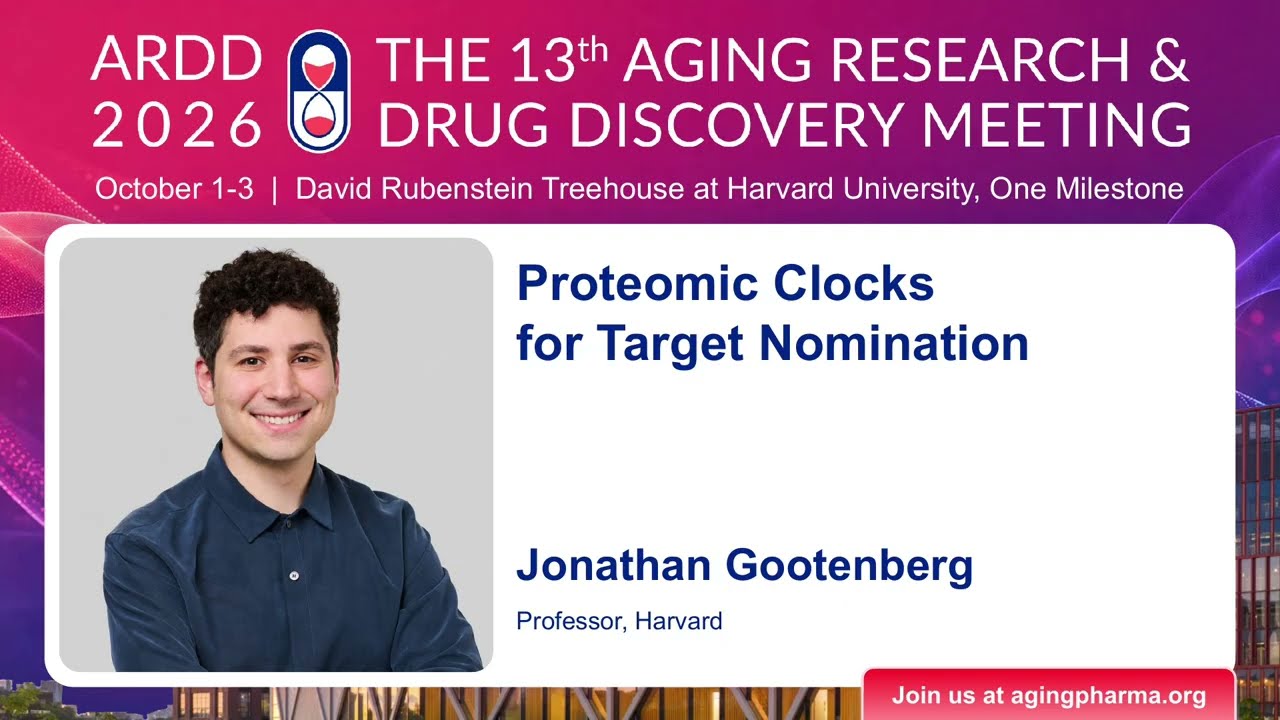
Jonathan Gootenberg at ARDD2026: Proteomic Clocks for Target Nomination
Keywords
Summary
131 words
Critical Evaluation
Value of the Information & Strength of the Argument
The talk provides valuable insights into how proteomic clocks can be used for drug target discovery. The argumentation is solid, supported by data from large biobanks and careful cross-validation. Gootenberg acknowledges limitations, such as confounding by disease, and uses longitudinal data to address biases. He presents novel findings, including the identification of causal drivers via Mendelian randomization, and outlines a clear rationale for using clocks as surrogates when outcome data are sparse. The reasoning is systematic, progressing from clock construction to validation and application, making a compelling case for proteogenomic approaches in aging research.
Scientific Rigor, Source Quality, Title Accuracy
The source quality is high; he refers to major biobanks and public databases, and mentions an upcoming preprint. The title accurately captures the content. The talk demonstrates scientific rigor through cross-validation, careful discussion of potential biases, and a cautious interpretation of drug effects. Although no specific citations are given, the reliance on established datasets and the structured methodology underscore the reliability. The title is well-aligned with the presentation, focusing on proteomic clocks as a tool for target nomination.
187 words
Title / Content Match
The title accurately reflects the content: the talk focuses on using proteomic clocks for drug target nomination in aging.
Quality & Reliability
8/10
The talk presents original research on proteomic clocks, using large biobanks (UK Biobank, All of Us) and Mendelian randomization, with cross-validation and cautious interpretation of limitations. The speaker is from Harvard Medical School and the talk was given at a reputable aging conference, enhancing credibility.
Key Moments
Markers derived by PSI from the transcript: the creator did not define chapters.
- Introduction: the need for new anti-aging drugs and the challenges in drug discovery.
- Overview of drug discovery approaches: biology, genetics, and new signals.
- Introduction to proteomics and the desirable features of proteomic clocks.
- Training organ-level clocks using feature selection based on the Human Protein Atlas.
- Cross-validation of clocks between UK Biobank and All of Us; correlation of performance.
- Using Mendelian randomization to identify causal drivers and distinguish them from markers.
- Novel drug target hits: UMOD, M6PR, CAK2, and their organ-specific effects.
- Need for more data and future directions; scaling curves for proteomic clocks.
Cited Sources
- Aging Pharma - Official Website — ARDD conference website, mentioned in the video description.
- Aging Pharma on LinkedIn — LinkedIn company page for ARDD, linked in the video description.
Concurring Sources
- UK Biobank — Used for training and validation of proteomic clocks; mentioned in the talk.
- All of Us Research Program — Used as a second biobank for cross-validation; mentioned in the talk.
- The Human Protein Atlas — Used for tissue-specific feature selection of proteins; mentioned in the talk.
Contribution & Novelties
This talk contributes to the field by demonstrating the utility of proteomic clocks for target nomination, particularly by combining them with Mendelian randomization to separate causal drivers from biomarkers. The cross-validation between UK Biobank and All of Us provides strong evidence for the robustness of the clocks. The identification of novel targets like UMOD and M6PR, which have no known connection to aging, highlights the discovery potential.
Pour aller plus loin :
- Proteomics on Wikipedia — Overview of the field of large-scale protein analysis.
- Mendelian randomization on Wikipedia — Methodology used to infer causality from observational data.
- Epigenetic clock on Wikipedia — Related concept of biological clocks based on DNA methylation.
111 words
Radar Profile
The radar profile shows high scores across all dimensions, indicating a well-balanced and rigorous presentation. The talk excels in quantitative information and technical level, with slightly lower but still strong scores in quality and reliability, reflecting its status as a research talk with a preprint foundation.