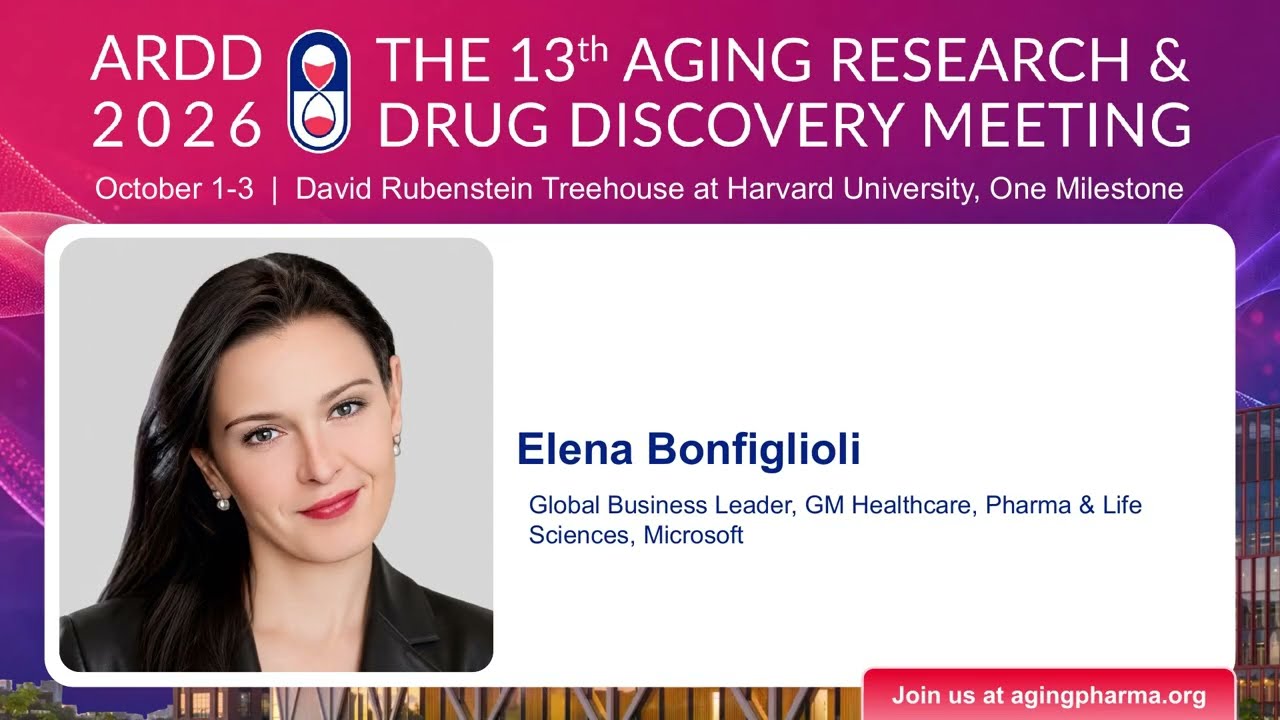
Elena Bonfiglioli at ARDD2026: AI clinical trials and the longevity discovery loop
Title history
- Elena Bonfiglioli at ARDD2026: AI clinical trials and the longevity discovery loop — observed on 20261102-1553 UTC (YouTube)
Keywords
Summary
132 words
Critical Evaluation
Value of the Information & Strength of the Argument
The talk provides valuable insights into how AI can be operationalized across the longevity landscape, connecting research to real-world applications. The argumentation is structured logically, moving from computational R&D to diagnostic and care delivery, then to consumer engagement. Concrete examples, such as the pancreatic cancer screening and the demographics paper, reinforce the feasibility of the proposed loop. However, the claims are mainly vendor-centric, without independent benchmarking or critical discussion of limitations. The speaker acknowledges the challenge of data harmonization and privacy, but does not deeply explore potential pitfalls or alternative approaches. Overall, the value lies in its breadth and concrete use cases, while the argumentation could benefit from more rigorous evidence and comparison with existing methods.
Scientific Rigor, Source Quality, Title Accuracy
Scientific rigor is moderate: the talk refers to a released paper on demographic cohorts and a Nature publication with industrial partners, lending some credibility. Yet, specific data or experimental details are not provided, and the speaker relies heavily on Microsoft’s own tools and platforms. The description lists official conference links, which are reliable but not direct sources for the claims. The title accurately reflects the content, which is focused on AI-based clinical trials and the longevity discovery loop. There is no apparent mismatch; the talk delivers precisely what the title promises. No public comments are available to assess audience reception or additional credibility signals.
235 words
Title / Content Match
The title accurately reflects the content, which discusses AI in clinical trials and the longevity discovery loop.
Quality & Reliability
6/10
The talk provides a high-level overview of AI applications in longevity, referencing concrete projects and collaborations, but as a vendor presentation it lacks independent verification.
Key Moments
Markers derived by PSI from the transcript: the creator did not define chapters.
- Introduction: framing the discovery loop and the promise of AI for healthy aging.
- Four phases of technology: research, diagnostics, care delivery, and consumer health.
- Microsoft Discovery platform and a Nature paper on retrosynthesis with Novartis and GSK.
- Quine world model applied to pancreatic cancer, identifying a novel phenotype.
- Longitudinal data hubs in UK and UAE for population health and early intervention.
- Agentic AI to support longevity clinicians and multimodal patient data integration.
- Health Core pilot for consumer health queries and integration with wearables.
- Conclusion: call for collaboration to align AI capabilities with longevity challenges.
Cited Sources
- AgingPharma.org — Official website of the ARDD conference, providing information about the event and its organizers.
- ARDD LinkedIn page — Company page for updates on the conference and associated activities.
Contribution & Novelties
This presentation contributes a unifying vision of an AI-driven ’longevity discovery loop’ spanning from basic research to consumer habits. It showcases concrete tools (Microsoft Discovery, Quine, Health Core) and collaborative case studies (pancreatic cancer, population health datasets) that illustrate practical applications. The demographic cohort lens adds a temporal dimension to technology deployment. While the ideas are not entirely novel, the integrated framework and specific examples (e.g., retrosynthesis validation) are valuable. The speaker emphasizes data privacy and interoperability as critical enablers.
Pour aller plus loin :
- AI agent — For understanding autonomous AI systems in research.
- Confidential computing — For privacy-preserving data processing.
- Longevity — For the scientific background on aging research.
111 words
Radar Profile
The radar profile shows moderate scores across all dimensions, with quantity of information slightly higher than quality and technical level, indicating a broad but not deeply detailed presentation.