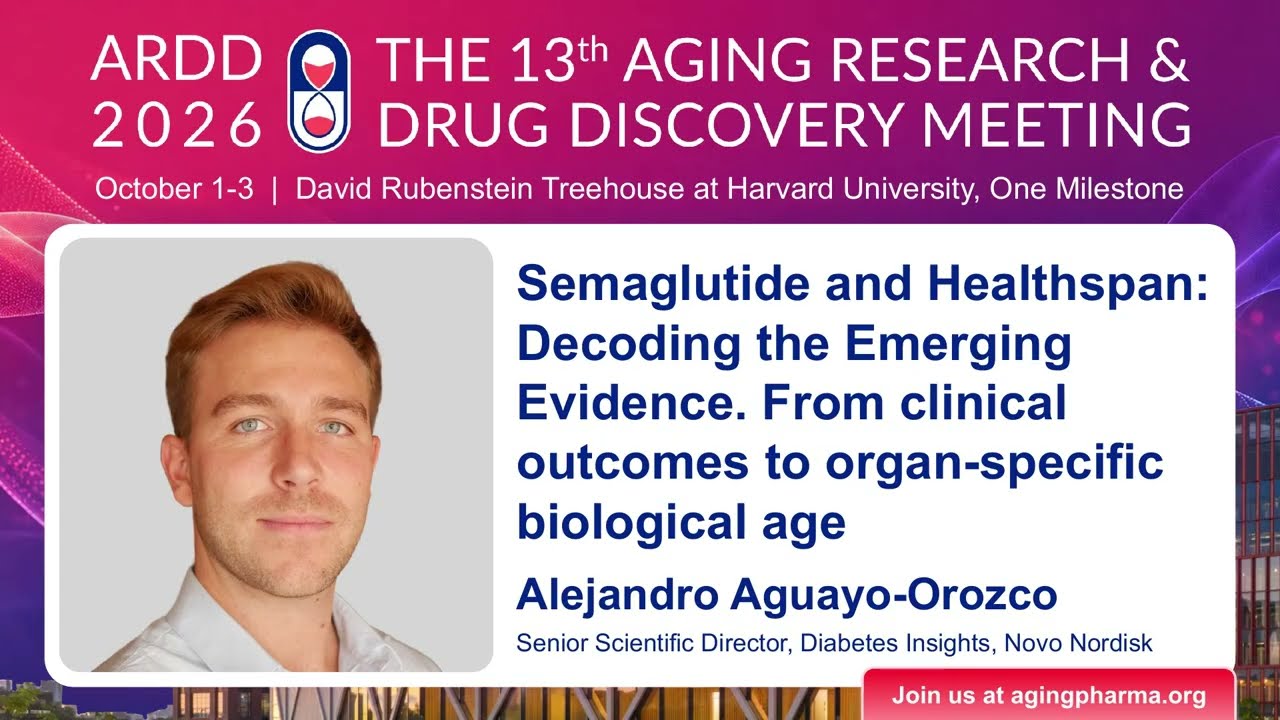
Alejandro Aguayo-Orozco at ARDD2026: Semaglutide and Healthspan
Keywords
Summary
159 words
Critical Evaluation
Value of the Information & Strength of the Argument
The talk provides substantial new data linking a widely used metabolic drug to biological aging markers. The argumentation is structured around four tests (diseases, function, survival, biology) and uses large, randomized trial data with consistent findings across five independent cohorts and two formulations. The mediation analysis strengthens the claim that the proteomic clock effects are not solely weight-driven, which is an important step in understanding mechanisms. However, the speaker appropriately acknowledges that the proteomic response was not randomized, so causal inference is limited. The combination of clinical outcomes with molecular surrogates offers high value for generating hypotheses and guiding future research in geroscience.
Scientific Rigor, Source Quality, Title Accuracy
The presentation demonstrates methodological rigor by using multiple large trials, prespecified endpoints, and state-of-the-art proteomic clocks. The speaker discloses his employment by Novo Nordisk and the absence of an indication for aging, which adds transparency. Sources cited include the conference organization and the company, with no external references beyond those in the description. The title is faithful to the content. No comments were provided to analyze public sentiment.
186 words
Title / Content Match
The title accurately reflects the content, which systematically evaluates semaglutide's effects on healthspan-related biomarkers and clinical outcomes.
Quality & Reliability
8/10
The talk presents data from large randomized clinical trials (over 32,000 participants) combined with advanced proteomic organ-age scores. The analysis is systematic, discloses conflict of interest, and includes exploratory mediation analysis. However, it is industry-sponsored and relies on surrogate endpoints.
Key Moments
Markers derived by PSI from the transcript: the creator did not define chapters.
- Introduction and framing: need for data and systemic view of aging.
- Overview of GLP-1 biology and receptor expression across organs.
- Clinical outcomes: MACE reduction and early separation of curves.
- Kidney composite endpoint and functional improvements in HFpEF.
- All-cause mortality reduction across six trials.
- Proteomic organ-age clocks methodology and results across five trials.
- Mediation analysis showing independence from weight, HbA1c, and hsCRP.
- Frailty scores and mediation of mortality reduction.
- Conclusion and acknowledgment of collaborators and trial participants.
Cited Sources
- Aging Pharma (ARDD conference website) — Official website of the Aging Research and Drug Discovery meeting.
- ARDD LinkedIn page — LinkedIn page for the organizing company of the ARDD conference.
Contribution & Novelties
This talk contributes new evidence that semaglutide, a GLP-1 receptor agonist, modulates proteomic organ-age scores in a manner not explained by weight loss, suggesting potential direct effects on biological aging. The use of five large randomized trials with unified proteomic analysis is novel and strengthens the hypothesis that age-related pathways are influenced.
Pour aller plus loin :
- Semaglutide — Overview of the drug, its uses, and clinical trials.
- Glucagon-like peptide-1 receptor agonist — Class mechanism and effects.
- Epigenetic clock — Related biomarker concept used in aging research, though the talk uses proteomic clocks.
93 words
Radar Profile
The radar profile shows a well-balanced presentation with strong quantitative content and technical depth, but moderate scores in reproducibility due to industry sponsorship and exploratory analyses. The high information quantity and quality are offset by the lack of external corroboration in the provided sources.