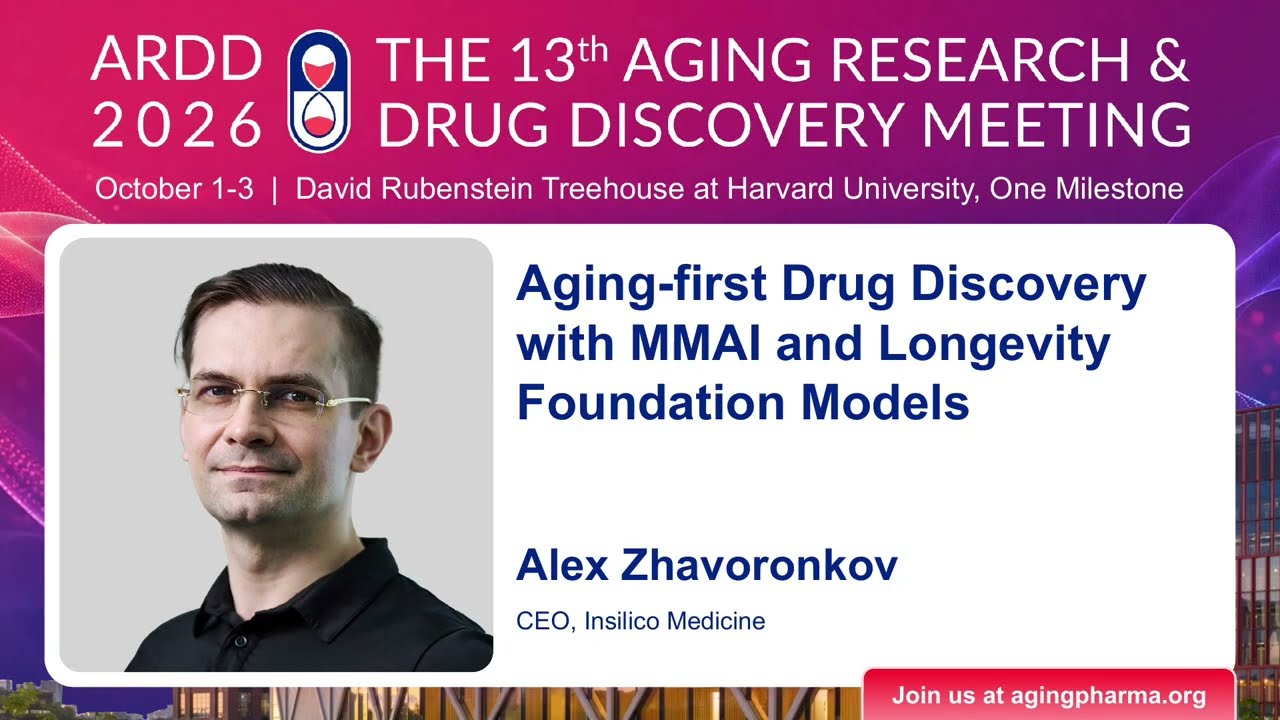
Alex Zhavoronkov at ARDD2026: Aging-first Drug Discovery with MMAI and Longevity Foundation Models
Keywords
Summary
132 words
Critical Evaluation
Value of the Information & Strength of the Argument
The talk provides a clear argument that smaller, fine-tuned models can outperform larger foundation models for specific aging-related tasks, supported by their benchmarking results. The reasoning is logical and based on empirical comparisons, though details of the benchmarks are not fully explained. The presentation is persuasive for the open-source strategy, but the evidence is self-reported and lacks independent verification.
Scientific Rigor, Source Quality, Title Accuracy
The talk mentions several published works, but no specific citations are given on slides (though they are likely present). The sources mentioned include Horvath’s clocks, their own papers in Nature Aging, and collaborations with other labs. The quality is moderate, as it is an expert presentation rather than a peer-reviewed review. The title is accurate and not misleading.
132 words
Title / Content Match
The title accurately reflects the content: the speaker discusses aging-first drug discovery and longevity foundation models, aligning with the title.
Quality & Reliability
7/10
The talk is an expert opinion with a comprehensive overview of AI in aging research, but it is self-promotional and lacks specific citations during the talk. The described work is plausible and aligned with known AI trends, but verification would require checking the referenced publications.
Key Moments
Markers derived by PSI from the transcript: the creator did not define chapters.
- Introduction: Alex Zhavoronkov introduces the topic and the mission of InSilico Medicine.
- Analogy between mechanical watches and smartwatches for biological clocks, introducing the evolution of aging clocks.
- Overview of deep learning clocks and InSilico's early contributions in methylation and proteomic clocks.
- Introduction of foundation models: the precious GPT series and the shift to multimodal transformers.
- Discussion of benchmarking 18 frontier LLMs and the finding that fine-tuned smaller models outperform larger ones.
- Emphasis on target discovery, commercial tractability, and the multi-agent system for longevity research.
Cited Sources
- ARDD (Aging Research and Drug Discovery Meeting) website — Official website of the conference presenting the event and related information.
- ARDD LinkedIn page — Official LinkedIn page of ARDD for updates and community.
Contribution & Novelties
The talk contributes a novel perspective on applying foundation models to aging research by advocating for fine-tuning smaller models and creating benchmarks tailored to longevity tasks. It highlights the practical value of benchmarking in AI drug discovery and introduces an open-source multi-agent framework for always-on aging research.
Pour aller plus loin :
- Epigenetic clock — Relevant to the discussion on biological clocks and their evolution.
- Foundation model — Core concept behind the longevity foundation models described.
- AlphaFold — Mentioned as a tool with limited direct value in drug discovery, relevant to the debate on task importance.
- Horvath’s epigenetic clock — Specific reference to Steve Horvath’s pioneering work.
107 words
Radar Profile
The radar profile indicates high technical level and information density, with moderate quality and reliability. The speaker's expertise is clear, but the reliance on self-reported results and lack of transparent methodology temper the overall reliability score.