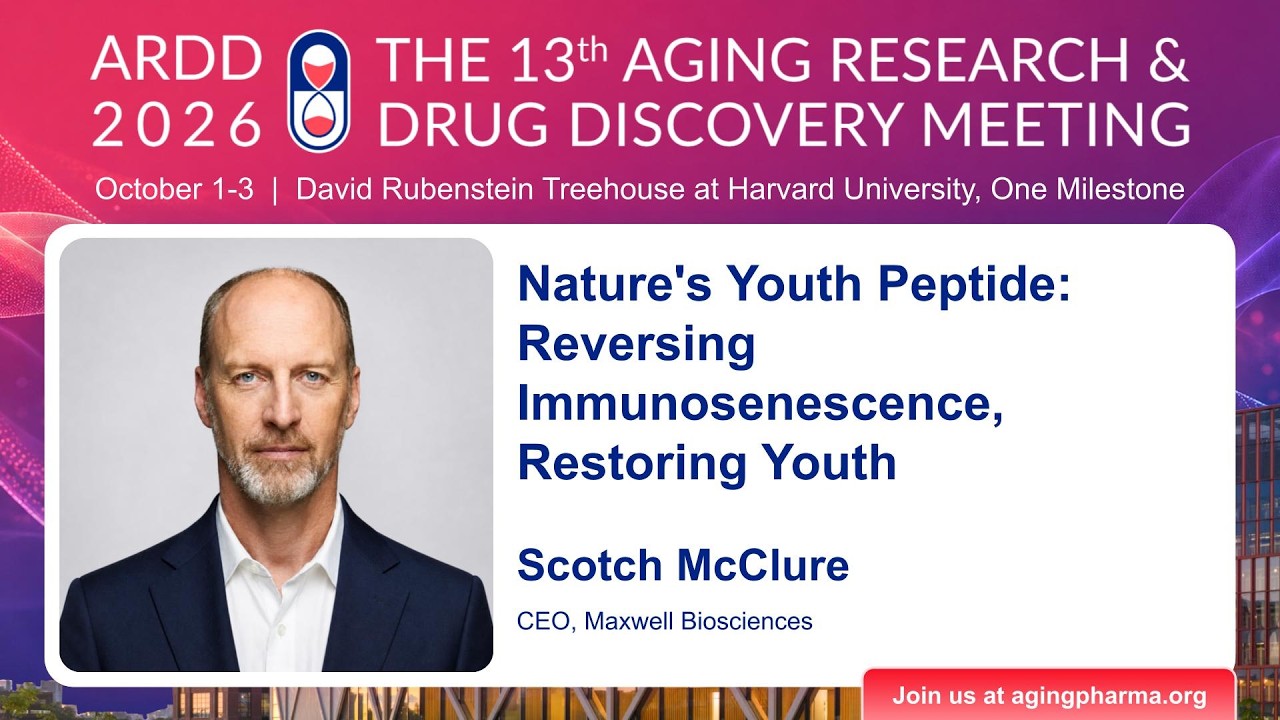
Scotch McClure at ARDD2026: Nature's Youth Peptide
Keywords
Summary
172 words
Critical Evaluation
Value of the Information & Strength of the Argument
VALUE: The talk provides a novel concept of using a stabilized LL-37 to combat immunosenescence and reduce pathogen load, which is a plausible mechanism for longevity. It presents substantial in vitro and animal data, including from military and government studies, and the FDA designation adds regulatory validation. The idea of a synthetic innate immune peptide is intriguing and could have broad applications. However, the value is undermined by lack of clinical data and the promotional nature. ARGUMENTATION: The argumentation is assertive but not always rigorous. He supports the importance of pathogen control with historical examples, but the leap to LL-37 as the key is more based on correlation than causation. He cites many claims without providing specific references in the talk, though he mentions peer-reviewed publications. The argument that LL-37 decline is a ‘death sentence’ is dramatic but not backed by direct evidence. The technical explanation of stabilization is plausible but not detailed enough for critical evaluation. The Q&A answers are somewhat speculative (e.g., planned obsolescence). Overall, the argumentation is compelling but not fully convincing due to lack of independent verification.
Scientific Rigor, Source Quality, Title Accuracy
SCIENTIFIC RIGOR: The talk references over 500 peer-reviewed publications and government-sponsored studies, but no specific citations are given in the video. The description links to the company website and LinkedIn, but not to research papers. The FDA QIDP designation is a regulatory milestone but not peer-reviewed. SOURCE QUALITY: The talk is part of a conference organized by Insilico Medicine, a company with commercial interests, and the speaker is promoting his own company, introducing potential bias. TITLE ADEQUACY: The title is appropriate and not misleading, accurately describing the focus on LL-37 and its potential for longevity.
291 words
Title / Content Match
The title accurately reflects the content, which focuses on LL-37 as a 'nature's youth peptide' and its role in reversing immunosenescence.
Quality & Reliability
6/10
The talk presents a company's own product with some peer-reviewed backing, but it's promotional and lacks independent verification. The speaker provides detailed claims but no direct data or citations in the talk, though he mentions studies. The FDA designation adds some credibility, but the talk is at a conference sponsored by the company, which introduces potential bias.
Key Moments
Markers derived by PSI from the transcript: the creator did not define chapters.
- Introduction of the talk and overview of longevity escape velocity
- Historical impact of pathogen control on human life expectancy
- Announcement of FDA QIDP designation for broad-spectrum antimicrobial
- Introduction of LL-37 peptide and its multiple functions
- Decline of LL-37 production with age (99% loss by age 50, further 70% by 75)
- Issues with using natural LL-37: instability and dosing challenges
- Technology: replacing carbon bonds with nitrogen bonds to stabilize the peptide
- Broad-spectrum efficacy against pathogens, including military testing
- Partnerships and indications, including India and Africa collaborations
- Q&A: microbiome interactions and regulation of LL-37 via vitamin D
Cited Sources
- Aging Pharma (ARDD official website) — Official website of the Aging Research and Drug Discovery meeting, providing general conference information.
- ARDD on LinkedIn — LinkedIn page of ARDD, used for updates and networking.
Contribution & Novelties
The original contribution is the development of a stabilized synthetic LL-37 peptide, which the presenter claims can combat immunosenescence and reduce pathogen burden as a foundational approach to longevity. The technology of replacing carbon bonds with nitrogen bonds is presented as a breakthrough, overcoming the inherent instability of natural peptides. Additionally, the FDA QIDP designation spanning both bacterial and fungal infections is highlighted as unprecedented. Their approach aims to target multiple pathogens without harming the beneficial microbiome, which is a significant novelty in antimicrobial therapy.
Pour aller plus loin :
- Cathelicidin — The precursor protein of LL-37, relevant to understanding the peptide’s origin and regulation.
- Antimicrobial peptides — An overview of this class of molecules, providing context on their role in innate immunity.
- Immunosenescence — Age-related decline of the immune system, central to the talk’s thesis.
- Bifidobacterium — Beneficial gut bacteria mentioned in the Q&A, relevant to the microbiome effects of the compound.
153 words
Radar Profile
The scores indicate a moderate quantity of information with relatively high technical detail but lower reliability due to promotional context. The balance suggests the content is informative but requires critical evaluation, as the presentation combines plausible science with company-centric claims.