Lecture 1 Plane Wave Propagation in Different Mediums Part 1
Title history
- Lecture 1 Plane Wave Propagation in Different Mediums Part 1 — observed on 20261026-1220 UTC (YouTube)
Keywords
Summary
150 words
Critical Evaluation
Value of the Information & Strength of the Argument
The lecture provides a solid foundation for understanding wave propagation by systematically deriving equations from first principles. It excels in clarifying the relationships between material properties (permittivity, permeability, conductivity) and wave behavior. The argumentation is logical and progressive, moving from Maxwell’s equations to the wave equation and then to practical examples. The inclusion of a numerical problem reinforces the theoretical material. However, the presentation is largely a review of established concepts without offering new insights or critical analysis of the underlying assumptions.
Scientific Rigor, Source Quality, Title Accuracy
The scientific rigor is acceptable for a tutorial: derivations are accurate, and terms are defined clearly. However, no specific sources are cited, neither in the description nor within the talk. The title is appropriate and matches the content precisely, as the lecture indeed covers plane wave propagation in various mediums, with a focus on lossy dielectrics. The lack of citations limits the verifiability of the material, but the content aligns with standard electromagnetic theory.
171 words
Title / Content Match
The title accurately reflects the content: a lecture on plane wave propagation in various media, focusing on lossy dielectrics, propagation constants, and attenuation.
Quality & Reliability
7/10
The lecture presents rigorous derivations from Maxwell's equations and provides numerical examples. However, it lacks explicit citations to external sources, relying on standard textbook knowledge.
Key Moments
Markers derived by PSI from the transcript: the creator did not define chapters.
- Introduction and review of Maxwell's equations
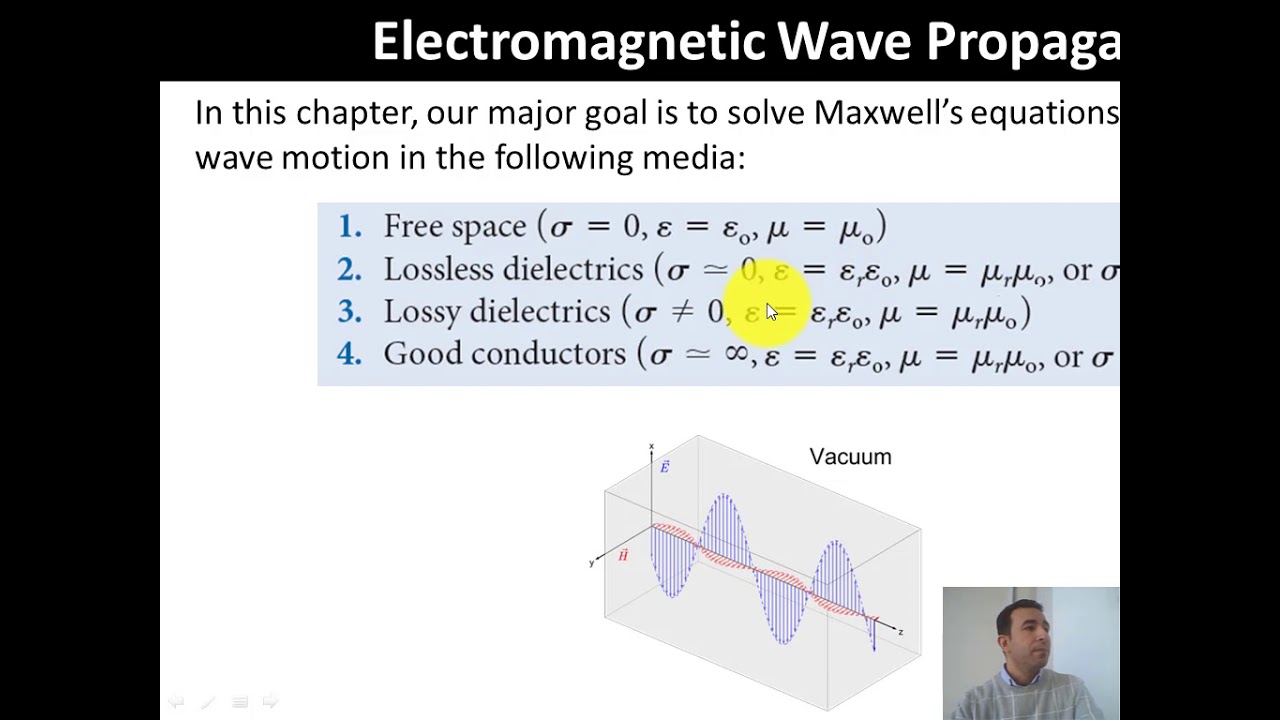
- Classification of media: free space, lossless, lossy, conductors
- Derivation of the wave equation from Maxwell's curl equations
- Wave parameters: amplitude, frequency, propagation constant
- Phase velocity and group velocity; numerical example
- Detailed example: electric field in free space, finding propagation direction and time for half-wavelength
Contribution & Novelties
The video offers a clear pedagogical approach to wave propagation, bridging theoretical equations with practical examples. It systematically explains how the properties of the medium affect the wave’s behavior, which is valuable for learners. The content is standard but presented in a structured manner.
Pour aller plus loin :
- Maxwell’s equations — Foundational to understanding electromagnetic wave propagation.
- Wave equation — The governing differential equation derived in the lecture.
- Phase velocity — Key concept discussed for monochromatic waves.
- Permittivity — Material parameter affecting wave propagation in dielectrics.
87 words
Radar Profile
The profile shows balanced scores across quantity, quality, technical level, and reliability, with quantity slightly higher. This indicates a comprehensive tutorial that is technically sound but not groundbreaking.