How a Heat Pump Works 10-Minute Take | Joel Swisher | Stanford Understand Energy
Keywords
Summary
200 words
Critical Evaluation
Value of the Information & Strength of the Argument
The video offers high educational value by explaining a complex technical subject in an accessible manner without oversimplifying the scientific principles. The argumentation is logically structured, moving from fundamental laws of thermodynamics to specific applications. The speaker effectively uses the refrigerator analogy to make the concept intuitive, then systematically breaks down the four-step cycle. The claim of >100% efficiency is well justified by distinguishing between efficiency and coefficient of performance, and by explicitly showing the energy balance. The explanation of COP variability with temperature lift is insightful and practical. The argumentation is solid, though it remains qualitative without numerical examples or experimental data, which could strengthen the case further.
Scientific Rigor, Source Quality, Title Accuracy
The scientific rigor is high given the credentials of the speaker and the correct usage of thermodynamic concepts. No external sources are cited in the description or mentioned in the video, so the content relies on the speaker’s expertise. The explanation aligns with standard thermodynamic theory, and the visual aids (implied from the lecture) likely clarify the cycle. The title accurately describes the content, focusing on the 10-minute format and the core topic. No comments were provided, so no public reception analysis is possible.
208 words
Title / Content Match
The title accurately reflects the video's focus on explaining heat pump operation within a 10-minute framework.
Quality & Reliability
8/10
The content is presented by a Stanford professor, is technically accurate and well-structured, but remains a high-level overview without advanced mathematical depth or empirical data.
Key Moments
Markers derived by PSI from the transcript: the creator did not define chapters.
- Introduction to heat pump efficiency and comparison with resistive heating.
- Explanation of the laws of thermodynamics and energy quality.
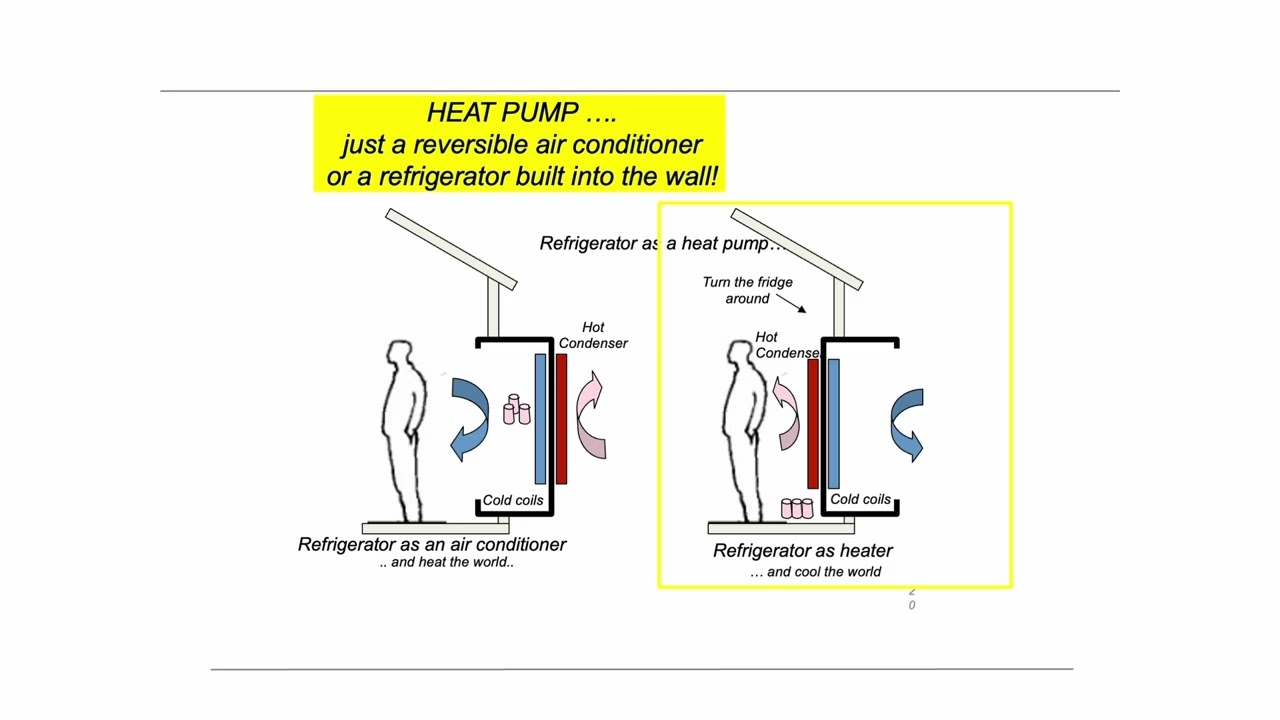
- Analogy with refrigerator and air conditioner to illustrate heat movement.
- Detailed walkthrough of the four-step vapor-compression cycle: evaporation, compression, condensation, expansion.
- Discussion of coefficient of performance (COP) and its dependence on temperature difference.
- Practical applications: central vs. ductless heat pumps, heat pump water heaters and dryers.
- Ground-source heat pumps and their advantages in certain climates.
Contribution & Novelties
The video provides a succinct and clear synthesis of heat pump technology, making the thermodynamics approachable while maintaining technical correctness. Its novelty lies in the pedagogical efficiency of condensing a complex topic into a 10-minute lecture without sacrificing conceptual depth. The explanation of COP as a function of temperature lift and the emphasis on building insulation as a complementary measure are practical insights.
Pour aller plus loin :
- Heat pump (Wikipedia) — Overview of heat pump types, applications, and thermodynamics.
- Coefficient of performance (Wikipedia) — Mathematical definition and context for COP.
- Vapor-compression refrigeration (Wikipedia) — Detailed description of the cycle and components.
102 words
Radar Profile
The radar profile shows balanced scores across information quantity, quality, and reliability, with a slightly lower technical depth. This indicates a well-rounded educational video accessible to a broad audience while maintaining scientific integrity.