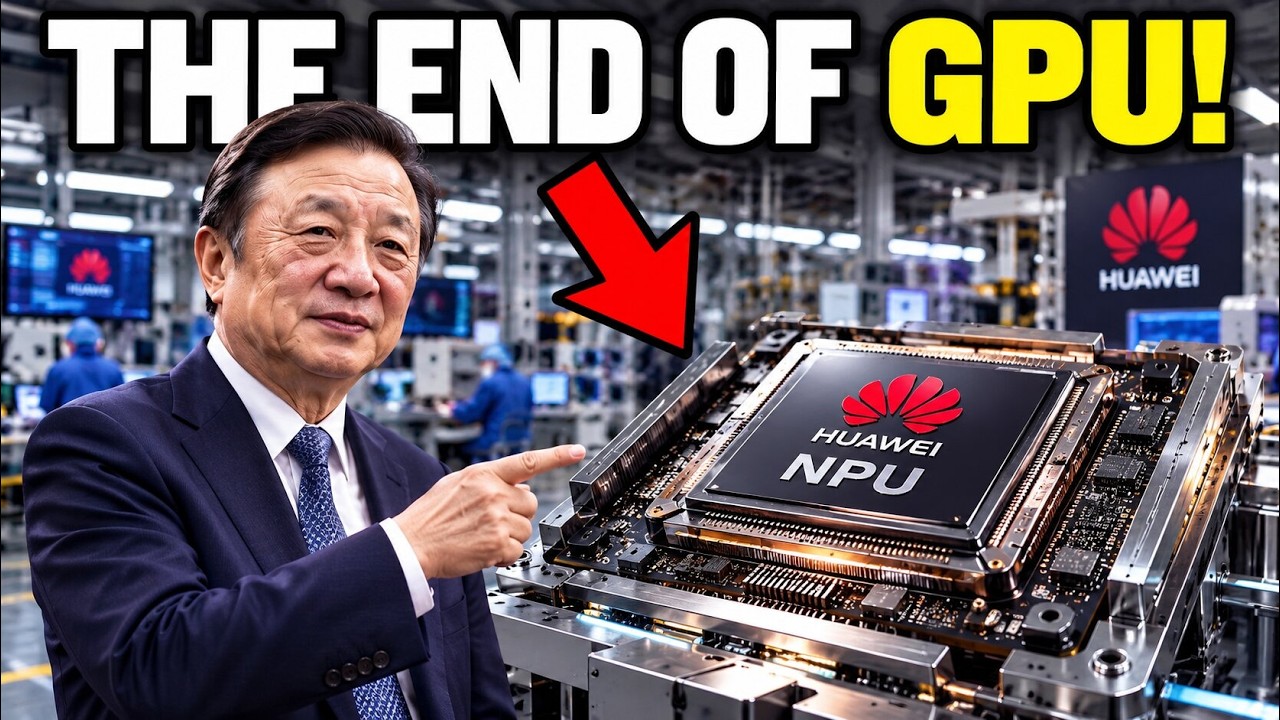
HUAWEI RELEASES NEW NPU STUNS THE INDUSTRY WITH 2,000% Faster Than A GPU!
Title history
- HUAWEI RELEASES NEW NPU STUNS THE INDUSTRY WITH 2,000% Faster Than A GPU! — observed on 20261031-2308 UTC (YouTube)
Keywords
Summary
174 words
Critical Evaluation
Value of the Information & Strength of the Argument
The video provides substantial value by deconstructing a sensational headline and presenting a balanced view of Huawei’s technological progress and limitations. It clearly differentiates between marketing numbers and measurable specifications, such as the 1.56 petaflops of the Ascend 950 PR versus Nvidia’s H20, while also acknowledging that the single-chip performance still lags behind Nvidia’s flagship. The argumentation is well-structured, with a chronological narrative that connects historical events (Kirin 970, sanctions) to current developments. The use of specific data points (e.g., 62x faster cluster communication, 112GB of HBM, 7.2Tbps optical engines) strengthens the analysis. However, the video relies heavily on Huawei’s own claims for many improvements, and some figures are presented without independent verification, which slightly undermines the overall reliability. The shift from a chip-centric to a system-centric perspective is convincingly argued, supported by examples of superpods and superclusters that scale to hundreds of thousands of processors.
Scientific Rigor, Source Quality, Title Accuracy
The video demonstrates scientific rigor by citing multiple established media outlets (Reuters, Bloomberg, Financial Times, Associated Press) and research firms (SemiAnalysis, Bernstein). It consistently distinguishes between Huawei’s announcements and third-party estimates, and it highlights when data is unverified. The sources are varied and include both technical and market analyses, providing a comprehensive picture. However, the video does not provide direct links to sources in the description, relying instead on verbal mentions, which limits traceability. The title is deliberately provocative and does not accurately represent the content’s nuanced message. While the video corrects the ‘2,000%’ misconception, the initial sensationalism could mislead viewers, although the content itself is responsible and analytical.
270 words
Title / Content Match
The title claims a dramatic '2,000% faster' figure, but the video explicitly debunks this as internet shorthand and focuses on system-level performance, market dynamics, and strategic implications. The content is far more nuanced than the clickbait title suggests.
Quality & Reliability
7/10
The video draws on multiple credible sources (Reuters, Bloomberg, SemiAnalysis, Financial Times) and clearly distinguishes between Huawei's official claims and independent estimates. However, many performance figures originate from Huawei itself and lack independent verification. The title is sensationalized but the content corrects the misleading '2,000%' headline.
Key Moments
Markers derived by PSI from the transcript: the creator did not define chapters.
- Huawei's rotating chairman David Wang promises a new generation of Ascend processors every year at Shanghai event.
- Flashback to 2017 Kirin 970, the first smartphone NPU, recognizing 2,000 images per minute.
- Analysis of the '2,000%' claim: it is internet shorthand; real comparisons show ~180% better than Nvidia H20.
- US sanctions and Huawei's response: entity list, export controls, and reliance on SMIC with low yields.
- Memory bottleneck: Huawei stockpiles HBM, develops own high-bandwidth memory and new optical interconnect.
- Atlas 350 accelerator card launch with Ascend 950 PR, 112GB HBM, and customer adoption by ByteDance and Alibaba.
- Nvidia's Jensen Huang admits losing China market to Huawei; market share collapse from 95% to ~8%.
- Superpods and superclusters: Atlas 960E with 4,096 chips, near-packaged optics, and software ecosystem strategy.
Cited Sources
- Reuters — Reports on Ascend chip prices, yields, and customer orders (e.g., ByteDance and Alibaba).
- Bloomberg — Estimate that Ascend 950 delivers only 6% of Nvidia's Vera Rubin performance and production plans.
- SemiAnalysis — Analysis of Huawei's die stockpile (2.9M dies), HBM stockpiles, and SMIC capacity growth.
Contribution & Novelties
The video’s original contribution lies in clarifying the misleading ‘2,000%’ headline and reframing the competition as a battle of computing systems rather than single chips. It compiles data from multiple sources to explain how Huawei offsets single-chip disadvantages through massive clustering, advanced optical interconnects, and self-developed memory. The analysis of Nvidia’s market share collapse and the shift toward inference workloads adds a fresh perspective. A key insight is that Huawei’s ’torch’ scaling law and annual roadmap signal a strategic push beyond current limits.
Pour aller plus loin :
- Neural processing unit - Wikipedia — Background on NPU designs and applications.
- High-bandwidth memory - Wikipedia — Technical details on HBM and its importance for AI accelerators.
- Huawei Ascend - Wikipedia — Overview of Huawei’s Ascend product line and history.
- United States sanctions on Huawei - Wikipedia — Context on export controls and their impact.
143 words
Radar Profile
The radar profile shows high scores in information quantity, technical level, and global reliability, with slightly lower quality information due to reliance on some non-verified claims. The balance suggests a well-researched but partly dependent on Huawei's own data, reflecting the difficulty of independent verification in this domain.