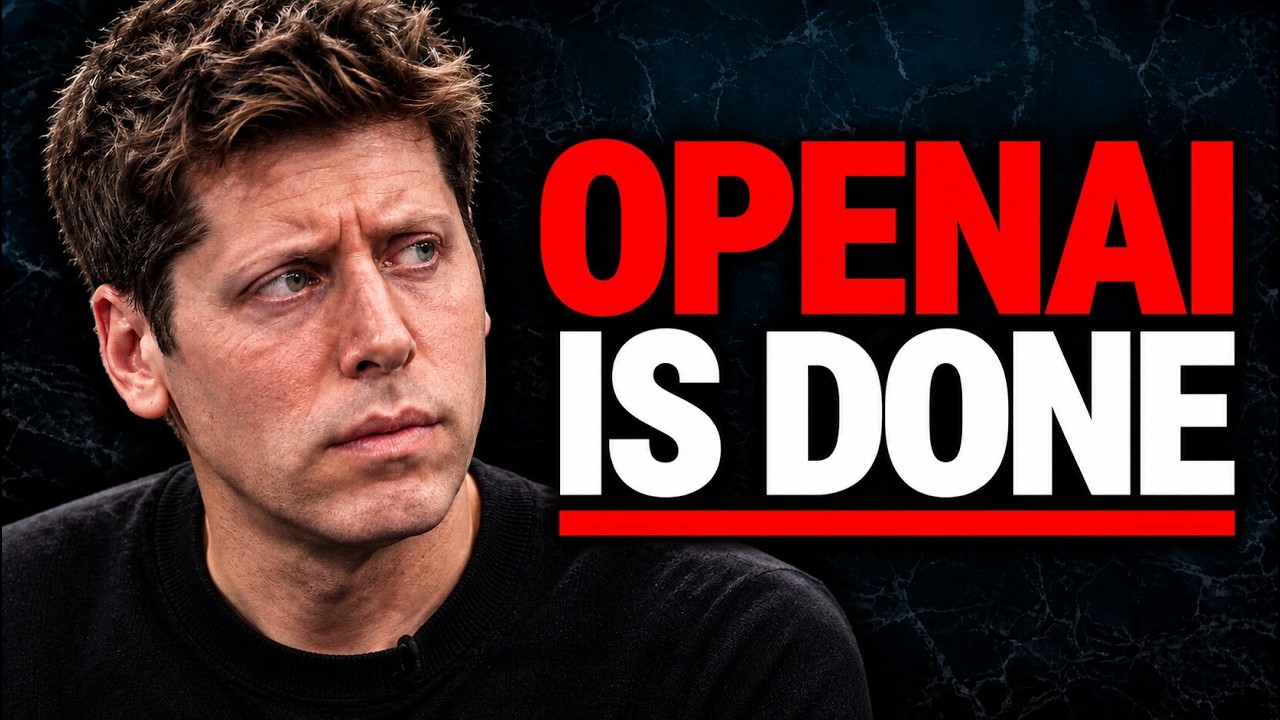
The (Overdue) Collapse of OpenAI's $900B Empire
Title history
- The (Overdue) Collapse of OpenAI's $900B Empire — observed on 20261031-2257 UTC (YouTube)
Keywords
Summary
182 words
Critical Evaluation
Value of the Information & Strength of the Argument
The video provides substantial value by aggregating a wide array of financial metrics and news reports into a coherent narrative. It synthesizes data from sources like Sacra, Sensor Tower, and Ramp, offering concrete figures on gross margins, market share, and enterprise growth. The argumentation is structured and logical: it establishes the scale of OpenAI’s expenditures, contrasts with competitors, and then examines the market’s reaction. The presenter effectively uses a chronological approach, building from the valuation cut to historical context and then forward-looking concerns. However, the argument is emotionally charged, using metaphors like ’empire’ and ‘collapse,’ which may bias interpretations. It also selectively discusses positive counterpoints, but these are presented as footnotes to the primary pessimistic thesis. Overall, the argument is well-evidenced but not entirely neutral, leaning heavily on critical analysts and downplaying optimistic projections.
Scientific Rigor, Source Quality, Title Accuracy
The video demonstrates strong rigor by citing multiple authoritative financial publications: the Wall Street Journal (operating losses, missed targets, compute spending projections), Financial Times (negative cash flow, revenue discrepancies), CNBC (revenue targets), The Information (ad revenue forecasts, Stargate financing), and Sensor Tower (market share data). These are reliable sources. The presentation correctly attributes claims and often provides specifics like report dates and figures. The title is accurate but somewhat alarmist; the word ‘collapse’ is used loosely, yet the content substantiates a decline. Adequation between title and content is strong—the video directly addresses the valuation drop and financial instability. The only minor weakness is the lack of direct links in the description, though the video names sources verbally. No comments were provided for analysis, so public reaction trends cannot be assessed.
279 words
Title / Content Match
The title accurately captures the video's core thesis: the examination of OpenAI's decreasing valuation and systemic financial challenges. While slightly sensationalist, it correctly reflects the content's focus on the 'collapse' narrative.
Quality & Reliability
7/10
The video relies on multiple reputable financial outlets (Wall Street Journal, Financial Times, CNBC, The Information) and provides a balanced presentation by countering negative reports with recent positive metrics. It exhibits a clear analytical structure, though it leans toward a critical interpretation. The inclusion of both sides enhances credibility, but the subjective angle and lack of direct primary sources slightly reduce the score.
Key Moments
Markers derived by PSI from the transcript: the creator did not define chapters.
- Introduction: OpenAI lowers valuation by $150 billion; Nasdaq drops 2.6%.
- History of OpenAI's valuation growth: from $300B in March 2025 to $852B in March 2026.
- Q2 2026 financials: revenue $6.7B, operating loss $12.3B.
- Sacra estimates gross profit margin of 33 cents per dollar and compute costs.
- Stargate project in Abilene, Texas: 4 million sq ft, 6,000 workers, 85% tax break.
- Cancellation of 800MW expansion and Stargate UK/Norway pauses.
- Sensor Tower: ChatGPT market share falls below 50% for first time.
- WSJ reports missed internal targets and CFO warnings about compute contracts.
- October 8 FT report on revenue discrepancy; Nasdaq 100 falls 1.4%.
- Critics: Burry compares to Netscape, Eisman calls AI trade Achilles' heel.
Cited Sources
- Wall Street Journal — Reported OpenAI's operating loss of $12.3B in Q2 2026, missed user and revenue targets, and CFO warnings.
- Financial Times — Projected negative free cash flow of $278B (2026-2030) and reported $50B annualized revenue in early October.
- The Information — Reported OpenAI's ad revenue expectations ($2.4B in 2026, $102B by 2030) and Stargate funding contributions.
- CNBC — Reported OpenAI's target of $280B revenue in 2030.
- Sensor Tower — Analytics firm data showing ChatGPT's share of AI assistant app market at 46.4% in May 2026.
- Sacra — Research estimates on OpenAI's gross margins and compute costs.
- Menlo Ventures — Survey showing Anthropic at ~33% of enterprise market vs OpenAI at 25%.
- Open Router — Data on OpenAI's share of coding and productivity traffic, viewed by WSJ.
Concurring Sources
- Wall Street Journal — Corroborates the operating loss and internal target misses.
- Financial Times — Supports the cash flow projections and revenue concerns.
Dissenting Sources
- OpenAI official statement — Altman and Friar called the WSJ report 'ridiculous' and insisted they were 'completely aligned' on compute purchases, contradicting the narrative of internal discord.
Contribution & Novelties
The video’s original contribution lies in consolidating fragmented financial disclosures and market reactions into a single narrative, framing OpenAI’s situation as a classic valuation correction rather than a technology failure. It synthesizes data from multiple proprietary research firms (Sacra, Sensor Tower, Ramp) and major financial press, highlighting discrepancies in revenue recognition that distort comparisons with Anthropic. The ‘circular financing’ concept is well-illustrated with concrete dollar figures and stakeholder links. The video also humanizes the impact through the Abilene case study, contrasting job creation and tax breaks.
Pour aller plus loin :
- OpenAI - Wikipedia — For background on the company’s structure and evolution.
- AI bubble - Wikipedia — Discusses the broader debate about valuation of AI companies.
- Netscape - Wikipedia — Burry’s comparison; historical analogy of a tech pioneer’s decline.
130 words
Radar Profile
The radar profile shows high scores in quantity and quality of information (9 and 8), indicating a data-dense and well-sourced video. Technical level (6) suggests accessibility to a general audience with some financial background. Reliability (7) is solid but tempered by a clear editorial bias. Overall, the video is informative and well-argued, though not fully objective.