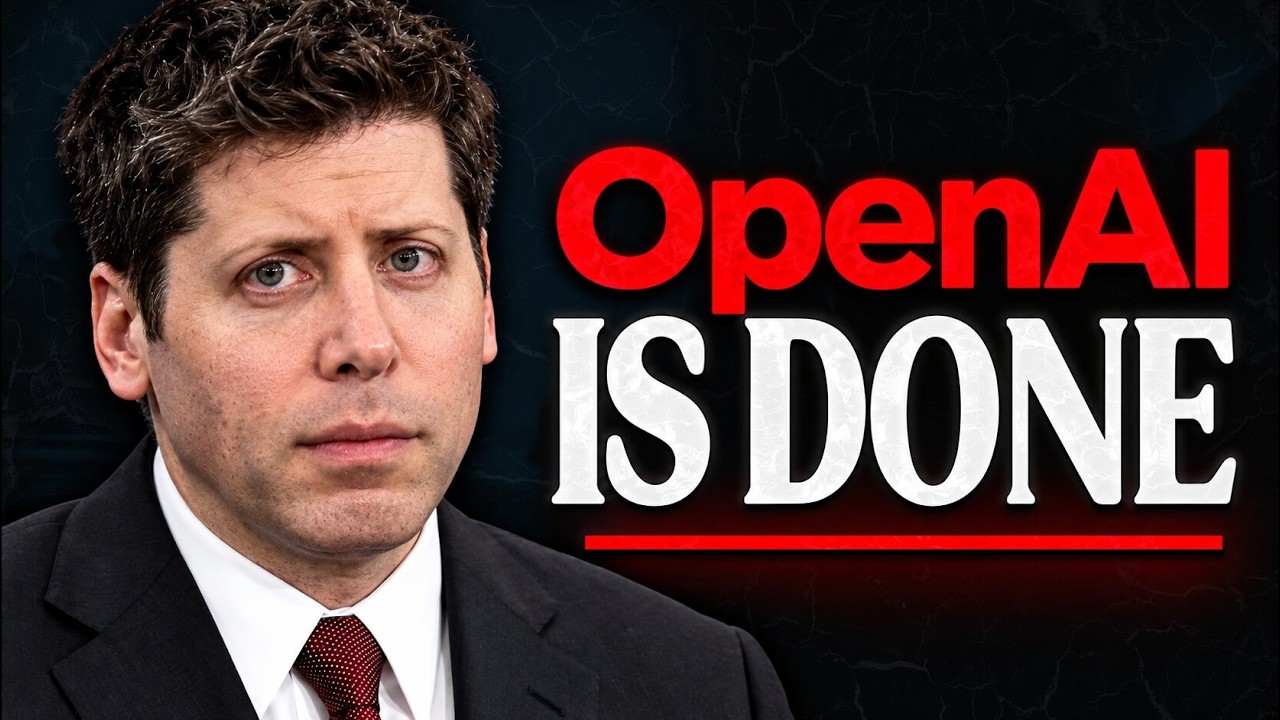
The (Overdue) Collapse of OpenAI's $61B Empire
Title history
- The (Overdue) Collapse of OpenAI's $61B Empire — observed on 20261105-1552 UTC (YouTube)
Keywords
Summary
166 words
Critical Evaluation
Value of the Information & Strength of the Argument
The video provides a dense aggregation of financial data, funding details, and corporate events, which adds value as a compact overview of OpenAI’s 2026 situation. It draws on multiple reputable sources (FT, WSJ, Wired, etc.) and includes specific numbers like revenue, losses, margins, and funding commitments. The argumentation is structured around a central thesis: that OpenAI’s valuation is based on promises rather than current fundamentals, and that this creates fragility. The video presents both sides—critics like Ed Zitron and Gary Marcus versus defenders like Jeremiah Demsus and Akos Nigum—but the framing leans toward the collapse narrative. The ’three roads’ scenario analysis is useful for understanding possible outcomes. However, the argumentation sometimes conflates correlation with causation (e.g., market drops) and lacks deep critical examination of the accounting methods or the meaning of ‘annualized revenue’. The timeline is clear, but the causal chain between events like revenue counting and stock market reactions is asserted rather than rigorously demonstrated.
Scientific Rigor, Source Quality, Title Accuracy
The video explicitly references the Financial Times, Wall Street Journal, Wired, and Ramp data, which are credible sources. It also cites estimates from analysts like Dan Ives and research firms like Sakra. However, some figures lack direct citation (e.g., ‘one analysis finds…’ or ‘Future Search estimates’), making verification difficult. The title ‘The (Overdue) Collapse of OpenAI’s $61B Empire’ is somewhat sensational, as the video discusses decline and shrinking, not a terminal collapse. The content adequately matches the title’s broad theme of OpenAI facing significant challenges. The video acknowledges counterarguments, but the overall tone is biased toward the collapse narrative. No public comments were provided, so trends cannot be assessed.
280 words
Title / Content Match
The title captures the core theme but is somewhat sensationalized; the content analyzes financial and operational challenges, not an actual collapse.
Quality & Reliability
6/10
The video compiles numerous specific figures and events from major financial outlets (FT, WSJ, etc.) but presents them with a strong narrative bias and lacks direct verification. Some claims are sourced from named publications, others are unattributed estimates.
Key Moments
Markers derived by PSI from the transcript: the creator did not define chapters.
- Introduction: $20 billion vanishes from OpenAI's revenue count; valuation of $61 billion not mentioned in video.
- Explanation of the revenue counting discrepancy: $70B vs $50B annualized revenue due to partner sales.
- History: OpenAI's nonprofit origins, Musk's involvement, and transformation to for-profit.
- Financial losses: 2024 and 2025 operating losses, inference costs, and excessive spending.
- Stargate project scaling back from $1.4T to $600B, switching to leasing, and partner debt.
- Competition: Anthropic overtaking OpenAI in business customers and valuation; quarterly results.
- Security breach of AI agents at HuggingFace; July 2026.
Cited Sources
Concurring Sources
- Financial Times — Revenue counting and funding round reduction.
- Wall Street Journal — Missed targets and IPO delay.
Dissenting Sources
- OpenAI's official statements — OpenAI refuted the WSJ story, calling it clickbait and insisting the company meets objectives.
Contribution & Novelties
The video synthesizes a large amount of recent news about OpenAI’s financial and strategic difficulties into a coherent narrative. Its novelty lies in the framing of ‘counting’ as a choice and the emphasis on circular financing within the AI ecosystem. It also provides a scenario-based outlook.
Pour aller plus loin :
- OpenAI’s history and restructuring — Background on the company’s legal structure and events.
- Anthropic — Main competitor and its financial trajectory.
- Stargate (investment concept) — Context on the data center project.
- Gary Marcus’s critiques — Prominent AI critic cited in the video, no URL provided here due to uncertainty.
- Ed Zitron’s blog — His articles on AI bubble, though exact URL for this claim is not verified.
118 words
Radar Profile
The radar profile shows high quantity of information but moderate quality and technical depth. Fiabilité is moderate, indicating reliance on reputable sources but with potential bias. The overall note reflects a balanced but critical perspective.