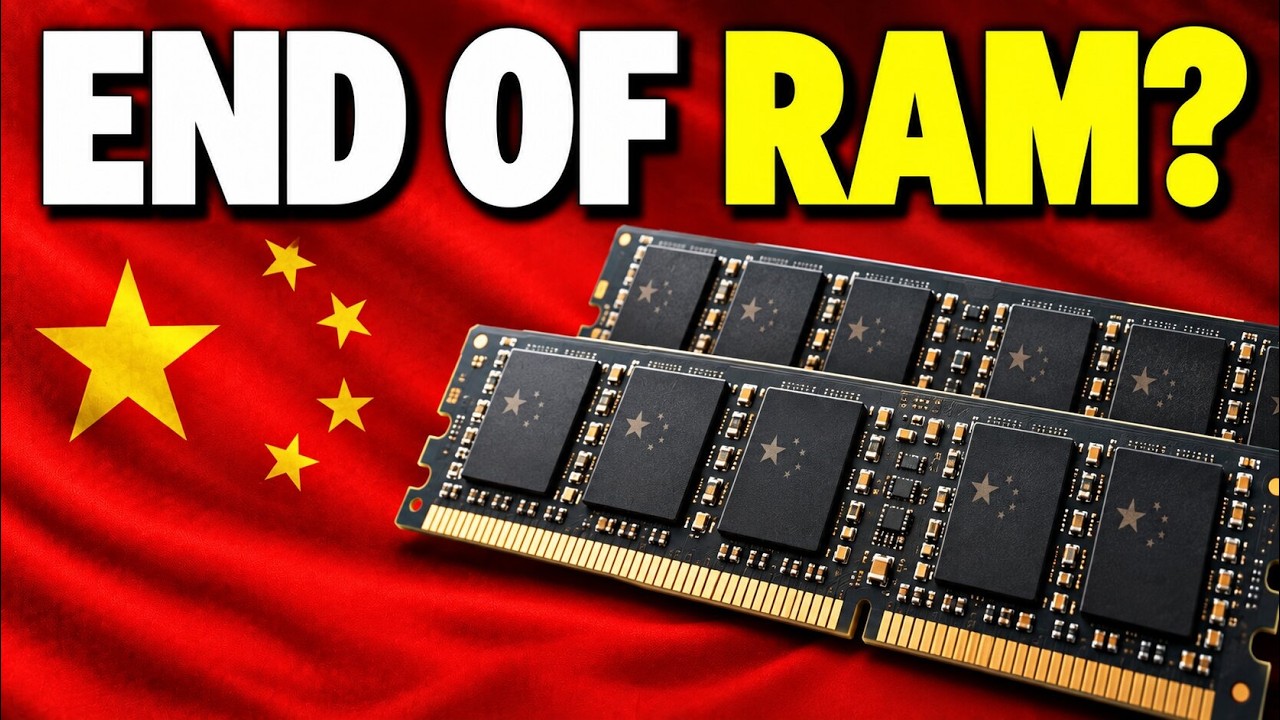
China's $40 RAM Are Destroying A $68 Billion Monopoly — Here's How
Title history
- China's $40 RAM Are Destroying A $68 Billion Monopoly — Here's How — observed on 20261031-2253 UTC (YouTube)
Keywords
Summary
145 words
Critical Evaluation
Value of the Information & Strength of the Argument
The video offers substantial value by consolidating fragmented data from multiple industry sources into a coherent narrative. It explains complex semiconductor economics—such as wafer pricing, capacity shifts, and price cycles—in an accessible way. The argument is well-structured, logically flowing from the price crisis to the rise of Changxin, and it balances optimistic projections with critical caveats. However, it relies heavily on media reports and analyst estimates, some of which are speculative or based on unproven allegations. While the storytelling is compelling, the presentation occasionally favors dramatic effect over nuance, particularly in framing the monopoly as being ‘destroyed’ when the data suggests gradual erosion rather than collapse.
Scientific Rigor, Source Quality, Title Accuracy
The video demonstrates strong sourcing by referencing established industry analysts (Omdia, TrendForce, Counterpoint Research) and major financial news outlets (Reuters, WSJ, FT, Bloomberg). It also mentions specific legal documents, such as the antitrust complaint and the Seoul indictment, grounding the narrative in verifiable events. However, some key claims—like the handwritten notes copying Samsung’s process—are based on allegations not yet proven in court, and the video does not weight probabilities or present counterarguments. The title ‘China’s $40 RAM Are Destroying A $68 Billion Monopoly’ is catchy but overstates the impact; the content shows a 7-point market share shift, not destruction. The video’s rigor is above average for a YouTube essay, though it would benefit from more explicit disclaimers and balanced sourcing for contested claims.
244 words
Title / Content Match
The title accurately reflects the core narrative of Chinese memory challenging the incumbent trigopoly, though 'destroying' is slightly overstated; the content demonstrates erosion rather than annihilation.
Quality & Reliability
8/10
The video provides a data-rich analysis with multiple citations from reputable outlets (Omdia, TrendForce, Reuters, WSJ, FT). However, some claims rely on unverified allegations and forward-looking projections, warranting a high but not perfect score.
Key Moments
Markers derived by PSI from the transcript: the creator did not define chapters.
- Introduction: A $32GB memory kit's price jumps from $115 to $490, framing the memory shortage and market control.
- Historical context: Memory price cycles, the 2023 crash to $1.78 per GB, and the emergence of the trigopoly.
- The trigopoly's grip: Samsung, SK Hynix, and Micron control >90% of memory revenue; a class-action lawsuit accuses them of price-fixing.
- Changxin's origins: Zhu Yiming's background, Hefei's state backing, and licensing of Qimonda patents.
- Growth and market share: Changxin reaches 10% global share by Q2 2026, with its STAR Market IPO and major customer adoption.
- Future outlook: Capacity expansion, pricing strategy, and the possibility of $40 RAM returning; incumbents' response and long-term implications.
Cited Sources
- Omdia — Cited for data on global memory revenue market share.
- TrendForce — Cited for wafer pricing and contract price forecasts.
- Counterpoint Research — Cited for calling Changxin the fastest-growing memory supplier and market share figures.
- Reuters — Cited for reporting on Changxin's pricing and potential new plant in Beijing.
- Wall Street Journal — Cited for reporting on Apple's tests of Changxin memory chips.
- Financial Times — Cited for describing Apple's move from talks to technical testing of Changxin chips.
- Bloomberg — Cited for reporting on Tim Cook lobbying the U.S. government over Changxin approval.
- Tom's Hardware — Cited for noting the limited impact of Changxin chip discounts on retail prices.
- Hardware Unboxed — Cited for benchmark tests comparing Changxin-based RAM with big-three silicon in gaming.
Contribution & Novelties
The video offers an original synthesis of disparate industry data and news reports, framing Changxin’s rise as a systemic challenge to the memory trigopoly. It provides a comprehensive timeline and integrates technical, economic, and geopolitical angles rarely combined in one source. The key contribution is highlighting how capacity shifts and pricing decisions affect consumer markets, and how a state-backed entrant can disrupt long-standing monopolistic behavior.
Pour aller plus loin :
- Dynamic random-access memory (DRAM) — Essential background on the technology at the center of the discussion.
- High Bandwidth Memory (HBM) — Explains the AI-driven demand that reallocated production away from conventional DRAM.
- Sherman Antitrust Act — Legal basis of the class-action lawsuit mentioned in the video.
- Changxin Memory Technologies — Company profile providing further context on its founding and technology.
- STAR Market — The Chinese stock exchange where Changxin had its record IPO.
143 words
Radar Profile
The radar profile shows high scores in information quantity and technical level, reflecting the video's dense data presentation. It scores slightly lower on reliability due to reliance on unverified allegations and projections, while still maintaining strong qualitative sourcing.