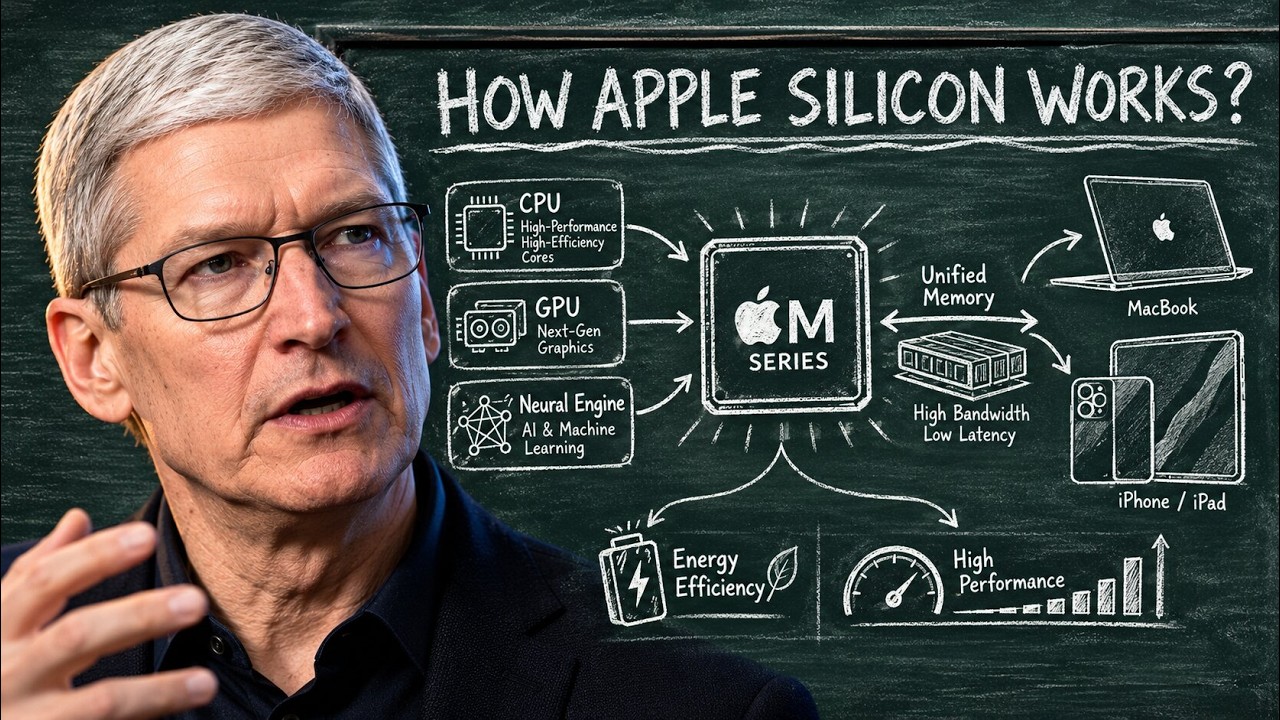
If You Don't Understand Apple Silicon, You Don't Understand Apple
Title history
- If You Don't Understand Apple Silicon, You Don't Understand Apple — observed on 20261105-1552 UTC (YouTube)
Keywords
Summary
153 words
Critical Evaluation
Value of the Information & Strength of the Argument
The video provides substantial value by synthesizing a wide range of data points from market research firms, financial analysts, and news reports into a coherent strategic narrative. It explains complex technical concepts like unified memory and chiplets in accessible terms, and connects them to business decisions. The argumentation is strong, using a chronological structure that builds from historical events to current dynamics. It supports claims with specific numbers (e.g., 6.2 million Macs shipped, 9.5% market share, 170 GB/s bandwidth) and quotes from analysts (e.g., Ming-Chi Kuo, Mark Gurman). The reasoning is logical, but it occasionally overstates the causal link between silicon and overall Apple success, as other factors like branding and ecosystem also contribute. Nevertheless, the chain of evidence is robust and well-organized.
Scientific Rigor, Source Quality, Title Accuracy
The video demonstrates high scientific rigor by repeatedly citing reputable sources: Bloomberg, Macworld, International Data Corporation (IDC), TrendForce, Morgan Stanley, and the Wall Street Journal. It distinguishes between actual shipped data and analyst estimates, and acknowledges uncertainty (e.g., ’estimated’, ‘reported’). The sources are used contextually, such as citing IDC for market share and TrendForce for notebook forecasts. The title ‘If You Don’t Understand Apple Silicon, You Don’t Understand Apple’ is well-supported by the content, which shows how silicon strategy drives Apple’s product lineup and competitive positioning. The only minor caveat is that some claims rely on anonymous sources or unverified leaks, but overall the video is responsibly sourced.
246 words
Title / Content Match
The title accurately reflects the content, which explains how Apple Silicon is central to Apple's strategy and history.
Quality & Reliability
8/10
The video is well-researched, citing specific numbers, analysts, and reports (e.g., IDC, TrendForce, Bloomberg, Macworld, Morgan Stanley). It presents a coherent narrative with data points and quotes. However, as a YouTube documentary, it relies on secondary sources and some claims are not independently verifiable.
Key Moments
Markers derived by PSI from the transcript: the creator did not define chapters.
- Introduction of the MacBook Neo and its significance as an iPhone chip in a laptop.
- History of ARM and Apple's 2008 acquisition of PA Semi to build in-house chip talent.
- Transition to Apple Silicon with the M1 and the concept of unified memory.
- Apple's custom modem journey, the C1 chip, and the battle with Qualcomm.
- Vulnerabilities: reliance on TSMC, memory price surges, and cloud AI gap.
- 2nm chips, new products, and leadership changes consolidating silicon as core.
Cited Sources
- Bloomberg — Cited for reviewing the MacBook Neo and reporting on Apple chip plans like the C1 and M6.
- Macworld — Cited for analysis of MacBook Neo's performance and M6 memory bandwidth limitations.
- International Data Corporation (IDC) — Cited for Mac shipment statistics and market share data.
- TrendForce — Cited for notebook shipment forecasts and Apple's expected growth.
- Morgan Stanley — Cited for reports on Apple acquiring advanced packaging capacity for the Baltra chip.
- Wall Street Journal — Cited for reporting the preliminary deal between Apple and Intel for chip manufacturing.
- Ming-Chi Kuo — Analyst cited for predictions on M7 chips, Baltra mass production, and Apple's memory strategy.
- Ben Thompson — Technology analyst cited for pointing out the impact of PA Semi acquisition on Apple's A-series chips.
Concurring Sources
- International Data Corporation (IDC) — Supports the claim of Apple's Mac shipment growth and market share increase.
- TrendForce — Concurs with the forecast of Apple's notebook growth while the overall market declines.
- Morgan Stanley — Corroborates Apple's investment in packaging capacity for AI server chip, aligning with the noted strategy.
Dissenting Sources
- Taiwan-based analysts — They dispute the notion that Intel can be a viable replacement for TSMC, arguing that TSMC's lead in yield and packaging remains unmatched, which contrasts with the video's presentation of Intel as a potential hedge.
- Some reviewers — The video mentions that Macworld's analysis found the M6's memory bandwidth to be a bottleneck, which is a caveat against overstating the chip's performance gains.
Contribution & Novelties
The video offers a compelling synthesis of Apple’s silicon strategy, connecting technical chip details with broader business implications. It provides original insights into how the MacBook Neo’s existence hinges on an iPhone chip, and how Apple’s control over its own silicon gives it strategic leverage unmatched by competitors. The narrative highlights recent developments such as the C1 modem, the 2nm leap, and leadership changes, offering a fresh perspective on Apple’s future. However, it does not present original research, but rather a curated interpretation of existing reports. The value lies in the coherent storyline and the drawing of connections that may not be widely recognized.
Pour aller plus loin :
- Apple Silicon — Overview of Apple’s chip line and history.
- Unified memory — Explanation of the architecture used in Apple Silicon.
- TSMC — The foundry that manufactures Apple’s chips.
- ARM architecture — The instruction set used by Apple Silicon.
- Qualcomm modem litigation — Background on Apple’s modem disputes.
157 words
Radar Profile
The radar profile shows high scores across all dimensions, with slight dips in technical level and reliability. This indicates a video that is rich in data and analysis but may require some technical background to fully appreciate, and while generally reliable, it does not offer primary source verification.