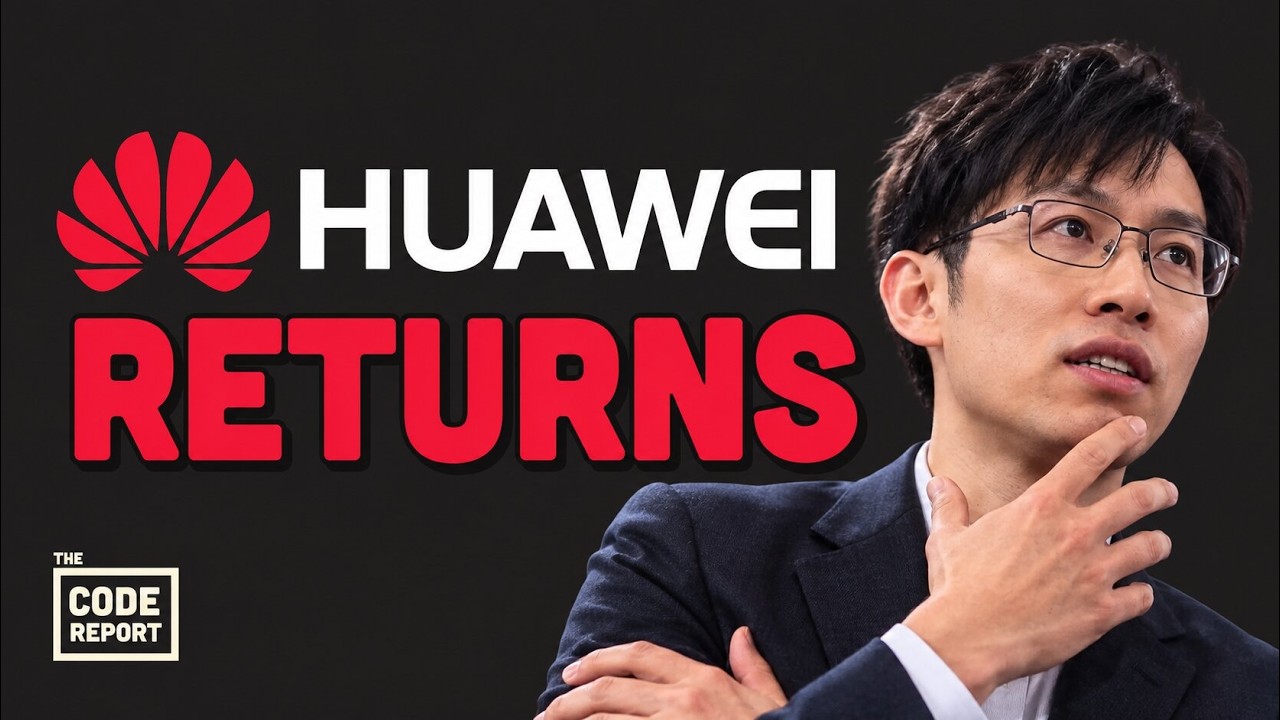
Huawei is back... and Nvidia is terrified
Title history
- Huawei is back... and Nvidia is terrified — observed on 20261031-2309 UTC (YouTube)
Keywords
Summary
100 words
Critical Evaluation
Value of the Information & Strength of the Argument
The video provides valuable, up-to-date information on strategic semiconductor developments, with many specific numbers and quotations from industry leaders. The argumentation is well-structured: it first builds a case for Huawei’s comeback, then intentionally presents counterpoints (e.g., Epoch AI analysis, production limits) to avoid one-sidedness. This creates a nuanced overall picture. The reasoning is generally sound, though it often relies on estimates from third-party research rather than primary data.
Scientific Rigor, Source Quality, Title Accuracy
The video cites credible sources (Bloomberg, Reuters, Nikkei, The Register, Epoch AI, etc.) and gives precise context for each claim. The title corresponds well to the content, focusing on Huawei’s resurgence and Nvidia’s concerns. The scientific rigor is acceptable for a news review, with a clear effort to distinguish facts from opinions. The inclusion of explicit weaknesses of Huawei strengthens credibility.
144 words
Title / Content Match
The title accurately reflects the core narrative: Huawei's resurgence and Nvidia's strategic concerns. It is catchy but not misleading.
Quality & Reliability
7/10
The video draws on well-known media outlets (Bloomberg, Reuters, Nikkei) and provides concrete figures. It mixes facts with opinion, and some estimates come from analyst firms, but the presentation remains balanced and includes counterarguments.
Key Moments
Markers derived by PSI from the transcript: the creator did not define chapters.
- Announcement of the Qualcomm-Huawei licensing deal.
- Background on US sanctions and the federal prosecution against Huawei.
- Nvidia's loss of the Chinese market, with Beijing blocking H200 sales.
- Huawei Connect: unveiling of Ascend roadmap and Atlas 960E SuperPod.
- DeepSeek aligns with Huawei, open-sourcing Tile Lang and building on Ascend.
- Counterarguments: Epoch AI analysis, production constraints, and performance gap.
Cited Sources
- Bloomberg — Cité pour les détails de l'accord Qualcomm-Huawei et les déclarations de Huawei.
- Nikkei Asia — Article sur l'accord Qualcomm-Huawei et l'approbation de Washington.
- Reuters — Reportage sur le blocage des ventes de H200 et les restrictions chinoises.
- Financial Times — Interview de Jensen Huang sur Huawei.
- The Register — Spécifications techniques des puces Ascend et atlas.
- Epoch AI — Analyse indépendante sur les capacités computationnelles de Huawei.
- The Information — Rapports sur DeepSeek et les investissements en puces Huawei.
Contribution & Novelties
The video’s main contribution lies in synthesizing recent events and strategic trends: the Qualcomm-Huawei reversal, the development of a Chinese AI ecosystem, and the nuanced comparison of hardware capabilities. It highlights the importance of software ecosystems and developer habits, going beyond simple chip benchmarks. The inclusion of both bullish and bearish perspectives adds depth.
Pour aller plus loin :
- CUDA — Nvidia’s software platform, central to the ecosystem comparison.
- DeepSeek — The Chinese AI lab collaborating with Huawei, relevant details on models and strategy.
- 3D integrated circuit — Technology underlying LogicFolding, stacking logic layers to improve performance.
97 words
Radar Profile
The radar profile shows high information quantity, good information quality, moderate technical depth, and reasonable reliability. This indicates a content-rich yet accessible analysis, suitable for viewers seeking a balanced update.