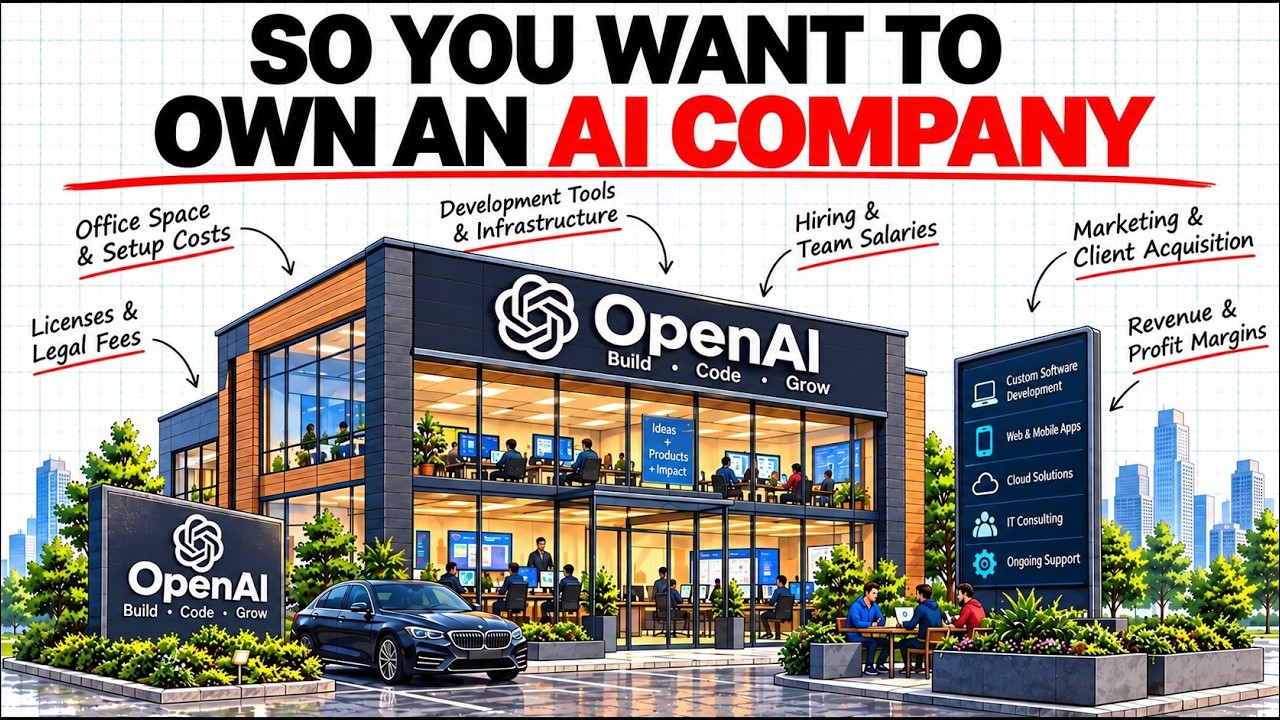
The Economics of Owning an AI Company
Title history
- The Economics of Owning an AI Company — observed on 20261101-1054 UTC (YouTube)
Keywords
Summary
254 words
Critical Evaluation
Value of the Information & Strength of the Argument
The video offers substantial value by synthesizing a large amount of financial data into a coherent narrative about the AI industry’s economic structure. Its argumentation is well-supported with specific numbers from multiple sources, including audited financials, industry surveys, and analyst estimates. The presentation is logical, moving from fundamental cost drivers to real-world examples, and it avoids oversimplification by acknowledging both bullish and bearish perspectives. The use of analogies (e.g., utilities, restaurant landlord) makes complex concepts accessible. However, some figures are presented without explicit sourcing, and the video’s reliance on projections (e.g., Anthropic’s valuation near $2 trillion) introduces uncertainty. Overall, the argumentation is solid, constructing a compelling case that AI companies face unique economic challenges, yet some revenue-growth trajectories could be undermined by cost inflation.
Scientific Rigor, Source Quality, Title Accuracy
The video demonstrates strong scientific rigor by citing reputable sources: Financial Times for financial data, Epoch AI for training cost tracking, SemiAnalysis for margin estimates, levels.fyi for compensation, and CB Insights for startup mortality rates. It also references specific reports and documents, such as OpenAI’s audited 2025 figures and Anthropic’s prospectus. The reliance on established business media and research groups enhances credibility. The title is perfectly aligned with the content, which systematically explores the economics from costs to revenue to profitability. The video explicitly addresses limitations, such as accounting differences in revenue recognition, and distinguishes between cash losses and paper losses. While no external links are provided in the description, the in-text citations to named sources are identifiable. The material is presented objectively, with both bull and bear cases given fair consideration, and the synthesis is thoughtful and balanced.
278 words
Title / Content Match
The title perfectly captures the content, as the video delves into the financial realities, cost structures, and strategic challenges of owning an AI company.
Quality & Reliability
8/10
The video grounds its analysis in verifiable data from reputable sources like the Financial Times, Epoch AI, SemiAnalysis, and CB Insights, and clearly distinguishes between reported facts, estimates, and projections. However, some figures are based on unaudited or speculative reports, and the absence of direct links in the description limits immediate verification.
Key Moments
Markers derived by PSI from the transcript: the creator did not define chapters.
- Introduction: Anthropic's IPO filing reveals $16.3B revenue and $80.7B net loss, setting the stage.
- Comparison of software gross margins (75-85%) vs AI (52%), explaining inference costs.
- Compute costs: Nvidia chip prices, data center construction ($45-55B per gigawatt), and Big Tech capex of $725B in 2026.
- Training costs: frontier model training reaches billions, with 90% of R&D spent on failed experiments.
- Elite researcher compensation: median packages over $1M, record signings including a $250M deal.
- OpenAI financials: $13.07B revenue vs $34B costs in 2025, operating loss of $20.92B, and high dependency on Microsoft.
- Anthropic's turnaround: revenue growth to $16.3B in H1 2026, operating loss down to $693M, and $430B compute commitments.
- Cursor case study and DeepSeek's price war, illustrating the middle-layer vulnerabilities and market dynamics.
- Michael Burry's bearish argument on chip depreciation and the potential bubble, contrasted with bullish revenue growth.
Cited Sources
- Financial Times articles on AI spending and OpenAI finances — Cited for capital expenditure estimates (hyperscaler spending, Amazon, Microsoft, Alphabet) and OpenAI's financial data including annualized revenue and loss figures.
- Epoch AI research on training costs and compute — Cited for training cost growth (2.4x per year) and the breakdown of OpenAI's R&D compute allocation.
- Iconic Capital survey of AI executives — Cited for average gross margins of AI products (52% in 2026, up from 41% in 2024).
- levels.fyi compensation data — Cited for research scientist compensation at OpenAI ($1M median, $1.47M senior) and Meta's packages.
- SemiAnalysis analysis of Anthropic margins — Cited for Anthropic's gross margin improvement from -94% to mid-60% and potential inference margins up to 88%.
- CB Insights startup data — Cited for statistics on AI startup failures (14,000 launched in 2024, 40% gone in under 2 years).
- Anthropic prospectus — Cited for specific financials: $16.29B revenue in H1 2026, $9B compute spend, $72B non-cash charge, net revenue retention of 900%, and $430B compute commitments.
- OpenAI audited 2025 figures (reported by Ed Zitron and FT) — Cited for OpenAI's 2025 revenue of $13.07B, total costs of $34B, and $20.92B operating loss.
Concurring Sources
- Microsoft AI business run rate ($37B annual, 123% growth) — Supports the view that AI is generating significant revenue for big tech firms, consistent with the video's optimistic projections.
- Google Cloud backlog doubling to $460B — Reinforces the strong demand for cloud AI infrastructure, aligning with the video's assertion that cloud providers benefit from the AI boom.
Dissenting Sources
- Michael Burry's critique on chip depreciation — Burry argues that AI chips have a useful life of 2-3 years, not 5-6, leading to understated depreciation of $176B, which implies profits are overstated and a bubble exists. This contrasts with Nvidia's claim that hardware retains value and the video's more neutral stance.
Contribution & Novelties
The video provides a comprehensive synthesis of the AI business model, uniquely blending cost structure analysis with real-world financial disclosures. It demystifies the allure of AI startups by illustrating how compute, infrastructure, and talent costs can overwhelm revenue, while also showing that efficient scaling (e.g., Anthropic) can lead to rapid profitability. The video’s contribution lies in its holistic view of the value chain—from chip makers to app developers—and its clear explanation of the dependencies and risks inherent in relying on rented compute. It also highlights the growing role of Chinese open-source models in price competition, a factor often overlooked in Western analyses. The inclusion of Michael Burry’s critical perspective adds balance, making the video a valuable resource for investors and entrepreneurs.
Pour aller plus loin :
- Large language model — Provides foundational context on LLMs and their operational requirements.
- Data center — Explains the infrastructure and cost drivers for AI compute.
- Depreciation — Key accounting concept in the debate over chip lifespan and financial reporting.
165 words
Radar Profile
The radar chart would show high scores in quantity and quality of information (9 and 8), reflecting the dense data and credible sourcing. The technical level (7) indicates accessibility to a general audience while retaining depth. Overall reliability (8) is strong but slightly tempered by reliance on estimates and projections. The profile suggests a well-rounded, informative analysis with minor caveats on verifiability.