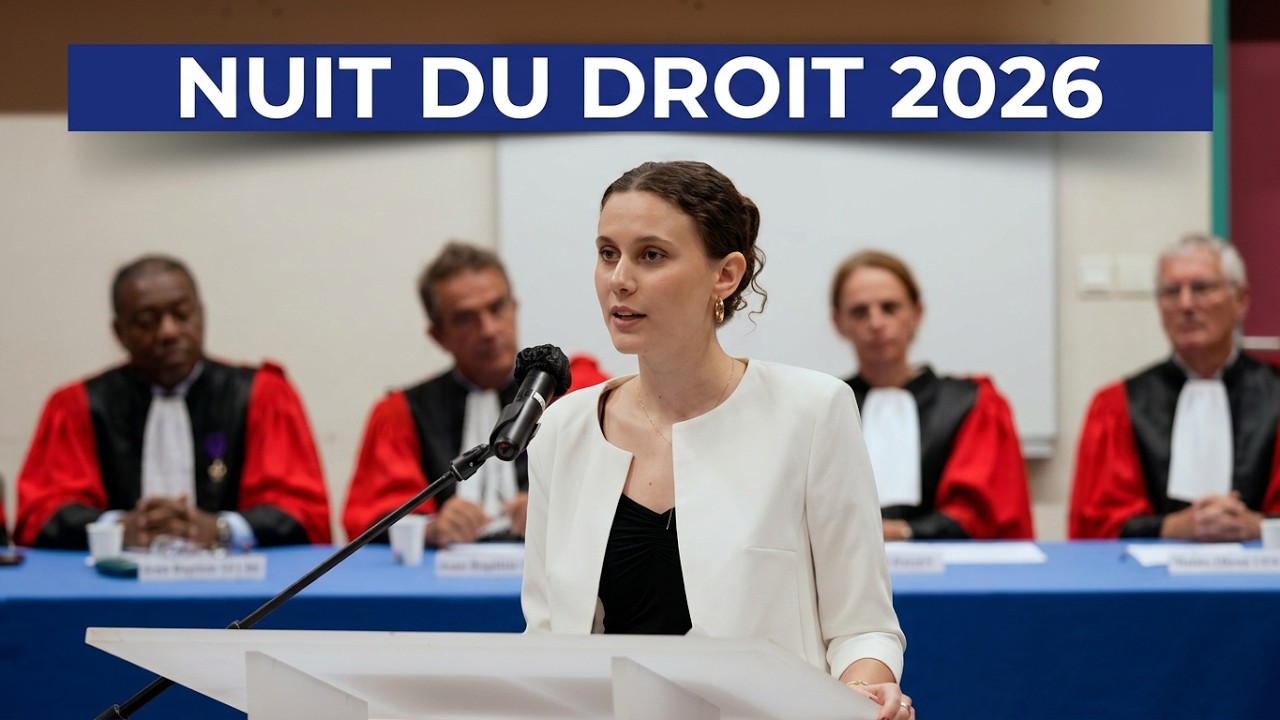
La nuit du droit 2026 : finale du concours d'éloquence
The Night of Law 2026: Oratory Competition Final
Keywords
Summary
150 words
Critical Evaluation
Value of the Information & Strength of the Argument
The video showcases the value of oral advocacy and legal reasoning among undergraduate and graduate law students. Each speech is well-structured, with an introduction, a body of argumentation, and a conclusion, often using rhetorical devices and personal appeals to engage the audience. The strengths of the argumentation lie in the clear exposition of legal principles and the use of historical and contemporary examples, such as the 1789 Declaration of the Rights of Man and the 1848 abolition of slavery in Réunion. The candidates skillfully connect abstract norms to concrete situations, demonstrating their ability to persuade. The jury’s feedback highlights the clarity, flow, and emotional intelligence of the presentations, but also notes the need for further development of certain legal concepts. Overall, the argumentation is solid for the level of study, but it remains an exercise rather than a breakthrough in legal thought.
Scientific Rigor, Source Quality, Title Accuracy
The video does not cite explicit external sources, but the content is grounded in fundamental legal doctrine and historical facts, such as appeals to constitutional principles and references to legal philosophers like Montesquieu and Portalis. The title is accurate and aligns perfectly with the content, as it promises a final of an eloquence contest and delivers exactly that. The production quality is professional, with clear audio and video, and the structure follows the event closely. However, the lack of scholarly citations and the subjective nature of the speeches limit the scientific rigor, making this more a documentary record than a rigorous academic exposition.
260 words
Title / Content Match
The title accurately reflects the content, as the video presents the final of the eloquence contest held during the Night of Law 2026.
Quality & Reliability
7/10
The video is an official recording from the University of La Réunion's channel, providing authentic documentation of the event. The content consists of student speeches and comments, which are subjective opinions rather than peer-reviewed research, thus limiting its scientific reliability.
Key Moments
Markers derived by PSI from the transcript: the creator did not define chapters.
- Opening speech by the dean of the law faculty
- Speech on equality by Meï-Ly MOCHULPICH (L1 law)
- Speech on the excess of laws by Axelle POTTIER (L2 law)
- Speech on laws and history by Maëva VIRGINIUS (L3 law)
- Speech on time and law by Délia VITRY (M1 law)
- Speech on truth and justice by Doriane DUBLIN (M2 law)
- Announcement of the laureate
Contribution & Novelties
The video provides a rare glimpse into the practice of legal rhetoric in a French university, capturing the preparation and delivery of speeches on contemporary legal issues. It highlights the importance of eloquence in legal education and the role of such contests in fostering confidence and civic engagement among students. The contributions are primarily pedagogical and cultural, offering a stage for young lawyers to articulate their ideas.
Pour aller plus loin :
- Declaration of the Rights of Man and of the Citizen — Foundational text invoked in the first speech.
- Jean-Étienne-Marie Portalis — Legal philosopher quoted in the opening discourse.
- Eloquence — The art of persuasive speaking central to the contest.
111 words
Radar Profile
The radar chart shows a high score in reliability (8) and information quantity (8), indicating that the video is a dense and authentic record of the event. The technical level (6) and overall quality (7) are moderate, reflecting that the content is accessible and well-argued but not deeply advanced or particularly innovative.