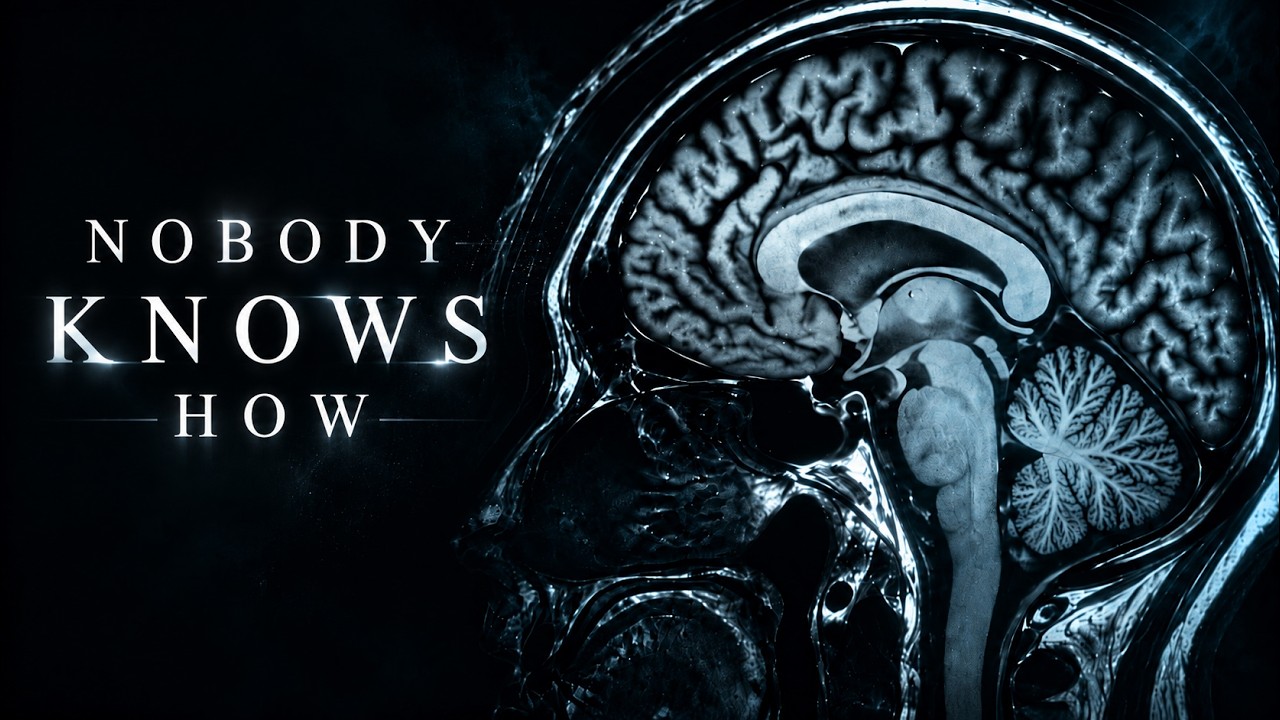
What If Your BRAIN Does Not Create CONSCIOUSNESS?
Keywords
Summary
214 words
Critical Evaluation
Value of the Information & Strength of the Argument
The documentary provides genuine intellectual value by assembling a diverse set of real, documented cases that challenge the standard materialist assumption that consciousness is directly produced by brain activity. The argumentation is structured logically, moving from individual case studies (hydrocephalus, hemispherectomy) to historical analogies (Newton’s prism) and philosophical theories (James, Huxley). The narrator rigorously states what remains speculative, repeatedly using phrases like ’not proof’ and ’this isn’t a measurement,’ which strengthens the overall credibility. The key strength is the balanced presentation: both the mainstream ‘factory’ (neuroscientific orthodoxy) and the fringe ‘receiver’ hypothesis are scrutinized, and the video explicitly acknowledges the absence of measurable evidence for an external signal. However, the argumentation is not experimental—it assembles evidence that is merely consistent with the receiver idea but does not provide a decisive test. The analogies (prism, radio) are evocative but not formally developed into falsifiable predictions, limiting their scientific weight.
Scientific Rigor, Source Quality, Title Accuracy
The scientific rigor is moderate. The video cites several real sources: the 2007 Lancet case of hydrocephalus, John Lorber’s unpublished observations (as covered by Science magazine), the 2019 Caltech study on hemispherectomy patients, and the 2012 Imperial College psilocybin study. It accurately notes when data are unpublished (Lorber) or based on a single case, which is commendable. However, some claims could be better contextualized—for instance, the exact percentage of remaining brain tissue in the Marseilles case is not specified, and the narrator acknowledges this. The title closely matches the content, which focuses on the philosophical and scientific question of whether the brain creates or merely receives consciousness. The documentary does not over-sensationalize; it respects the uncertainty inherent in the topic.
283 words
Title / Content Match
The title accurately reflects the philosophical and scientific question explored throughout the documentary, which systematically examines whether the brain produces consciousness or only transmits/shapes it.
Quality & Reliability
7/10
Solid science communication with clear presentation of the hard problem of consciousness and its paradoxes. The video presents real cases (hydrocephalus, hemispherectomy, savant syndrome) and fairly addresses both materialist and 'receiver' interpretations, though the latter remains speculative and not proven. The narrative stays honest by acknowledging the lack of empirical evidence for an external signal.
Key Moments
Markers derived by PSI from the transcript: the creator did not define chapters.
- Presentation of the 2007 case of a French man with severe hydrocephalus, still living a normal life.
- Wilder Penfield's brain stimulation experiments at the Montreal Neurological Institute.
- Newton's prism experiment used as an analogy for transmission versus production.
- William James's transmission hypothesis and the radio analogy.
- Aldous Huxley and the 'reducing valve' concept; his mescaline experience.
- Hemispherectomy patients and the Caltech 2019 study showing preserved brain networks.
- Acquired savant syndrome: Jason Padgett and Derek Amato; paradoxical lucidity.
Cited Sources
- The Lancet (2007) — Brain of a white-collar worker — Case report of a man with severe hydrocephalus and an ordinary intellectual life.
- Science — 'Is your brain really necessary?' — Article covering John Lorber's observations of severe hydrocephalus with high IQ.
- Caltech Study (2019) — Brain network analysis of hemispherectomy patients, showing preserved and reorganized networks.
- Imperial College London Study (2012) — Psilocybin brain scan study led by Robin Carhart-Harris and David Nutt, showing reduced hub activity during intense experiences.
Concurring Sources
- The Lancet — Brain of a white-collar worker — Case report showing preserved function with severe brain compression.
- Imperial College London — psilocybin study — 2012 study showing reduced brain activity during psychedelic experience.
Dissenting Sources
- Mainstream neuroscience perspective — Most neuroscientists maintain that consciousness is entirely produced by brain activity; the absence of measurable signals for a receiver hypothesis is a critical objection.
- Unpublished data on Lorber's cases — John Lorber's observations were never published in detail, and later claims have not been independently verified.
Contribution & Novelties
This video synthesizes decades of disparate case reports and theoretical ideas into a coherent and accessible narrative. Its originality lies in presenting the ‘receiver hypothesis’ not as a mystical claim but as a testable framework, while honestly acknowledging that no definitive experiment has been conducted. The use of real medical cases (hydrocephalus, hemispherectomy, savant syndrome) provides a solid foundation for questioning the assumption that consciousness is produced by the brain. The documentary does not claim to settle the debate, but succeeds in opening up a space for genuine inquiry.
Pour aller plus loin :
- Hard problem of consciousness — Central philosophical challenge addressed by the video.
- Wilder Penfield — Pioneer of brain stimulation whose experiments inspired the documentary.
- Psilocybin and brain activity — Context for the Imperial College study on altered consciousness.
- Acquired savant syndrome — Rare phenomenon of sudden abilities after brain injury, featured in the video.
- Hemispherectomy — Surgical procedure and recovery cases presented.
156 words
Radar Profile
The radar profile shows high scores in quantity and quality of information, reflecting the extensive collection of case studies and balanced presentation. The lower scores in technical depth and global reliability indicate that while the video is intellectually stimulating, it does not offer experimental rigor or embracive verification of its central hypothesis.