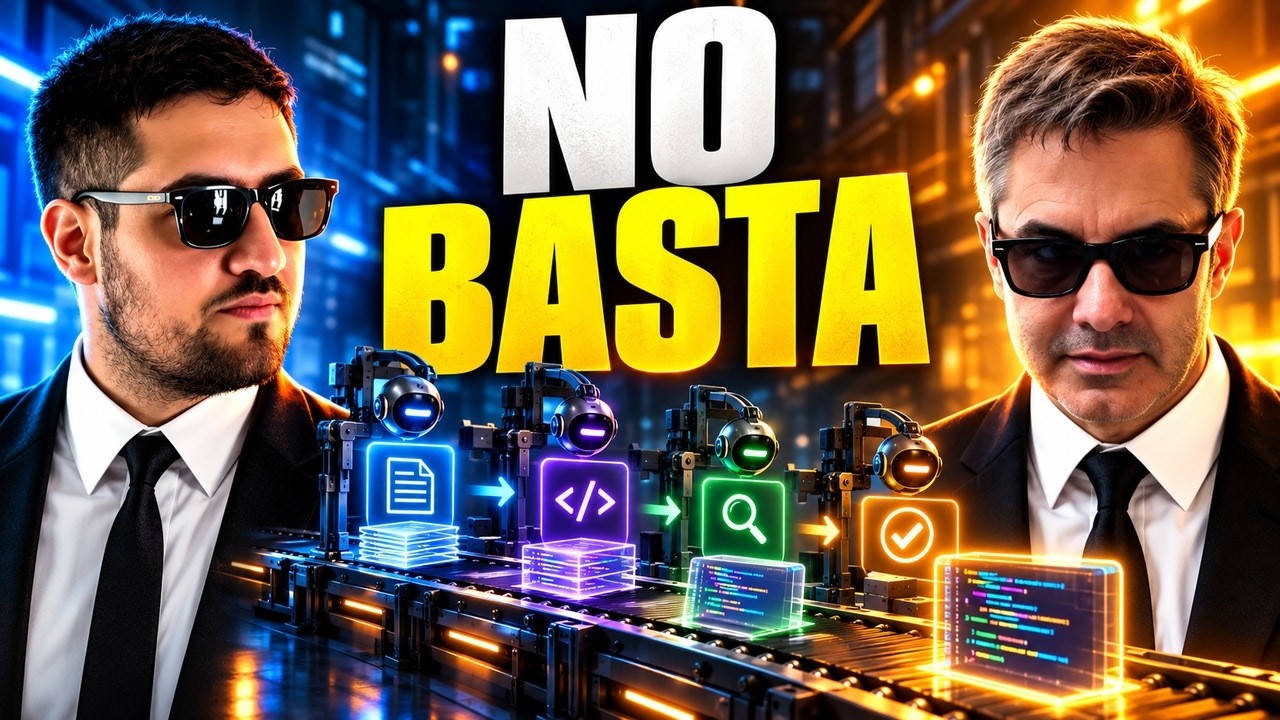
AI Factory: el siguiente nivel de programar con agentes
AI Factory: The Next Level of Agent-Based Programming
Title history
- AI Factory: el siguiente nivel de programar con agentes — observed on 20261026-0705 UTC (YouTube)
Keywords
Summary
167 words
Critical Evaluation
Value of the Information & Strength of the Argument
The value of this video lies in its first-hand account of implementing an AI-driven software factory, providing concrete workflow examples and personal insights. The argumentation is based on personal experience and anecdotal evidence rather than systematic experimentation, which limits its generalizability. The hosts distinguish between automation and autonomy, and their discussion of Codex’s quirks adds practical nuance. However, the lack of external validation or comparative data weakens the scientific rigor. The China travel segment offers observational but subjective impressions, with clear separation of facts and opinions.
Scientific Rigor, Source Quality, Title Accuracy
The video relies on personal experiences and informal observations, with no formal citations or links to research. The only sources referenced are in the description, including links to Alibaba Qwen, Pony.ai, and a Xiaomi factory video, which support specific claims but are not deeply analyzed. The title matches the content well, as the AI Factory is the central theme. The hosts acknowledge that the open-source project is not yet released, maintaining transparency about pending work. Overall, the scientific rigor is low due to lack of verifiable data or peer-reviewed references.
191 words
Title / Content Match
The title accurately reflects the main topic: the AI Factory as an evolution of AI programming workflows.
Quality & Reliability
6/10
The video presents personal experiences and opinions about AI factories and observations from a trip to China, without formal evidence or citations. The claims are anecdotal and not verified.
Chapters
- Avances del episodio
- Bienvenidos: Fernando vuelve de China y Eric de San Francisco
- Qué es una AI Factory y qué son las dark factories
- El cuello de botella eres tú: memoria y tipos de nodos
- La AI Factory de Eric: spec, builder, revisores y despliegue
- De software factory a content factory
- Codex revisa como Sheldon
- La AI Factory que Eric quiere publicar como open source
- China: Alibaba, Qwen y la IA en todo
- El viaje por Pekín, Hangzhou y Shenzhen
- «El mundo en el que crees que vives ya no existe»
- Xiaomi: la fábrica oscura
- Robots humanoides y cómo se entrenan
- Dahua: cámaras y seguridad
- Huawei y la inversión en I+D
- Pony.ai, coches autónomos y drones de reparto
- WeChat, trenes de alta velocidad y despedida
Cited Sources
- Codemancers - Inteligencia Artificial (Spotify) — Podcast platform for the episode
- Codemancers - Inteligencia Artificial (Apple Podcasts) — Podcast platform for the episode
- Alibaba Cloud - Qwen — Mentioned as AI models used by Alibaba
- Codemancers website — Channel's official website
- Eric Risco on LinkedIn — Host's LinkedIn profile
- Fernando Rodríguez on LinkedIn — Host's LinkedIn profile
- Pony.ai — Autonomous driving company mentioned in the trip
- Xiaomi electric vehicle factory (official video) — Video showing the Xiaomi factory, referenced to illustrate dark factories
Contribution & Novelties
The video contributes a practical explanation of how an AI Factory can be structured, emphasizing auditability and traceability, and shares unique experiences from a trip to China. The original ideas include the use of multiple specialized agents (spec writer, builder, reviewers) and the concept of ‘autonomy’ rather than mere automation. The hosts also propose an open-source initiative, which could be valuable for the community. However, the claims are anecdotal and lack empirical data.
Pour aller plus loin :
- Software factory — Historical concept relevant to the discussion.
- Intelligent agent — Foundational for understanding agent-based workflows.
- Claude Code — One of the tools mentioned; official product page.
- Qwen — AI models from Alibaba discussed in the video.
116 words
Radar Profile
The radar profile shows moderate scores across all dimensions, with a slight dip in reliability and quality, reflecting the anecdotal nature of the content. The high quantity of information is offset by lower quality and reliability, indicating a discussion-rich but evidence-poor video.