01 OCTUBRE
01 OCTOBER
Keywords
Summary
201 words
Critical Evaluation
Value of the Information & Strength of the Argument
The information presented is highly valuable for researchers, especially early-career investigators, as it demystifies common misconceptions about misconduct and provides concrete examples of what constitutes fabrication, falsification, and plagiarism. The argumentation is solid: the speaker systematically defines terms, contrasts them, and illustrates each with realistic scenarios. For instance, he explains why Turnitin is not a plagiarism detector but a similarity checker, and why eliminating participants without justification is a form of falsification. He also links misconduct to broader societal consequences, such as loss of public trust and reduced funding. The logical flow from the importance of integrity to the definition of misconduct and its practical examples strengthens the overall message, although the lack of cited sources slightly weakens the ability to cross-check details.
Scientific Rigor, Source Quality, Title Accuracy
Despite the absence of explicit references, the content adheres closely to established definitions in research ethics, such as those from COPE and ORI. The speaker’s credentials lend credibility, and his explanations are consistent with standard guidelines. However, the total absence of direct citations or links in the video or description limits the rigor from a source-tracing perspective. The title ‘01 October’ is merely a date and does not reflect the educational content, constituting a significant mismatch that could mislead viewers. No public comments were available for analysis, so assessment relies solely on the content.
232 words
Title / Content Match
The title '01 October' only indicates the session date and gives no indication of the substantive content on research integrity, resulting in poor title-content alignment.
Quality & Reliability
8/10
The presentation provides a clear and structured explanation of scientific misconduct, based on widely recognized definitions. The speaker has relevant academic credentials and illustrates points with realistic examples. However, no external references or sources are cited, limiting the ability to verify claims independently.
Key Moments
Markers derived by PSI from the transcript: the creator did not define chapters.
- Introduction and presentation of the speaker by the host
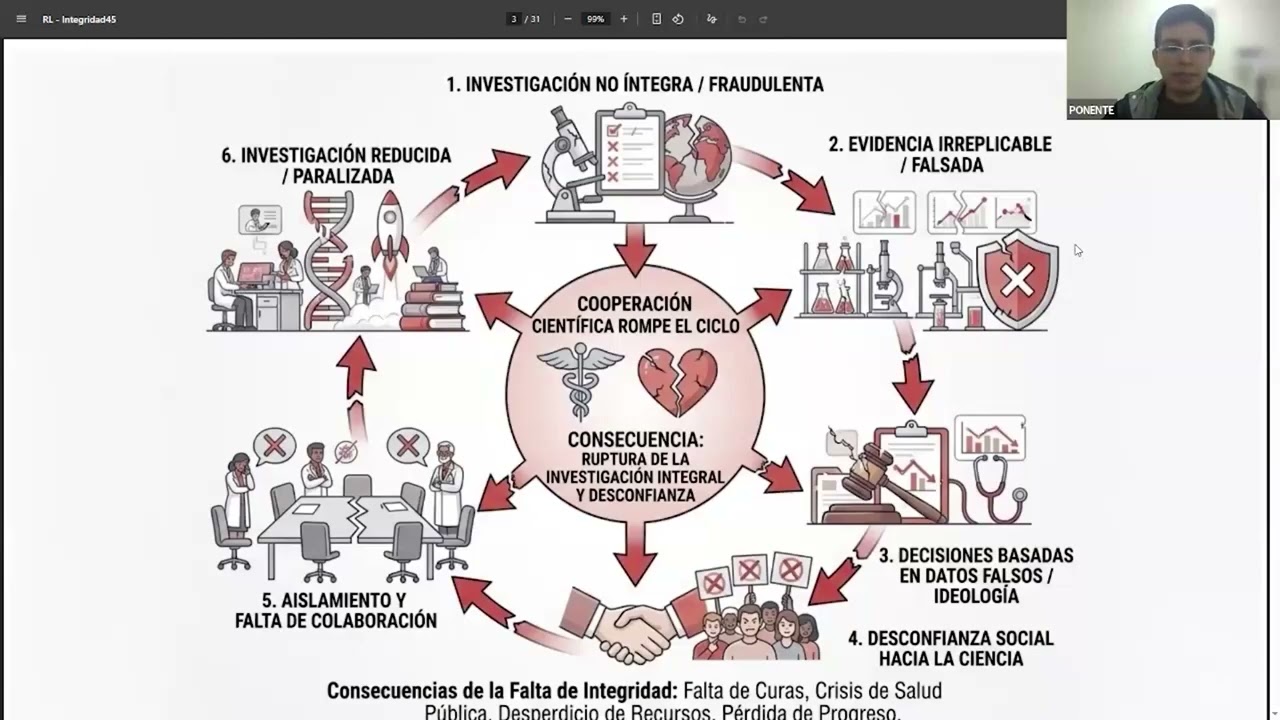
- Explanation of the trust cycle between science and society and the importance of evidence-based medicine
- Distinction between honest errors, questionable scientific practices, and deliberate misconduct
- Definition of fabrication with examples of inventing data or participants
- Discussion of falsification, including manipulating real data and deleting observations without justification
- Elaboration on plagiarism and the role of Turnitin as a similarity checker
- Final recommendations for transparency and ethical compliance in research
Cited Sources
- Turnitin — Mentioned as a similarity detection tool, not a plagiarism detector, to clarify its use in academic writing.
Contribution & Novelties
The video’s original contribution lies in its pedagogical clarity: it takes standard concepts of research ethics and translates them into accessible examples tailored to a clinical research audience. It effectively corrects the common misconception that Turnitin detects plagiarism, emphasizing that it only measures textual similarity. The presentation also highlights the importance of pre-specifying analyses and obtaining ethics committee approval for methodological changes, which is often overlooked in practice. Overall, it serves as a practical reminder of ethical responsibilities in research.
Pour aller plus loin :
- Committee on Publication Ethics (COPE) — Official site providing guidelines and resources for research and publication ethics.
- Office of Research Integrity (ORI) — U.S. government body defining research misconduct standards and case studies.
- Research integrity (Wikipedia) — General overview of the concept and related practices.
- Reproducibility (Wikipedia) — Key aspect of reliable research, directly connected to the talk’s emphasis on transparency.
146 words
Radar Profile
The radar profile shows a balanced content with high scores in information quantity and quality, moderate technical depth, and strong reliability. The emphasis on clarity and structure makes it a valuable tutorial, though the lack of explicit references slightly reduces the methodical rigor compared to formal scientific literature.