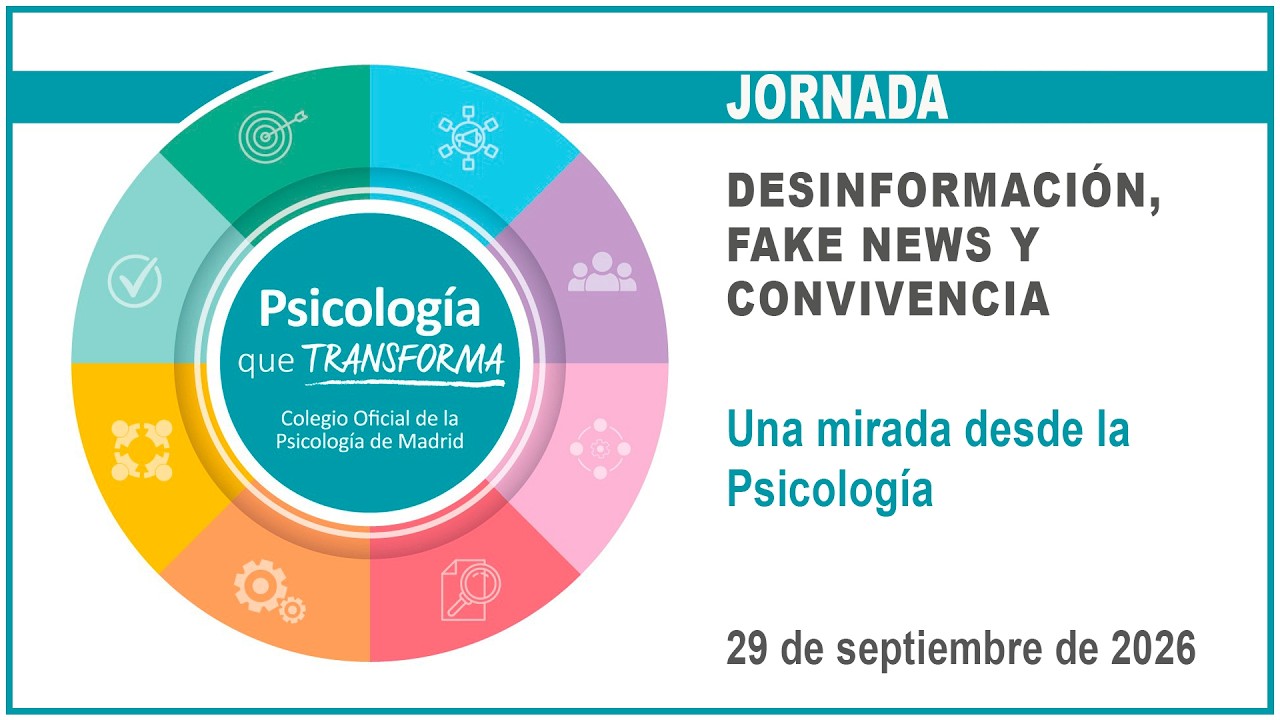
Psicología que transforma. Jornada Desinformación fake news y convivencia 29-09-26
Psychology that Transforms. Conference on Disinformation, Fake News, and Coexistence 09/29/26
Title history
- Psicología que transforma. Jornada Desinformación fake news y convivencia 29-09-26 — observed on 20261025-1525 UTC (YouTube)
Keywords
Summary
210 words
Critical Evaluation
Value of the Information & Strength of the Argument
The conference provides substantial value by combining journalistic and psychological perspectives on disinformation. The speaker Carla Pina offers a rich and well-illustrated analysis of disinformation phenomena, with concrete examples (Brexit banana hoax, migrant narratives, the Italy pool story) and references data from the Reuters Institute, which adds credibility. The argumentation is coherent and persuasive, highlighting psychological mechanisms and economic incentives behind disinformation production. The second lecture by Rocío Lana offers a more academic and intervention-oriented perspective, though its content is less detailed in the transcription, which gives slightly less argumentative weight. Overall, the discourse is well-structured and based on professional experience and cited data.
Scientific Rigor, Source Quality, Title Accuracy
The scientific rigor is generally good. The speakers are professionals in their fields (journalism, psychology academia) and rely on recognized entities such as Infoveritas, Reuters Institute, and Complutense University. The sources cited are mostly credible, although no direct academic references are explicitly listed in the description. The title of the video is well aligned with the content, which addresses the impact of disinformation on coexistence from a psychological perspective. The analysis does not claim to be an exhaustive scientific study but rather a professional reflection. In the absence of provided comments, no public tendencies are assessed.
215 words
Title / Content Match
The title accurately reflects the content: a psychology-focused conference on disinformation and fake news and their impact on coexistence.
Quality & Reliability
8/10
Conference featuring qualified professionals (journalist from Infoveritas, university psychology researchers) with data from official sources like Reuters Institute. Rigorous approach, though some arguments are based on professional experience rather than systematic studies.
Key Moments
Markers derived by PSI from the transcript: the creator did not define chapters.
- Inauguration and presentation of the conference by Noelia Morán (Psychology and Coexistence) and Lucía Halty (AI and Innovation).
- Start of the lecture 'Democracy under the algorithm: how hoaxes damage coexistence' by journalist Carla Pina García (Infoveritas). Examples of disinformation during Brexit and narratives about migrants.
- Analysis of the ingredients of disinformation: clickbait, emotional appeal, uncertainty, and opportunity windows.
- The economic motivations behind disinformation production and the problem of verification time and resources.
- Impact of social media algorithms: attention economy, echo chambers, polarization, and the role of AI in spreading disinformation.
- Start of the lecture 'Psychosocial intervention proposals in contexts of disinformation and fake news' by Rocío Lana Blond (Complutense University).
- Closing remarks by Timanfaya Hernández Martínez, Dean of the College of Psychology of Madrid.
Cited Sources
- Infoveritas — Mentioned as the platform for verifying hoaxes where the speaker works.
- Reuters Institute Digital News Report — Data on the percentage of people using social media for information and the percentage receiving personalized news.
Concurring Sources
- Infoveritas — Platform for debunking hoaxes, cited as reference for disinformation examples.
- Reuters Institute Digital News Report — International research on news consumption and trust, providing statistical backing for claims about social media and news avoidance.
Contribution & Novelties
The conference’s novelty lies in its interdisciplinary approach, combining psychology, journalism, and artificial intelligence to address disinformation, with a focus on coexistence. It offers both a descriptive analysis of the phenomenon and intervention proposals, providing a bridge between academic knowledge and practical action. The emphasis on psychosocial interventions is a contribution to the field of applied social psychology.
Pour aller plus loin:
- Cognitive biases in disinformation — Overview of cognitive biases that make individuals vulnerable to false information.
- Echo chamber (media) — Concept of filter bubbles and their role in polarization.
- Media literacy — Educational approaches to critical consumption of information.
101 words
Radar Profile
The radar profile shows high scores in information quality and reliability, reflecting the professional credibility and data citing. The quantity of information is moderate, as the conference covers both general and specific aspects. The technical level is relatively accessible, indicating a public-oriented event rather than a highly specialized academic thesis.