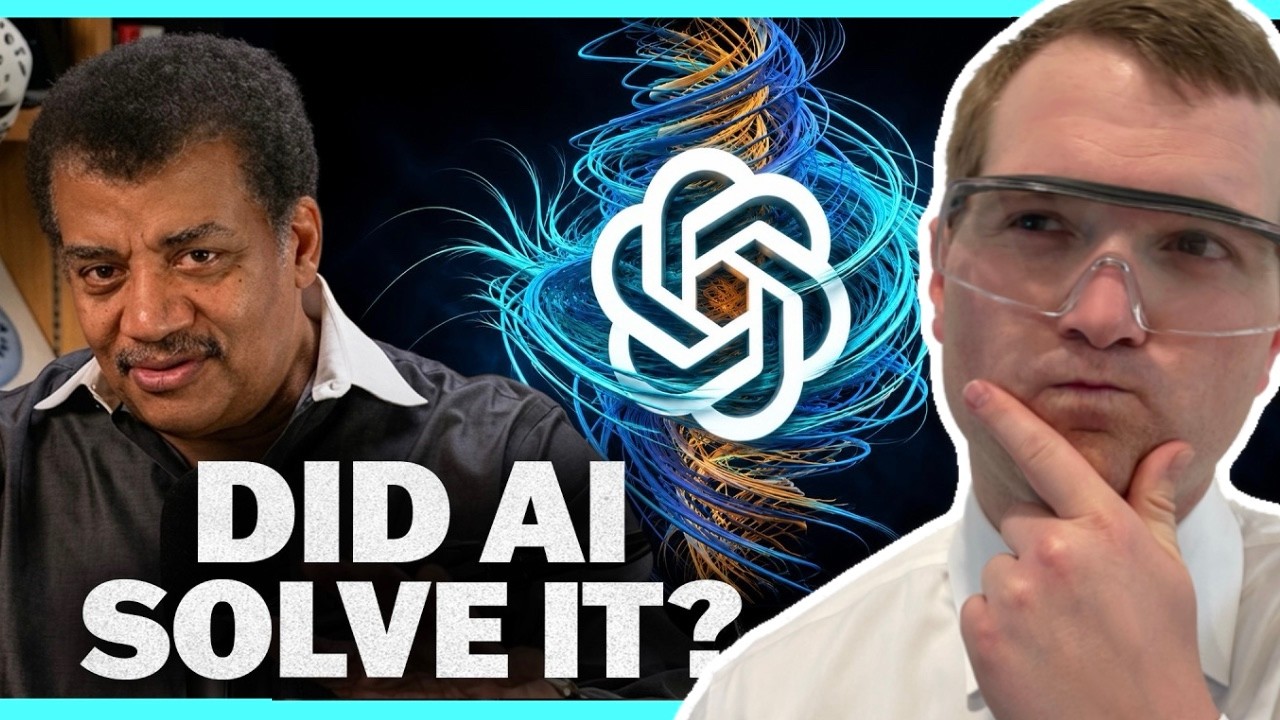
Did AI Solve One of Math's Hardest Problems? - Nuclear Engineer Reacts to Startalk
Keywords
Summary
152 words
Critical Evaluation
Value of the Information & Strength of the Argument
The video provides substantial value by clarifying misconceptions about the Navier-Stokes equations, explaining why ‘solving’ them is about proving smoothness and existence, and highlighting the nature of the AI proof’s verification. Tyler’s engineering background enriches the discussion with practical applications, such as turbulence management in reactor cooling and the philosophy of using approximations. His argumentation is coherent, drawing analogies between mathematical proofs and software validation in nuclear plants, and he carefully weighs the credibility of the AI result. The commentary is insightful and accessible, though it remains secondary to the original StarTalk content.
Scientific Rigor, Source Quality, Title Accuracy
The video relies primarily on the StarTalk source and the guest expert’s statements, with Tyler adding his own expertise. He does not provide external citations beyond the linked video, but his explanations align with known physics and mathematics. The title accurately sets expectations for a reaction format. The adequacy between title and content is strong, as the video directly addresses the question posed. The source quality is moderate, being an opinion-based reaction, but Tyler’s background lends authority to his explanations.
188 words
Title / Content Match
The title accurately reflects the video's content: a nuclear engineer reacts to StarTalk's discussion on whether AI solved the Navier-Stokes equations.
Quality & Reliability
7/10
The reaction video offers an expert engineer's perspective on the Navier-Stokes problem, clearly explaining key concepts and the controversy around the AI proof. However, it relies on a single source (StarTalk) and contains some personal opinions and approximations.
Key Moments
Markers derived by PSI from the transcript: the creator did not define chapters.
- Introduction: Tyler presents the question 'Did AI solve one of math's hardest problems?' and introduces the StarTalk video.
- Explanation of Navier-Stokes equations and their role in engineering, including nuclear reactor applications.
- Discussion on turbulence, including the golf ball dimple analogy and deliberate manipulation of boundary layers.
- Introduction of the Millennium Prize problem and what 'solving' Navier-Stokes actually means: proving smoothness and existence.
- Details on the OpenAI announcement, the use of Lean proof assistant, and the controversy over credit and verification.
- Tyler reflects on engineering education, weed-out courses, and the broader implications of AI in mathematics and nuclear plant software validation.
Cited Sources
- Original StarTalk video — The video Tyler is reacting to, featuring astrophysicist Mordecai Mark Mac Low discussing Navier-Stokes and the AI proof.
Concurring Sources
- StarTalk original video — The original source provides the context and expert commentary that Tyler reacts to, serving as a concordant source for the main claims.
Contribution & Novelties
This reaction video brings a unique engineering perspective to the AI Navier-Stokes controversy, connecting the mathematical problem to practical nuclear engineering applications. Tyler’s explanation of turbulence and its role in reactor design offers an original angle. He also emphasizes the importance of formal verification and the challenges of AI-generated proofs.
Pour aller plus loin :
- Navier–Stokes existence and smoothness — The exact Millennium Prize problem discussed.
- Lean (proof assistant) — The formal verification language used in the AI proof.
- Millennium Prize Problems — Background on the seven unsolved problems.
- Turbulence — The physical phenomenon central to the discussion.
98 words
Radar Profile
The scores indicate a balanced profile: high information quantity but slightly lower reliability due to opinion-based nature. Technical level is moderate, making it accessible to a general audience while keeping depth.
💬 Sur les 30 commentaires analysés, le climat est très positif, les spectateurs apprécient la clarté des explications et la façon dont Tyler rend la physique et les mathématiques accessibles. Plusieurs commentaires saluent sa manipulation de concepts complexes et son humour, avec une minorité évoquant la nostalgie de son intro.