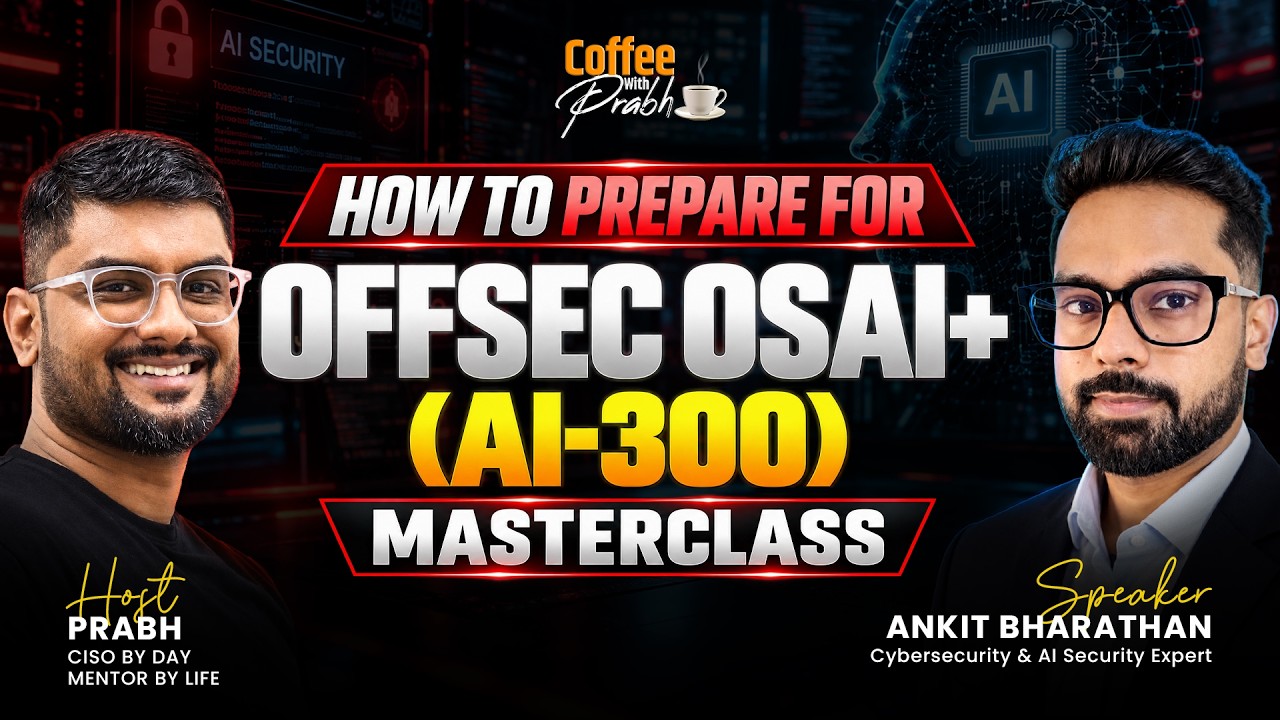
How to Prepare for OffSec AI-300 AI Red Teaming
Keywords
Summary
157 words
Critical Evaluation
Value of the Information & Strength of the Argument
The information is highly practical, offering concrete steps for preparing for the AI-300 certification, such as creating a local AI environment and studying OWASP LLM Top 10. The argumentation is based on real experience, making it credible for practitioners. However, some advice, like the importance of soft skills for hiring, is subjective and may vary across companies. The discussion effectively justifies the need for both traditional pentesting skills and AI-specific knowledge, providing a balanced perspective.
Scientific Rigor, Source Quality, Title Accuracy
The sources cited are authoritative: MITRE ATLAS, OWASP Top 10 for LLM, and Microsoft’s AI Red Teaming Playground Labs. These are referenced directly in the description, lending credibility. The title is accurate and matches the content, which is a focused guide on preparing for the AI-300 exam. The video is not a peer-reviewed study but an expert opinion, and its reliability is reasonable given the alignment with recognized frameworks. No contradictory or weak sources were identified.
166 words
Title / Content Match
The title accurately reflects the content, which focuses on preparation strategies for the OffSec AI-300 certification, including prerequisites, study roadmap, and exam execution.
Quality & Reliability
7/10
The content is based on the personal experience of an experienced professional and is aligned with recognized frameworks (OWASP, MITRE ATLAS). However, it is primarily anecdotal and lacks peer-reviewed or empirical evidence, limiting its objectivity.
Chapters
- 01:07 – Highlights
- 02:50 - Introduction, Guest welcome, hir credentials and Agenda
- 4:25 - Career Journey & General Cyber Security Background
- 06:48 - Job Market Dynamics & Entry-Level Hiring
- 12:50 - Employer Perspective on Shortlisting CVs & Practical Skills
- 16:00 - Overview of the OffSec AI-300 certification
- 23:17 - Prerequisites & Zero-to-100 Learning Path
- 26:01 - Core AI Security Topics
- 35:00 - Prerequisite Skills, Preparation Pitfalls, Topic Division & Challenges
- 38:47 - 60-Day Structured Study Roadmap
- 41:35 - OSCP vs. OSAI Comparison
- 45:25 - 24-Hour Exam Execution & Strategy
- 46:30 - End of the conversation by thanking Ankit Bharathan and key takeaway and looking forward to doing more Podcast
Cited Sources
- MITRE ATLAS — Referenced as a comprehensive framework for AI-related adversarial tactics and techniques, useful for threat modeling.
- Microsoft AI Red-Teaming Playground Labs — Recommended as a practical resource for hands-on AI security labs.
- OWASP Top 10 for Large Language Model Applications — Cited as a key guide for understanding vulnerabilities specific to LLM-based systems.
- Ankit Bharathan's LinkedIn Profile — Guest's professional profile, providing context on his background and credibility.
Concurring Sources
- MITRE ATLAS — Aligns with the video's emphasis on threat modeling and structured attack patterns.
- OWASP Top 10 for LLM Applications — Supports the discussion of typical AI vulnerabilities and the need for systematic testing.
Contribution & Novelties
The video provides a unique perspective from a recent exam taker, offering a realistic roadmap that combines traditional pentesting with AI-specific knowledge. It emphasizes the importance of building one’s own AI lab and understanding the underlying components (RAG, embeddings, agents) rather than just memorizing attack vectors. This practical approach is not commonly found in official documentation.
Pour aller plus loin :
- MITRE ATLAS — A comprehensive knowledge base of tactics and techniques for AI systems, essential for in-depth threat modeling.
- OWASP Top 10 for LLM Applications — A must-read for identifying common vulnerabilities and test cases in LLM-based applications.
- Microsoft AI Red-Teaming Playground Labs — Practical hands-on environment for honing AI red teaming skills in a controlled setting.
118 words
Radar Profile
The radar profile shows a balanced distribution across scores, with information quantity and reliability being moderately high, while technical depth and overall quality are slightly lower. This indicates a useful but not exhaustive guide, suitable for those seeking an overview and practical advice rather than in-depth technical analysis.