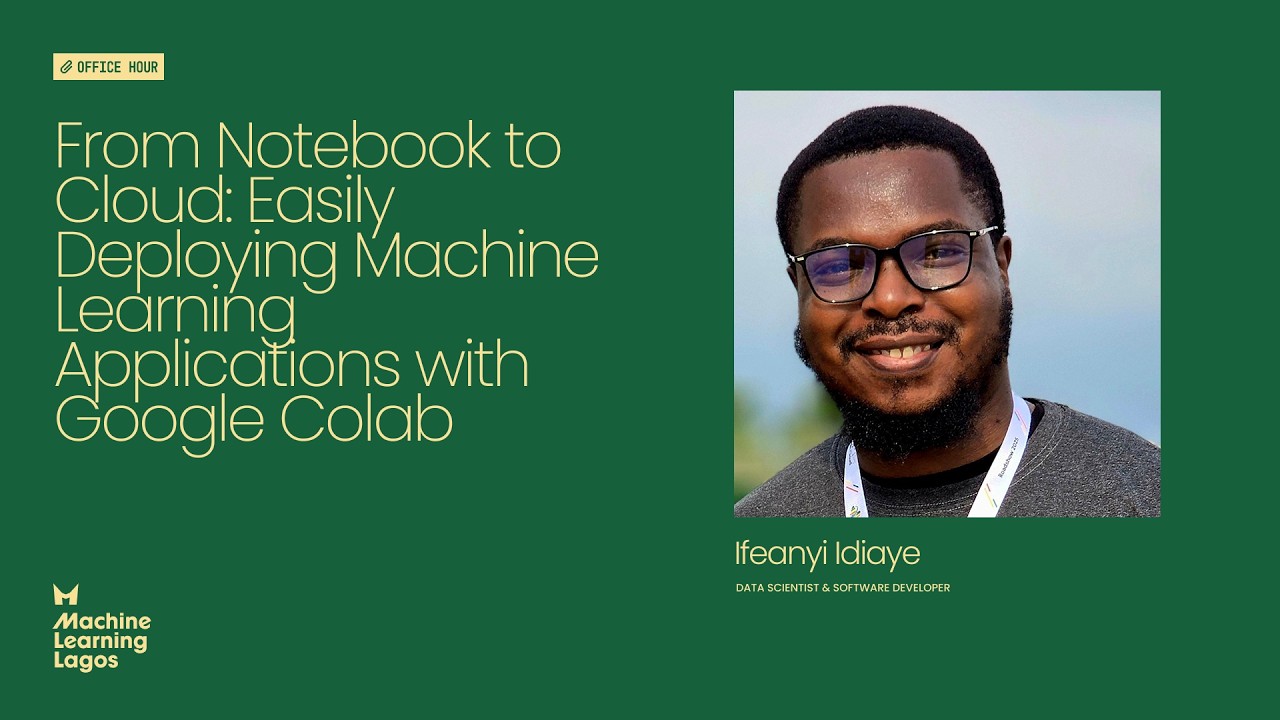
From Notebook to Cloud: Easily Deploying Machine Learning Applications with Google Colab
Keywords
Summary
139 words
Critical Evaluation
Value of the Information & Strength of the Argument
The video provides clear, actionable steps for deploying ML apps, emphasizing the simplicity and speed of the Colab-Gradio integration. The argumentation is based on a live demo, which solidifies the claims about one-click deployment and automatic scaling. However, the video does not delve into advanced topics such as security, custom containers, or complex deployment scenarios, limiting its value to simple use cases. The presenter’s credibility as a Google Developer Expert (GDE) in AI adds trustworthiness to the content, but the absence of cost analysis or comparison with other deployment methods weakens the scientific depth.
Scientific Rigor, Source Quality, Title Accuracy
The video does not cite external academic sources but relies on official tools (Gradio, Cloud Run) and the UCI repository, which are reputable. The title accurately reflects the content, as the video specifically covers moving from notebook to cloud deployment. The presentation is methodical and the demo is reproducible, which enhances its reliability. However, the lack of supporting documentation or references may be a drawback for users seeking deeper understanding. The content is up-to-date as of the publication date, but users should verify the latest documentation for any changes.
198 words
Title / Content Match
The title exactly matches the content: the video demonstrates how to deploy a machine learning application from a Google Colab notebook to the cloud using Gradio and Google Cloud Run.
Quality & Reliability
7/10
The video provides a clear, practical demo of deploying a machine learning app via Colab and Gradio to Cloud Run. The claims about Cloud Run's auto-scaling and cost efficiency are accurate and align with official documentation. However, the absence of any external citation of sources (only tool references) and the simple toy example limit its depth. The presenter, a Google Developer Expert, adds credibility, but the video lacks reproducibility notes and advanced considerations.
Key Moments
Markers derived by PSI from the transcript: the creator did not define chapters.
- Introduction to the session and ground rules.
- Starting the notebook: installing libraries and loading Iris dataset from UCI.
- Preprocessing the data and training a Random Forest classifier.
- Building the Gradio interface with sliders and a prediction function.
- Deploying the Gradio app to Google Cloud Run via the 'Deploy to Cloud Run' button.
- Demonstrating the live app on Cloud Run and making predictions.
- Showing Cloud Run dashboard and discussing cleanup to avoid costs.
Contribution & Novelties
This video brings a straightforward, practical recipe for deploying ML models using the native integration between Google Colab and Gradio, reducing the typical friction of containerization. It demonstrates a concrete one-click deployment to Cloud Run, a serverless platform, which is a convenient alternative to managing Docker files. The video also highlights the cost-effective pay-per-use model of Cloud Run and the automatic scaling features, which are valuable for developers and data scientists.
Pour aller plus loin :
- Gradio Documentation — Official documentation for building and deploying web interfaces for ML models, covering advanced customization and sharing options.
- Google Cloud Run Overview — Comprehensive guide to Cloud Run’s serverless container platform, including scaling, pricing, and best practices.
- Random Forest on Wikipedia — Detailed explanation of the random forest algorithm used in the demo, including its mathematical basis and applications.
- UCI Machine Learning Repository — Access to the Iris dataset and other classic datasets for machine learning practice.
155 words
Radar Profile
The radar profile shows moderate scores across all dimensions, with a slight peak in quality and reliability relative to quantity and technical depth. This reflects a tutorial that is solid in its practical demonstration but limited in extensive information coverage and advanced analysis.