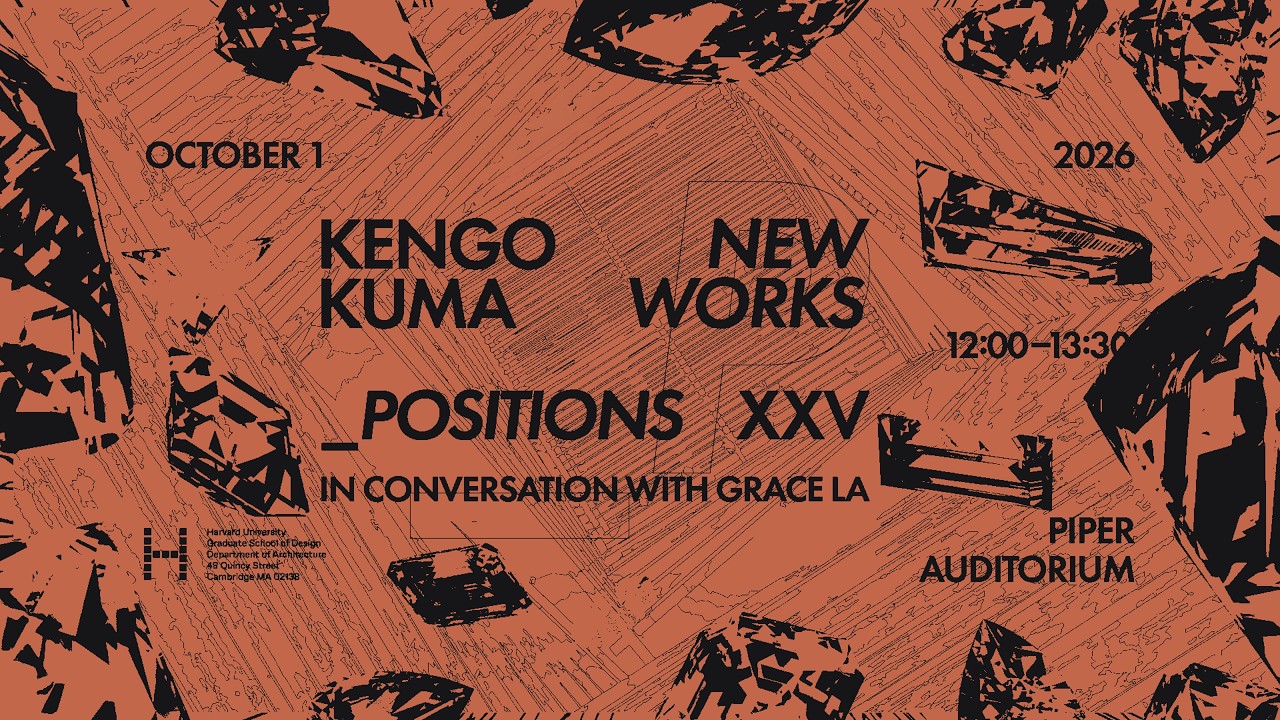
_positions XXV: Kengo Kuma: New Works
Title history
- _positions XXV: Kengo Kuma: New Works — observed on 20261016-0202 UTC (PSI archive)
Keywords
Summary
164 words
Critical Evaluation
Value of the Information & Strength of the Argument
The value of this discussion lies in the architect’s first-hand account of his design philosophy and project narratives. Kuma articulates his concept of ‘particles’ as a mathematical understanding of context, and argues that architecture should aim for intimacy and a dialogue with its surroundings. His argumentation is coherent and grounded in concrete examples, such as the stadium’s use of 4-inch wood members to recreate a human scale. He also explains the rationale behind the book’s thematic organization, which prioritizes human experiences over formal typologies. However, the argumentation is anecdotal and subjective, lacking measurable data or systematic analysis, which is typical for a designer’s talk but limits its empirical rigor.
Scientific Rigor, Source Quality, Title Accuracy
The content is presented by the creator of the work, making it a primary source. The book ‘Kengo Kuma: New Works’ (Thames & Hudson) is referenced extensively, and a second book ‘Kengo Kuma: Complete Works’ is mentioned. The title of the video correctly identifies the event as part of the ‘positions’ series and the subject of the talk. The discussion is informal but grounded in a professional context; no external sources are cited beyond the architect’s own publications and a few historical references (e.g., Maki Fumihiko, Zaha Hadid). There are no comments provided here, so no public reaction is assessed.
224 words
Title / Content Match
The title accurately reflects the event: a lecture series installment focusing on Kengo Kuma's new book and recent work.
Quality & Reliability
8/10
Primary source testimony from the architect himself, supplemented by a professor of architecture; the discussion is based on a published monograph and tangible projects, though subjective in nature.
Key Moments
Markers derived by PSI from the transcript: the creator did not define chapters.
- Grace La introduces the event and the book release.
- Kuma explains why the cover image is of Kōjoin Temple, his childhood playground.
- Kuma discusses the book's organization around themes of human experience.
- Discussion of the Asakusa project and the concept of 'particles'.
- Kuma recounts the Japan National Stadium competition and the protest against Zaha Hadid's design.
- Kuma describes the 'breathing' of the stadium and the importance of 4-inch wood members.
- The Hunan Museum of Art: its form echoes the mountain, and its small elements create shadows.
- The sake brewery project, blending champagne-making expertise with traditional Japanese sake.
Cited Sources
- Kengo Kuma: New Works — The monograph being celebrated; authored by Kengo Kuma, published by Thames & Hudson.
- Kengo Kuma: Complete Works — The earlier monograph referenced as a follow-up.
Contribution & Novelties
The video offers a rare direct insight into Kengo Kuma’s design reasoning, especially his notion of ‘particles’ that mediate between a building and its context. It also highlights the shift in his book’s organization from formal properties to lived experiences, which is a novel curatorial decision in architectural monographs. The account of the Japan National Stadium competition reveals the political and practical challenges behind a major project.
Pour aller plus loin :
- Kengo Kuma wikipedia — Overview of the architect’s career and key projects.
- Japan National Stadium wikipedia — Details on the stadium’s design and construction.
- Particle concept — General concept of particles as a metaphor for small-scale elements in architecture.
111 words
Radar Profile
The profile shows high-quality information and reliability, with moderate quantity and technical depth, reflecting a focused expert conversation rather than a dense data-driven lecture.