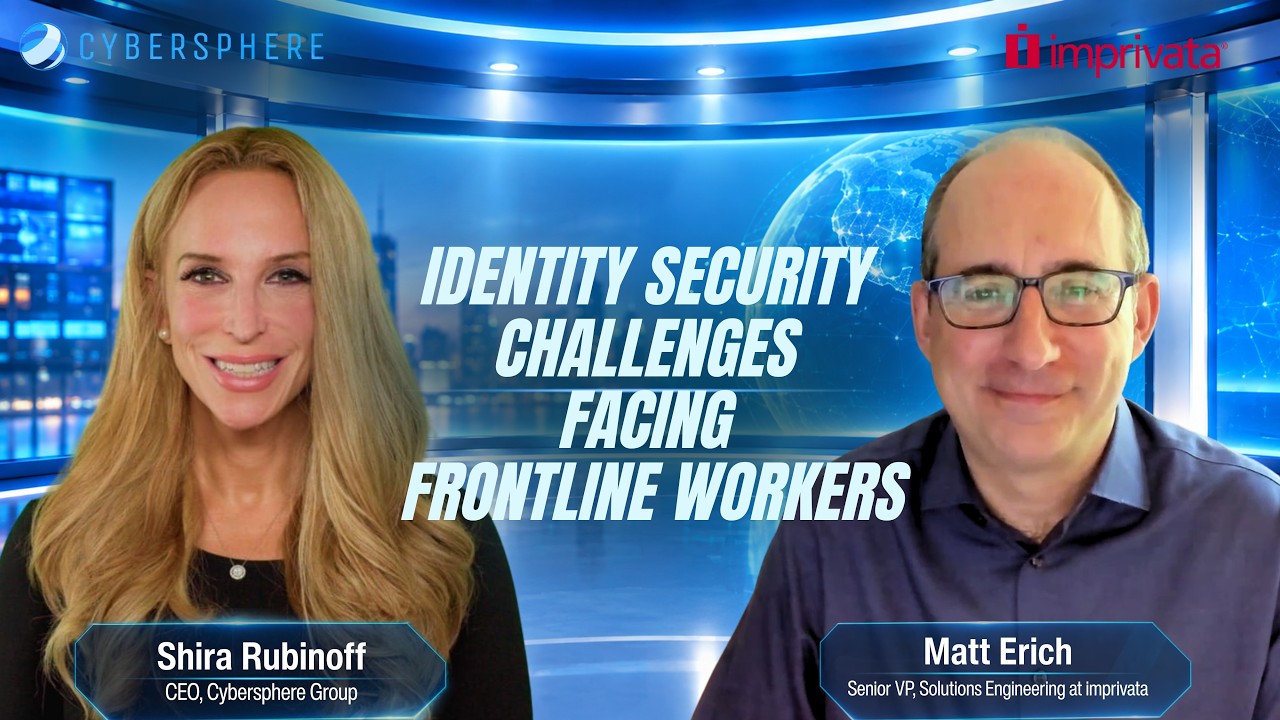
Authentication Challenges for Frontline Workers in Mission-Critical Industries
Keywords
Summary
167 words
Critical Evaluation
Value of the Information & Strength of the Argument
The value of this video lies in its focused attention on a niche but critical segment of identity security: frontline workers. Unlike typical office-worker scenarios, the discussion brings to light the operational realities of shared devices, rapid user switching, and time-sensitive tasks. The argumentation is coherent and grounded in practical examples, such as nurses in emergency rooms and manufacturing workers. The interviewee effectively illustrates why standard authentication mechanisms fail in these contexts and proposes pragmatic solutions like frictionless front doors and SSO. However, the argument relies heavily on anecdotal evidence and does not provide quantitative data or case studies. The reasoning is sound, but the lack of empirical backing limits its persuasive strength. The dialogue also touches on human factors and workaround behavior, which is important but not deeply explored.
Scientific Rigor, Source Quality, Title Accuracy
The rigor is moderate. The conversation cites a joint report between Imprivata and Ponemon Institute (though the name is mispronounced in the transcript) and references the ebook provided in the description. The title fully aligns with the content. However, the discussion is primarily an informal expert opinion without formal citations or references to specific studies. The video does not provide any data points or statistics, which reduces its scientific rigor. The source quality is acceptable as it comes from a recognized vendor (Imprivata), but it is promotional in nature. The title is accurate and does not overpromise. There is no public discussion or comments provided, so audience reception cannot be assessed.
256 words
Title / Content Match
The title accurately reflects the content, which specifically addresses authentication challenges for frontline workers in critical industries, as discussed in the interview.
Quality & Reliability
6/10
The discussion provides practical insights from a senior solutions engineer, but it is largely anecdotal and based on personal observations rather than empirical data. The focus on real-world workplace friction adds credibility, yet no statistical evidence or formal studies are referenced, making it moderately reliable.
Key Moments
Markers derived by PSI from the transcript: the creator did not define chapters.
- Introduction of topic and guest, Matt Eric from Imprivata.
- Definition of frontline workers and examples: nurses, manufacturing, law enforcement.
- Discussion on passwords: complexity leads to friction and workarounds.
- Challenges with MFA: device portability, coverage, gloves, and impractical prompts.
- Passkeys are device-bound and confusing, not ideal for shift workers.
- Workarounds like leaving workstations open and sharing identities lead to security vulnerabilities.
- Strategic advice: observe frontline workflows and design authentication alongside workers.
- Bridging legacy systems: frictionless front door and single sign-on for legacy applications.
- Conclusion emphasizing human-centered security design.
Cited Sources
- Frontline Friction: The State of Authentication for Frontline Workers — Ebook referenced in the video description and discussed as the basis for the conversation.
Concurring Sources
- Frontline Friction: The State of Authentication for Frontline Workers — The ebook aligns with the interview's claims about authentication challenges for frontline workers.
Contribution & Novelties
This video sheds light on an often-overlooked segment of identity security—frontline workers—by contrasting their authentication needs with typical office workers. It emphasizes the concept of ‘friction’ as a driver of security workarounds, which is a valuable perspective for CISO and security professionals. The discussion provides practical, human-centered design principles, such as observing real workflows and implementing a ‘frictionless front door’ plus SSO for legacy systems. However, the content is largely qualitative and does not introduce new technical concepts—the novelty lies in the application to a specific use case.
Pour aller plus loin :
- FIDO Alliance: How Passkeys Work — Provides technical details on passkey standards and their limitations in shared-device environments.
- NIST Special Publication 800-63B: Digital Identity Guidelines — Official guidelines for authentication, including considerations for various contexts.
- Ponemon Institute Research — Source of the joint report mentioned in the video, offering data-backed insights on security friction.
147 words
Radar Profile
The profile shows balanced scores across all dimensions, indicating a moderately informative and credible video with limited quantitative depth. The highest scores are in technical level and information quality, reflecting the expert's practical knowledge, while the lower scores on quantity and reliability suggest a lack of extensive data or formal research backing.