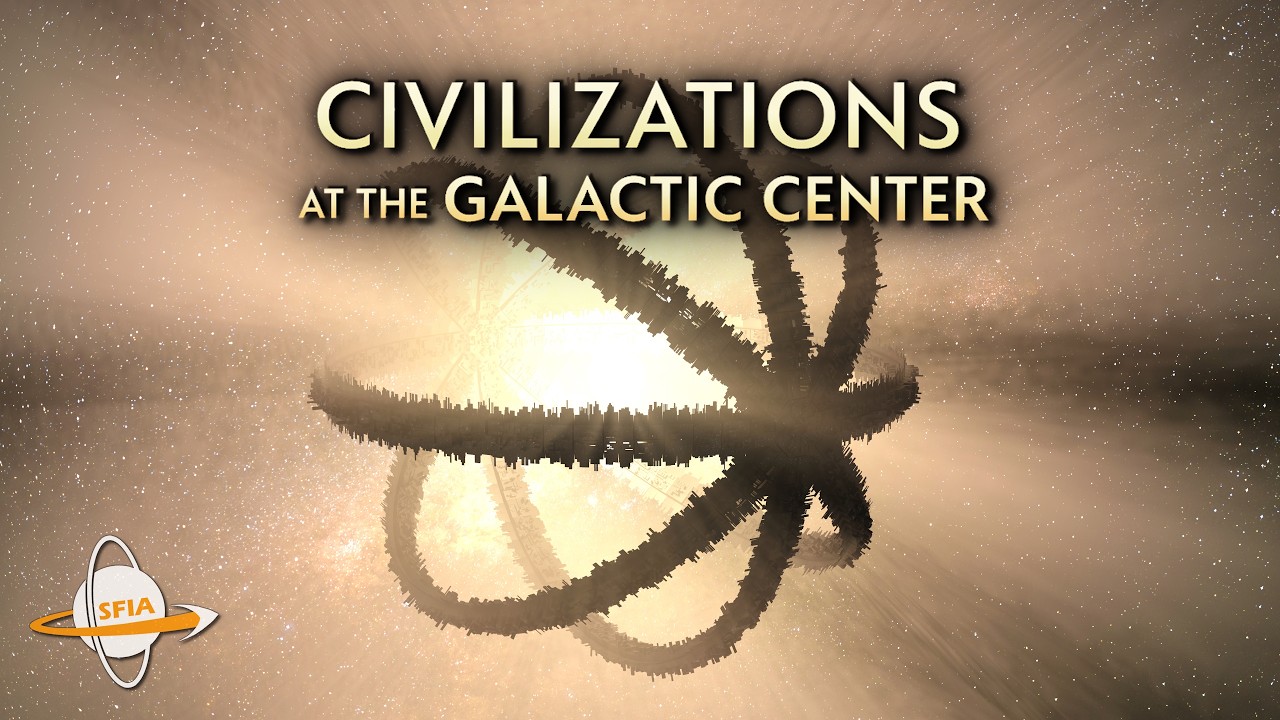
Civilizations at the Galactic Center: Thriving in the most extreme energy fields of the Milky Way
Title history
- Civilizations at the Galactic Center: Thriving in the most extreme energy fields of the Milky Way — observed on 20261016-0248 UTC (PSI archive)
Keywords
Summary
140 words
Critical Evaluation
Value of the Information & Strength of the Argument
The video provides a compelling and well-argued case for the galactic center as a future habitation zone, balancing scientific plausibility with bold speculative thinking. It systematically addresses potential objections—radiation, orbital instability—and counters them with practical engineering solutions such as subsurface habitats and dense megastructure networks. The argumentation is coherent, building from the astronomical context to the strategic advantages, and culminates in the concept of Birch Planets as ultimate structures. The value lies in its interdisciplinary synthesis of astrophysics, engineering, and futurism, offering fresh perspectives on long-term civilization survival and the fermi paradox.
Scientific Rigor, Source Quality, Title Accuracy
The scientific rigor is reasonably high for a popular science communication: Isaac Arthur references established astronomical concepts (e.g., stellar densities, supermassive black holes) and mentions specific phenomena like hypervelocity stars. However, the sources cited are primarily his own website and social media links, with no direct external research citations within the video itself. The title accurately reflects the content, focusing on the galactic center’s potential for civilization, and the video stays on-topic throughout. No significant discrepancies between title and body were observed.
189 words
Title / Content Match
The title accurately reflects the content, which explores the feasibility and potential advantages of civilizations in the galactic center, including the challenges and proposed megastructures.
Quality & Reliability
7/10
Well-structured and scientifically grounded speculative content, but relies on extrapolations and hypothetical scenarios. The presenter has a background in physics and science fiction, providing a credible narrative, yet many ideas remain theoretical and lack empirical verification.
Chapters
Cited Sources
- Isaac Arthur Website — Official website of the content creator, providing additional resources and episodes.
- Nebula Subscription — Affiliate link offering a discount to the streaming platform Nebula, where Isaac Arthur posts extended content.
- Space Industry Collection — A curated collection of episodes on space industry topics, promoted in the video.
- IsaacArthur Reddit Community — Community forum for discussion and fan engagement.
- Subscribestar — Crowdfunding platform supporting Isaac Arthur's content creation.
Contribution & Novelties
The video stands out for its detailed integration of astrophysical data with megastructure engineering concepts, presenting a unified vision of civilization at the galactic core. It goes beyond simple Dyson spheres to propose a dense network of swarms and Birch Planets, emphasizing the strategic benefits of reduced light-lag and centrality. The original contribution lies in framing the galactic center not as a death zone but as prime real estate for a converging civilization, and in introducing the idea of relocating Earth to maintain influence.
Pour aller plus loin :
- Galactic Center — Provides foundational astronomical facts about the region, including stellar density and the central black hole.
- Dyson sphere — Classic concept of stellar megastructures, expanded into swarms in the video.
- Birch planet — Theoretical shell worlds around black holes, central to the concluding part of the video.
- Kardashev scale — Energy consumption levels relevant to Type III civilizations mentioned in the video.
- Hypervelocity star — Actual phenomenon discussed as evidence of the core’s chaotic dynamics.
166 words
Radar Profile
The radar profile shows strong scores in information quantity and quality, with a moderate technical level and reliability. This indicates a rich, well-informed discussion that is technically accessible yet grounded in current understanding, though the speculative nature slightly lowers the reliability score.