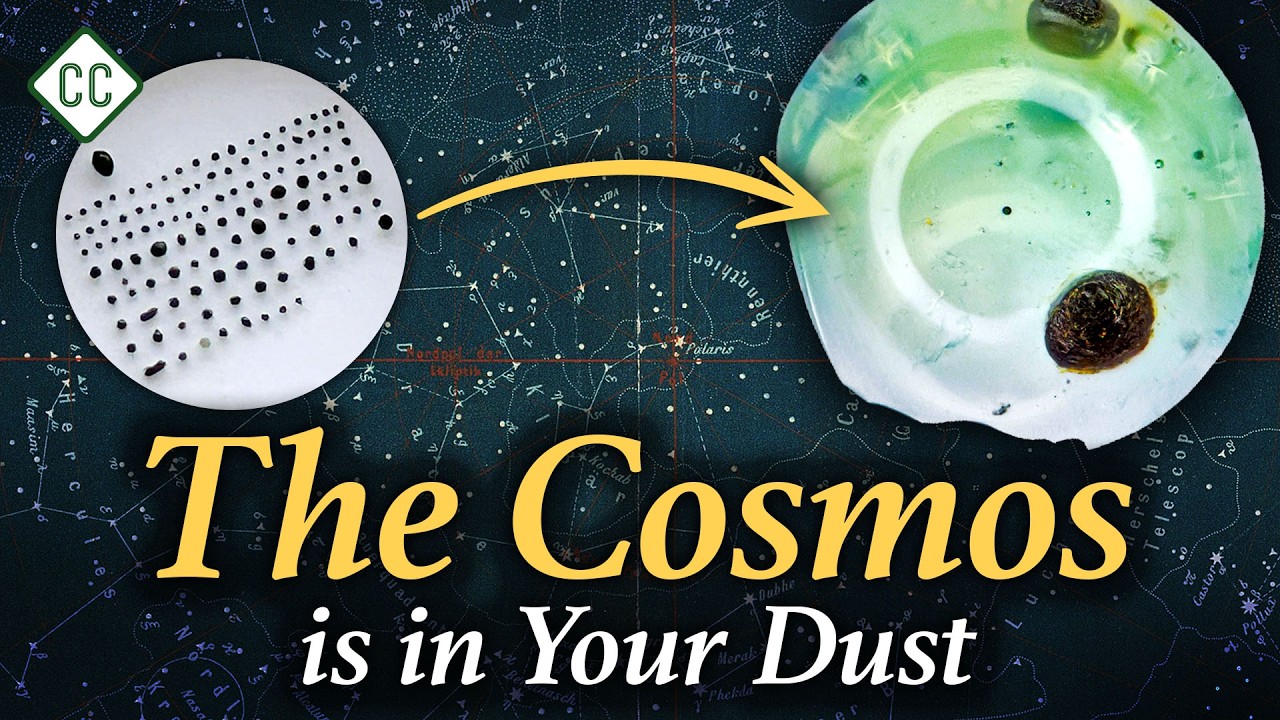
The Quest for Stardust: Crash Course Lecture
Title history
- The Quest for Stardust: Crash Course Lecture — observed on 20261105-1852 UTC (YouTube)
Keywords
Summary
167 words
Critical Evaluation
Value of the Information & Strength of the Argument
The video provides substantial value by presenting a compelling case study in citizen science, demonstrating that non-experts can contribute to scientific discovery. It argues that Larsen’s success challenges the assumption that micrometeorites are impossible to find in inhabited areas, and does so through documented evidence and expert validation. The argumentation is well-structured, presenting both the scientific background and the personal story, but it sometimes leans on anecdotal narrative rather than rigorous quantitative analysis. The inclusion of multiple hypotheses for the origin of life’s ingredients shows balanced reasoning, acknowledging uncertainties. The storytelling is engaging and effectively communicates complex concepts like the Poynting-Robertson drag and deuterium-hydrogen ratios, though these are explained at an accessible level.
Scientific Rigor, Source Quality, Title Accuracy
The video demonstrates scientific rigor by referencing established books (‘The Meteorite Hunters’ by Joshua Howgego and ‘Star Hunter’ by Jon Larsen) and providing a link to a Royal Society review paper on micrometeorite collections. It correctly distinguishes between established facts (e.g., Earth receives 4 tons of cosmic dust daily) and open questions (e.g., the exact delivery mechanisms of water). The title is fully aligned with the content, as the entire lecture focuses on the quest for stardust. The sources cited are credible and relevant, though the video does not cite all claims explicitly in-text, relying on the linked document for detailed references. The production quality of CrashCourse ensures clarity and educational value.
240 words
Title / Content Match
The title accurately reflects the content: the lecture narrates the quest to find micrometeorites (stardust) and its scientific significance.
Quality & Reliability
8/10
The video is produced by CrashCourse, a reputable educational channel, and bases its narrative on documented books and scientific sources, including a Royal Society review. It presents scientific consensus accurately and distinguishes between established knowledge and open questions.
Key Moments
Markers derived by PSI from the transcript: the creator did not define chapters.
- Introduction: Cosmic Messengers – overview of micrometeorites and their significance.
- Chapter 1: The Adventure Begins – Jon Larsen notices a speck on his breakfast table.
- Chapter 2: Stones Falling from the Sky – History of meteoritics, from ancient China to Edward Howard.
- Chapter 3: A Scientific Impossibility – Experts claim urban micrometeorites cannot be found; Jon begins his quest.
- Chapter 4: Life's Mysterious Origins – How micrometeorites may have delivered water and organic molecules to Earth.
- Chapter 5: The Crown Prince of Dust – Jon contacts expert Matthew Genge and builds a dust census.
- Chapter 6: A Dynamic Universe – Explanation of cosmic dust origins and the Poynting-Robertson effect.
- Chapter 7: Stardust in the City – Jon's rooftop gutter strategy and his 727th field search.
- Chapter 8: The Curious Amateur – Reflection on the value of curiosity and citizen science.
Cited Sources
- Crash Course Lecture Sources – Google Doc — Detailed source list for the lecture, including references to the books and scientific papers.
- A review of micrometeorite collections — Peer-reviewed article from Philosophical Transactions of the Royal Society A, providing scientific context for micrometeorite research.
Concurring Sources
- A review of micrometeorite collections — Supports the scientific context and provides up-to-date information on micrometeorite collection efforts.
External References
Contribution & Novelties
The video brings a novel narrative approach to science communication, highlighting an amateur’s significant contribution to meteoritics. It synthesizes historical and current knowledge about micrometeorites, emphasizing their role in understanding the solar system and life’s origins. The inclusion of Jon Larsen’s personal journey adds an engaging human element, demonstrating that scientific discovery can come from unconventional sources.
Pour aller plus loin :
- Micrometeorite — Detailed encyclopedia entry on micrometeorites, their characteristics, and collection methods.
- Poynting–Robertson effect — Explains the astrophysical mechanism that causes dust to spiral toward the Sun, as mentioned in the video.
- Carbonaceous chondrite — A type of meteorite rich in water and organics, relevant to discussion of life’s building blocks.
113 words
Radar Profile
The radar profile shows high information quantity and quality, with moderate technical depth. The fiabilite is high due to credible sources, while the overall assessment balances accessibility and scientific detail.