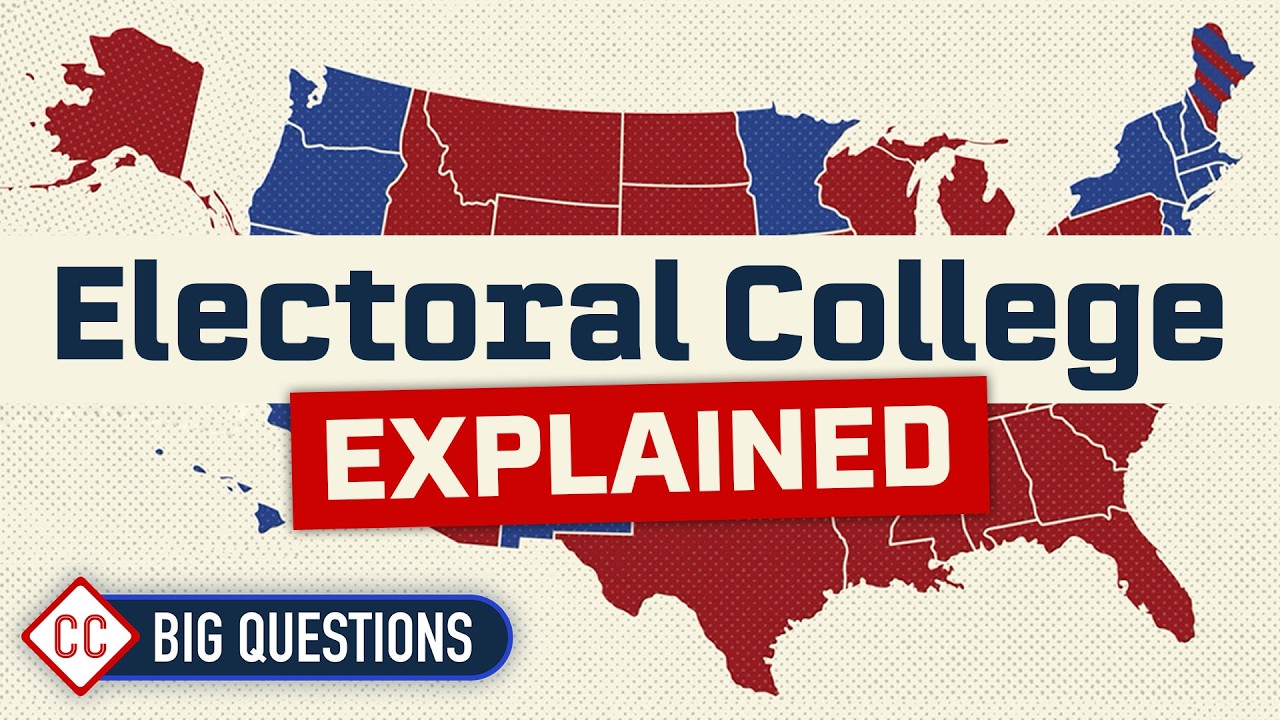
Is the Electoral College Broken?: Crash Course US Government #5
Keywords
Summary
191 words
Critical Evaluation
Value of the Information & Strength of the Argument
The video provides a balanced and thorough introduction to the Electoral College, covering its origins, mechanics, controversies, and proposed fixes. The argumentation is clear and logical, using concrete examples (Wyoming vs. California) to illustrate the disproportionate influence of smaller states. The discussion of the National Popular Vote Interstate Compact and the Electoral Count Reform Act demonstrates awareness of current debates. While the video maintains a neutral tone, it does not shy away from presenting the flaws and the historical compromise. The use of historical context and statistical illustrations strengthens the credibility of the information presented.
Scientific Rigor, Source Quality, Title Accuracy
The video is produced by an established educational channel and cites a Google Docs source document with further references. The partnership with USAFacts adds a non-partisan civic dimension, and the video explicitly directs viewers to supplementary resources. The title is accurately reflected in the content, as the episode directly addresses the question posed. The information is factually consistent with mainstream political science understanding, and the video acknowledges complexities such as faithless electors and constitutional challenges. No obvious bias was detected, though the framing leans toward a critical but fair assessment of the Electoral College.
204 words
Title / Content Match
The title directly prompts the question addressed in the video, and the content systematically explains the Electoral College, its controversies, and potential reforms, fully matching the title.
Quality & Reliability
8/10
The video is produced by a well-established educational channel (CrashCourse) in partnership with USAFacts, a non-partisan civic tech project. The content aligns with widely accepted historical and legal facts, and provides citations to a detailed source document. However, it presents a largely mainstream interpretation with some simplification inherent to its educational format.
Key Moments
Markers derived by PSI from the transcript: the creator did not define chapters.
- Introduction: The Electoral College problem, examples of popular vote losing elections, and outline of the episode.
- Picking Electors: How electors are chosen, the winner-takes-all system, and the role of party slates.
- The Electoral College Controversy: Explanation of why popular vote and electoral vote can diverge, with examples from Wyoming and California.
- Fixing the Electoral College: Potential solutions including constitutional amendment and the National Popular Vote Interstate Compact.
- Review & Credits: Summary of key points, discussion of the Electoral Count Reform Act, and closing remarks.
Cited Sources
- Crash Course Electoral College Source Document — Official source document referenced in the video description for further reading and citations.
- USAFacts Crash Course Electoral College Resource — Supplementary resource from USAFacts, the partner organization for this episode, providing additional data and context.
Concurring Sources
- USAFacts Electoral College Data — Provides data and analysis consistent with the video's claims about electoral votes and population weights.
External References
Contribution & Novelties
This video offers a concise and accessible introduction to the Electoral College, effectively bridging historical context, current mechanics, and modern reforms. Its originality lies in the clear explanation of the 2016 and 2000 cases, and the balanced presentation of both defense and critique. For viewers unfamiliar with the topic, it provides a solid foundation.
Pour aller plus loin :
- National Popular Vote Interstate Compact — An interstate agreement that aims to make the Electoral College reflect the national popular vote, as discussed in the video.
- Faithless elector — The concept of electors who do not vote as pledged, with historical examples and legal developments.
- Electoral Count Act — The 1887 law and its 2022 reform, which clarify the certification process for presidential elections.
123 words
Radar Profile
The radar profile shows high scores in information quantity and quality, with moderate technical depth and strong reliability. This indicates a well-rounded educational video that is both informative and accessible, though not highly technical.