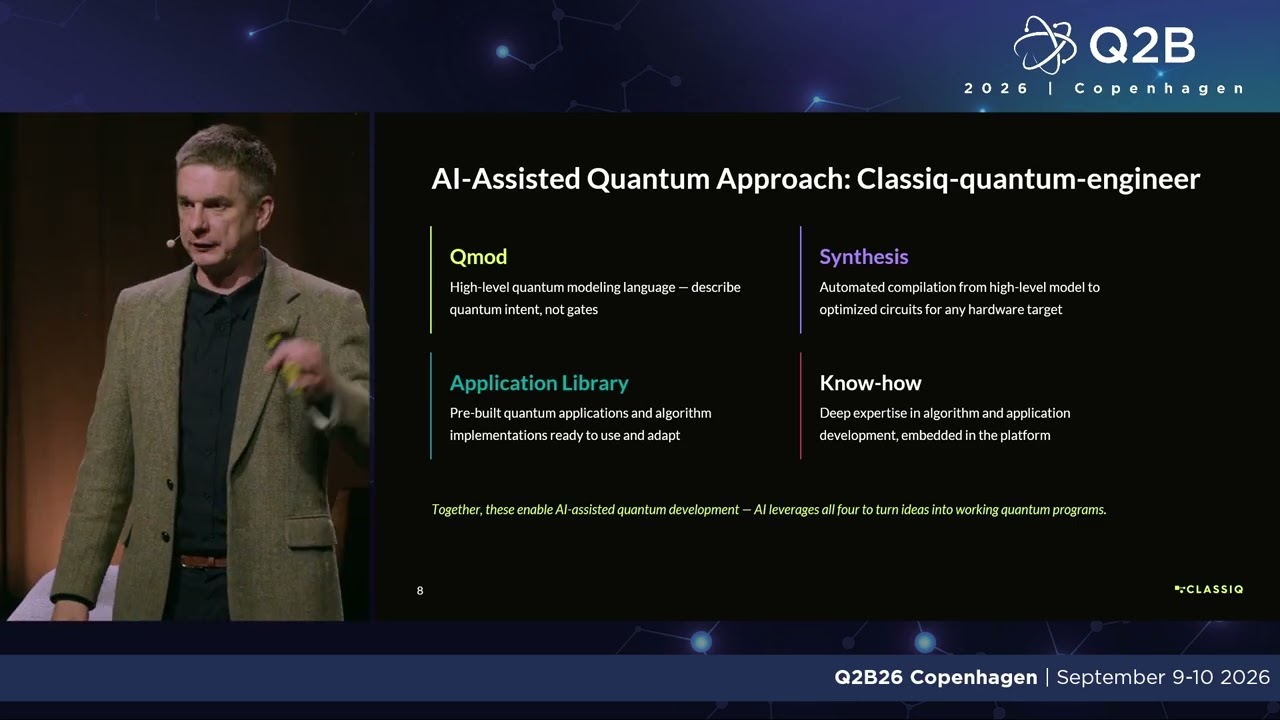
Q2B26 Copenhagen | Eugene Oleynik, Head of EMEA, Classiq
Keywords
Summary
195 words
Critical Evaluation
Value of the Information & Strength of the Argument
The value of the information lies in demonstrating a practical integration of AI to bridge the gap between complex quantum research papers and executable quantum code. The speaker argues convincingly that AI can handle low-level circuit design, letting developers focus on algorithm architecture and business value. The argumentation is structured logically: first establishing the trend in classical AI, then identifying pain points in quantum development, and finally presenting their solution with a concrete example. The demo is compelling, showing step-by-step how the AI agent interprets a paper, retrieves relevant library functions, builds a circuit, and performs benchmarking. However, the presentation is inherently promotional, lacking independent benchmarks or comparisons with other approaches, which weakens the strength of the claims.
Scientific Rigor, Source Quality, Title Accuracy
The scientific rigor is moderate. The speaker references a specific paper (IonQ on quantum TDA) and mentions a JP Morgan paper on portfolio optimization, but provides no citations or links. The only external source in the description is the Q2B conference page. The use of a live demo is illustrative but not a formal study. The title ‘Q2B26 Copenhagen | Eugene Oleynik, Head of EMEA, Classiq’ is generic; the subtitle in the description (‘Quantum-Enabled AI For Expert Quantum Developers’) better reflects the content. Overall, the talk is a product demonstration rather than a peer-reviewed presentation, and the lack of verifiable sources limits its scientific reliability.
238 words
Title / Content Match
Generic title but content matches: presents an AI-driven platform for quantum application development.
Quality & Reliability
6/10
The presentation is informative and technically coherent, but is primarily promotional for Classiq's platform, lacking independent validation of claims.