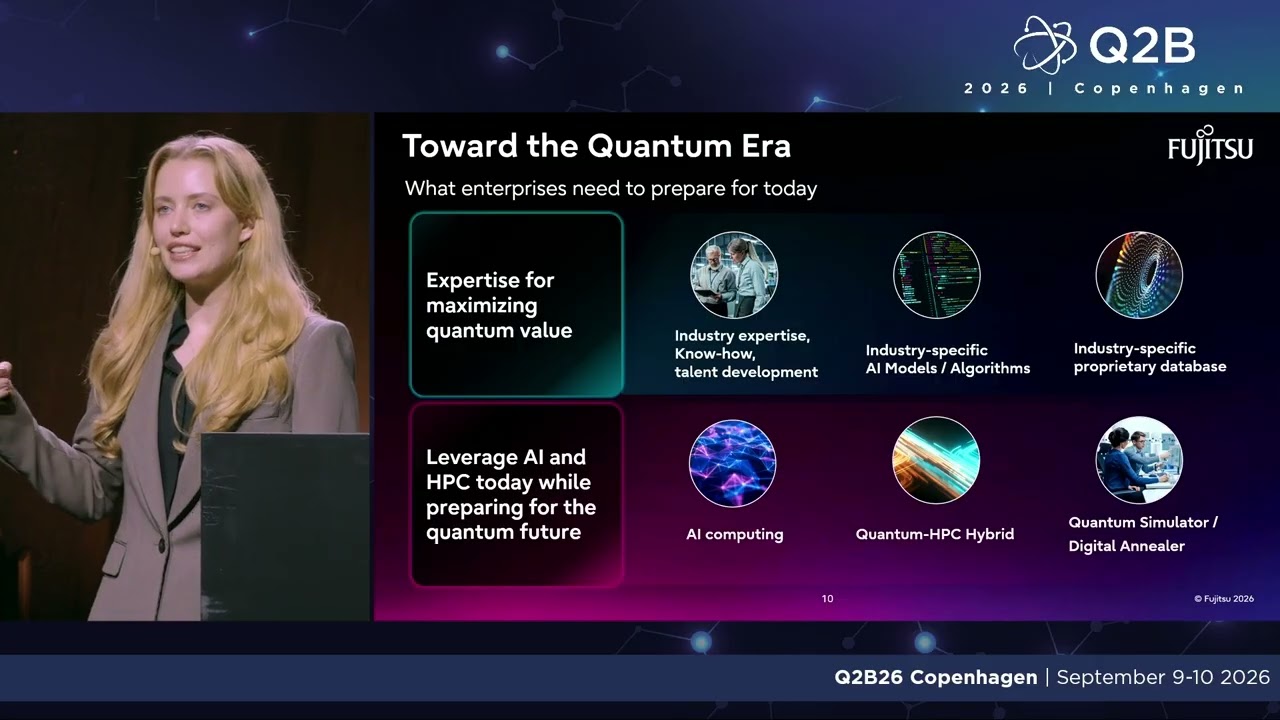
Q2B26 Copenhagen | Ellen Devereux, CTO Advisor for Quantum, Fujitsu
Keywords
Summary
217 words
Critical Evaluation
Value of the Information & Strength of the Argument
The value lies in the detailed, concrete timeline for quantum computing development from a major industrial player, including numbers on qubit counts, decoder performance, and a commercial use case (Cubitra). The argumentation is well-structured, building from historical credibility to a forward-looking roadmap, and using specific technological achievements as proof points. However, the discourse is inherently promotional, offering no alternative viewpoints or acknowledgment of potential technical hurdles or timelines risks, which limits its critical depth.
Scientific Rigor, Source Quality, Title Accuracy
The scientific rigor is moderate: the talk presents technical specifications and benchmark claims (e.g., decoder error rates, patent counts) without external citations or reproducible data. Sources cited are limited to the Q2B conference link in the description, and no academic or third-party publications are referenced, making verification difficult. The title matches the content accurately, as it names the event and the speaker, and the content aligns with announced topics.
158 words
Title / Content Match
The title accurately reflects the content: a talk at Q2B26 Copenhagen by Fujitsu's CTO Advisor for Quantum, matching the video.
Quality & Reliability
7/10
The presentation offers concrete technical details (qubit counts, error-correction decoder performance, patents, and a commercial co-venture) from an authoritative company insider. However, it is essentially a strategic and promotional pitch, with no independent verification or critical discussion of limitations, which tempers the reliability score.
Key Moments
Markers derived by PSI from the transcript: the creator did not define chapters.
- Ellen Devereux introduces herself and Fujitsu's computing legacy, from relay computers to Fugaku.
- Presentation of Fujitsu's 2035 vision for sovereign computing and the role of quantum in this roadmap.
- Details on the current 256-qubit superconducting machine and the target of 1,024 qubits by end of year.
- Discussion of quantum-inspired approaches, orchestration tools like Octopus, and the consulting suite (Cubitra).
- Four proof points of leadership: 256-qubit system, decoder efficiency, patent leadership, and catalyst discovery acceleration.
- Announcements of the diamond-spin prototype with tin vacancies and research on neutral atoms with Yakumo.
- Description of the Quantum Research Application Pack with GUI, Python, and C++ layers, and closing remarks on convergence.
Cited Sources
- Q2B Conference — Official conference page where the talk was presented.
Contribution & Novelties
The main contribution is an insider’s view of Fujitsu’s concrete roadmap for quantum computing, including specific architectural choices (superconducting and diamond-spin qubits), error-correction targets, and the strategic integration of quantum with HPC and AI via software layers. It also reveals the announcement of a new diamond-spin prototype and research on neutral atoms, showing multi-modal ambition. The ‘quantum-inspired’ approach offers a pragmatic path for immediate business value while awaiting fault-tolerant quantum machines.
Pour aller plus loin :
- Quantum computing — Overview of quantum computing principles and current state of the art.
- TOP500 — Reference list of the world’s most powerful supercomputers, relevant to Fujitsu’s history with Fugaku.
- Fujitsu Quantum — Official Fujitsu page on quantum computing initiatives (though not explicitly cited, it is the company’s primary resource).
126 words
Radar Profile
The radar profile shows above-average scores on information quantity and technical level, with moderate to high values on quality and reliability. This reflects a technically dense but commercially oriented talk, where the depth of detail is not matched by independent verification or critical analysis.