Q2B26 Copenhagen | Ieva Čepaitė, Quantum Algorithm Scientist, Phasecraft
Keywords
Summary
145 words
Critical Evaluation
Value of the Information & Strength of the Argument
The talk provides a balanced and honest assessment of quantum optimization, acknowledging that classical methods are already very strong and that proving quantum advantage is hard. The value lies in presenting a practical hybrid approach—using quantum correlations to seed classical heuristics—which is supported by hardware data and a clear explanation of why quantum sampling can be provably classically hard. The argumentation is logical: starting from a quantum-generated bitstring that contains useful correlations can accelerate classical local search, without requiring full fault tolerance. The speaker also pragmatically discusses caveats (noise, scaling, need for efficient circuit implementation) and situates the work within a broader research direction (MIPs).
Scientific Rigor, Source Quality, Title Accuracy
The talk is based on a funded project with Nisso (UK energy grid operator) and references an arXiv paper (though the URL is not shown). The speaker cites classical solvers (Gurobi, CPLEX) and mentions hardware partnerships with major vendors. The title–content fit is excellent: it is exactly a talk by Ieva Čepaitė from Phasecraft at Q2B26 Copenhagen. However, external sources are sparse within the video, and the conference description provides only a general link. The rigor appears high given the presenter’s expertise and the honest treatment of limitations, but verification would require consulting the referenced paper.
216 words
Title / Content Match
The title accurately describes the session: a talk by Ieva Čepaitė from Phasecraft at Q2B26 Copenhagen.
Quality & Reliability
8/10
The speaker is a quantum algorithm scientist at a reputable company, presents specific results from a funded project, and honestly discusses limitations. However, the talk is not peer-reviewed and lacks external validation within the video.
Key Moments
Markers derived by PSI from the transcript: the creator did not define chapters.
- Introduction of speaker and Phasecraft as a quantum algorithms company.
- Overview of optimization problems: continuous, mixed integer, and QUBO.
- Energy grid as a network with QUBO applications.
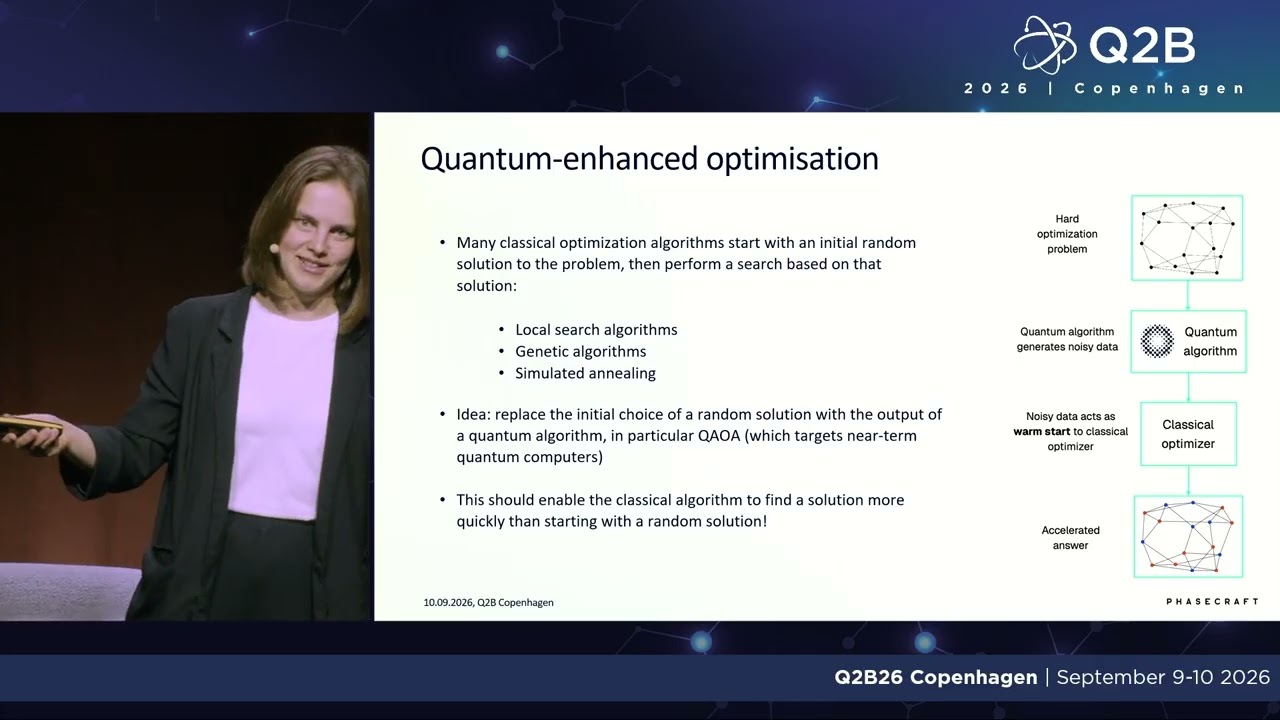
- Challenges of quantum optimization and the quantum-enhanced optimization idea.
- Results showing up to 1000x speedup on hardware.
- Specific energy grid problems: MIS, PMU placement, partitioning.
- Mandrean pipeline and implementation details.
- Future work on Mixed Integer Programming and conclusion.
Cited Sources
- Q2B Conference — Conference website where the talk was presented.
Concurring Sources
- Quantum approximate optimization algorithm — Supports the description of QAOA as a heuristic quantum algorithm.
- Max cut problem — Corroborates the combinatorial nature of the example problem.
- Quadratic unconstrained binary optimization — Background on QUBO formulation.
Contribution & Novelties
The original contribution is the quantum-enhanced optimization approach: using QAOA-generated bitstrings to seed classical heuristic solvers, yielding significant speedups on real hardware while circumventing the need for fault tolerance. The talk also highlights practical implementation efforts (efficient circuit compilation, routing, bypassing variational optimization).
Pour aller plus loin :
- Quantum approximate optimization algorithm (QAOA) — Directly relevant to the method discussed.
- Quadratic unconstrained binary optimization (QUBO) — Core problem formulation used throughout.
- Max cut problem — The primary graph problem used in the results.
83 words
Radar Profile
The radar profile shows high scores in information quantity and quality, with moderate technical depth and reliability. This reflects a talk that is informative and credible but not extremely technical or heavily verified, aligning with a conference presentation.