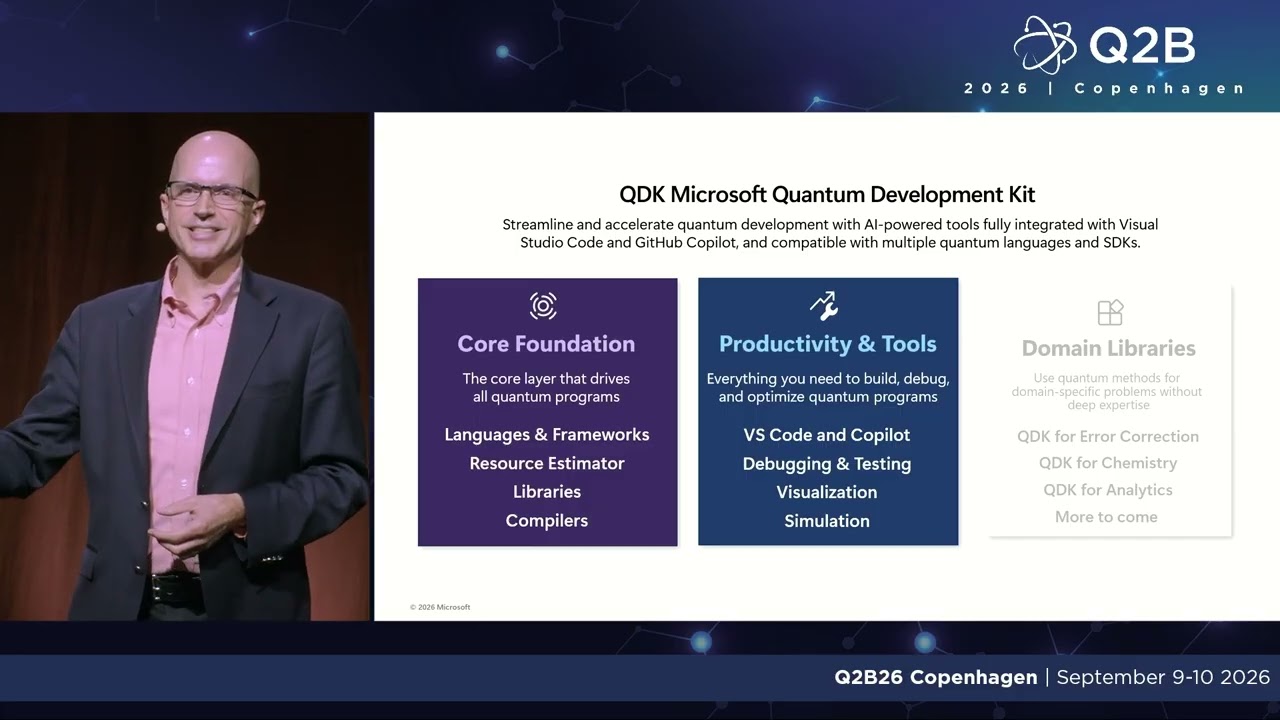
Q2B26 Copenhagen | Dr. Nathan Baker, Partner, Quantum Applications, Microsoft Quantum
Title history
- Q2B26 Copenhagen | Dr. Nathan Baker, Partner, Quantum Applications, Microsoft Quantum (PSI archive)
- Q2B26 Copenhagen | Dr. Nathan Baker, Partner, Quantum Applications, Microsoft Quantum — observed on 20261026-1137 UTC (YouTube)
Keywords
Summary
224 words
Critical Evaluation
Value of the Information & Strength of the Argument
The talk provides valuable insights into Microsoft’s open-source QDK ecosystem, detailing how the tools are designed to lower barriers for quantum application development. The argumentation is coherent: quantum computers are positioned as specialized accelerators, complemented by AI and HPC, and the described libraries directly address practical challenges in chemistry and data analytics. The speaker’s reasoning is clear and logically structured, though it primarily serves to advocate for Microsoft’s solutions rather than offering a balanced comparison with alternatives.
Scientific Rigor, Source Quality, Title Accuracy
The presentation is rigorous in its technical explanation of quantum computing concepts, resource estimation, and error correction, but it relies on Microsoft’s own claims and tools without external scholarly citations. The title is accurate and matches the content exactly. No comments were provided, so no analysis of public reception is possible.
143 words
Title / Content Match
The title accurately reflects the content: Dr. Nathan Baker, from Microsoft Quantum, discusses quantum applications and open-source tools at Q2B26 Copenhagen.
Quality & Reliability
7/10
The talk provides an authoritative overview of Microsoft's quantum computing tools and strategy, grounded in the presenter's role and references to open-source software. However, it remains promotional and does not delve into peer-reviewed sources or independent validations.
Key Moments
Markers derived by PSI from the transcript: the creator did not define chapters.
- Introduction and vision for quantum utility in chemistry, materials, and life sciences.
- Quantum computers as accelerators alongside HPC and AI.
- Computational chemistry scaling problem and quantum advantage.
- Overview of the Quantum Development Kit (QDK) and its core components.
- QDK core libraries, Q# language, and resource estimator.
- AI integration and Copilot for quantum programming.
- QDK for error correction and fault-tolerant computing.
- QDK for chemistry library: models, molecules, and materials.
- QDK for analytics and Tensor PCA algorithm.
- Conclusion and open-source philosophy.
Cited Sources
- Q2B Conference Website — The conference where the talk was given, providing background and context.
Contribution & Novelties
The talk contributes an insider perspective on Microsoft’s strategy for quantum application development, highlighting upcoming tools like QDK for analytics and Tensor PCA. It underscores the emphasis on modular, extensible, and open-source libraries to foster community adoption. The discussion of combining quantum acceleration with AI and HPC, and the focus on error-corrected systems, reflects current industry trends.
Pour aller plus loin :
- Microsoft Quantum Development Kit (QDK) — Official open-source repository for the QDK, including Q# language and libraries.
- Quantum error correction — Overview of the principles and methods for fault-tolerant quantum computing.
- Quantum computing — General reference on quantum computing concepts and potential applications.
105 words
Radar Profile
The radar profile shows balanced scores across dimensions, with technical level slightly lower than information quantity and quality, reflecting an accessible but authoritative presentation. The fiabilite_globale score of 7 indicates a reliable source, though promotional bias is present.