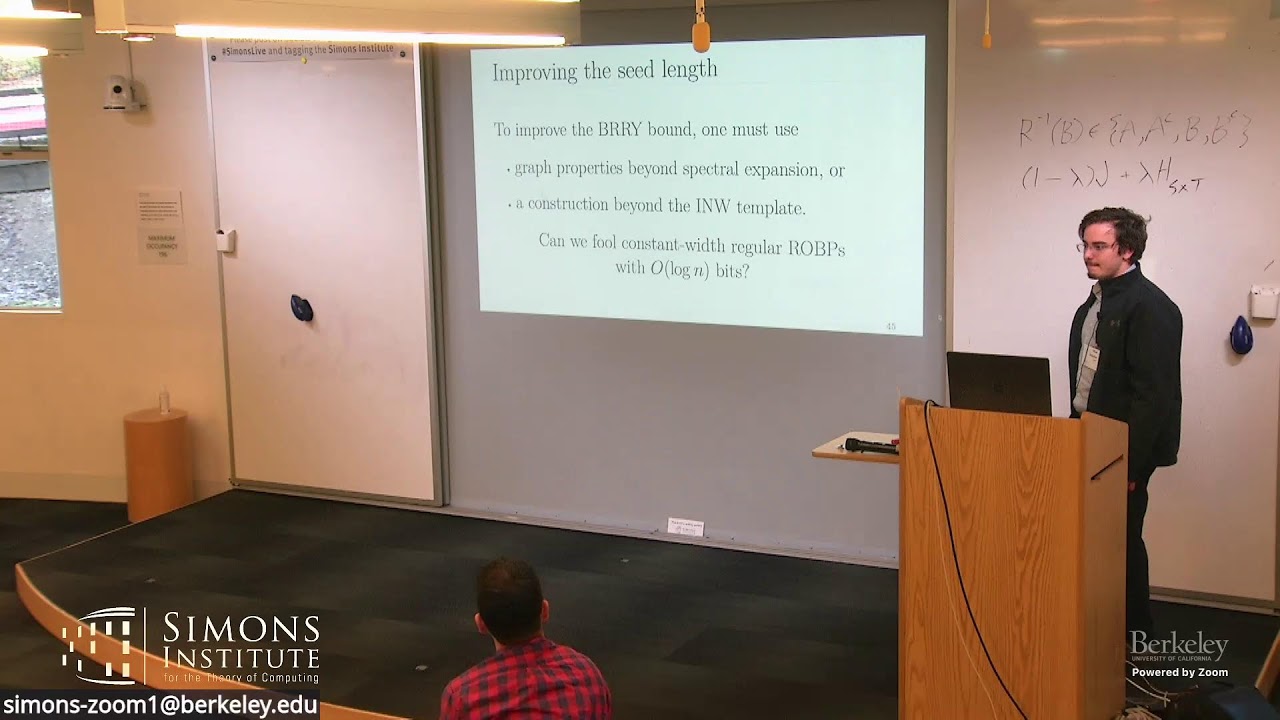
The BRRY analysis of the INW generator is optimal
Title history
- The BRRY analysis of the INW generator is optimal — observed on 20261101-0403 UTC (YouTube)
Keywords
Summary
156 words
Critical Evaluation
Value of the Information & Strength of the Argument
The talk offers significant value by settling a theoretical question about the limits of a well-known derandomization technique. The argumentation is rigorous, following a clear logical structure: defining the INW generator, stating the BRRY guarantee, and then presenting a lower bound against any spectral analysis. The proof is constructive and elegant, employing a width-6 branching program and tailor-made expanders to force the generator to fail. The speaker carefully addresses assumptions and highlights the novelty, particularly the distinction between forward and backward running of branching programs, which is crucial for achieving subconstant probabilities. The argument is compelling and well-motivated, with appropriate caveats about the scope of the result.
Scientific Rigor, Source Quality, Title Accuracy
The talk demonstrates high scientific rigor, typical of a Simons Institute presentation. The content is based on joint work with William Hoza, presumably available as a preprint or paper. The speaker does not cite external sources in the presentation itself, but the description provides a link to the talk page on the Simons Institute website, which likely includes further references. The title is perfectly matched to the content, accurately describing the theorem proved. The talk is technically dense, requiring a strong background in complexity theory and expander graphs, but the speaker manages to convey the intuition while leaving formal proofs for the written paper.
226 words
Title / Content Match
The title accurately reflects the content: the speaker proves that the BRRY analysis of the INW generator is optimal, with a small asterisk.
Quality & Reliability
8/10
The talk presents a new theoretical result, part of a peer-reviewed research program. The speaker is a researcher from UChicago, and the talk is hosted by the Simons Institute. The technical content is rigorous, with clear proof outlines. However, as a talk, it lacks full details and formal verifiability in this format.
Key Moments
Markers derived by PSI from the transcript: the creator did not define chapters.
- Introduction to branching programs and the INW generator
- Statement of the BRRY theorem and the open question on seed length
- Outline of the lower bound proof against spectral analysis
- Construction of the width-6 branching program R and K
- Key lemma for correlating rare events using expanders
- Parameter choices and final result
Cited Sources
- Simons Institute talk page — Official page for the talk, likely containing abstract and further details.
Contribution & Novelties
The primary novelty is the proof that the BRRY analysis of the INW generator is optimal among all spectral analyses. This sets a fundamental limitation on the power of this technique, suggesting that new ideas are needed to achieve O(log n) seed length for regular branching programs. The talk also introduces an interesting use of backward-running branching programs to create subconstant probabilities, and a clever expander construction to correlate rare events. This work advances the understanding of derandomization and may inspire new approaches.
Pour aller plus loin :
- Pseudorandom generator — Background on PRGs.
- Branching program — Definitions and variants.
- Expander graph — Spectral expansion and applications.
- Derandomization — Overview of the field.
113 words
Radar Profile
The radar profile shows very high technical level and information density, with slightly lower reliability due to the informal setting. The talk is highly specialized, as expected for a theoretical computer science workshop. The scores reflect a balance between the depth of the content and the constraints of a concise presentation.