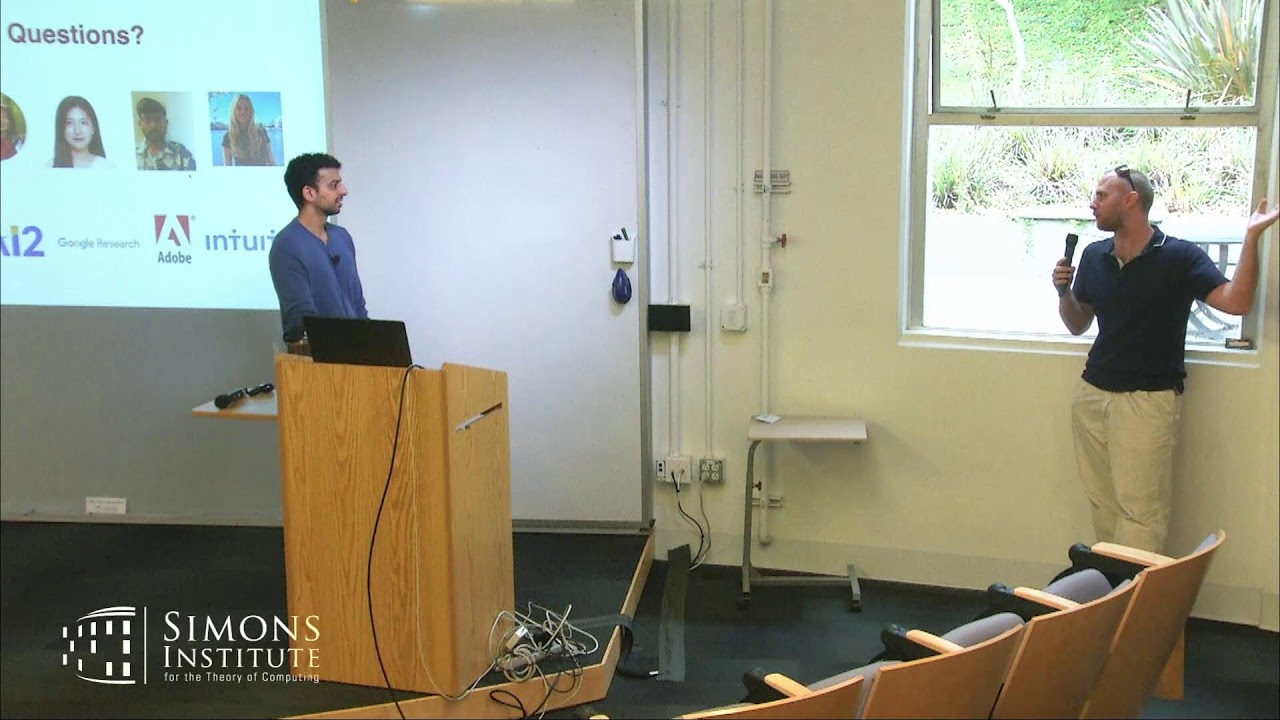
Evaluating factuality in long-form generation
Title history
- Evaluating factuality in long-form generation — observed on 20261025-1531 UTC (YouTube)
Keywords
Summary
153 words
Critical Evaluation
Value of the Information & Strength of the Argument
The talk provides substantial value by presenting concrete empirical evidence on the prevalence of AI hallucinations in news articles and connecting this to broader trust issues. The decompose-and-verify framework is a practical contribution to evaluation methodology, offering a way to scale factuality assessment. The argumentation is solid: claims are supported by data from datasets and studies, and the author transparently acknowledges limitations and open problems. The presentation is well-structured, moving from motivation to methodological contributions and then to unresolved challenges. The use of real examples (e.g., the Druckenmiller op-ed, the Vietnam claim) makes the argument compelling and accessible without oversimplifying.
Scientific Rigor, Source Quality, Title Accuracy
The speaker cites a Pew Research survey, uses the Pangram detector, and references his own datasets and papers. The contribution is grounded in prior work such as FactScore, though specific citations are not explicitly given in the talk. The title accurately reflects the content, focusing on factuality in long-form generation. The talk adheres to scientific rigor by describing experimental setups and acknowledging limitations of the methods. The link in the description provides access to the talk page for further details. Overall, the sources are credible and the research is presented with appropriate caveats.
208 words
Title / Content Match
The title precisely describes the focus on factuality evaluation for long-form generative text.
Quality & Reliability
8/10
The talk presents original research from a leading academic group, supported by empirical data and a clear methodological framework. The author is a recognized expert in NLP, and the presentation is rigorous despite some unavoidable simplifications.
Key Moments
Markers derived by PSI from the transcript: the creator did not define chapters.
- Motivation: AI-generated news articles and trust issues
- Hallucination detection in AI-written news and comparison with human-written articles
- Introduction of decompose-and-verify framework for factuality evaluation
- VeriScore: extracting verifiable claims and using search engines
- Open problems: complex claims, counterfactuals, and verifiability challenges
Cited Sources
- Talk page on Simons Institute — The talk is part of the Trustworthy AI workshop; this page provides official details and supplementary materials.
Concurring Sources
- Talk page on Simons Institute — This is the official source for the talk, consistent with the content presented.
Contribution & Novelties
The talk contributes a practical framework for evaluating factuality in long-form text, decomposing it into atomic claims and verifying them against retrieved evidence. It also introduces VeriScore as a method to extract only verifiable factual claims, reducing noise from metaphorical or unverifiable statements. The discussion of open problems highlights critical gaps in current evaluation, such as handling complex counterfactual claims and the reliability of search-based evidence.
Pour aller plus loin :
- Hallucination (artificial intelligence) — Overview of hallucination phenomena in LLMs.
- Large language model — Context on generative models and their evaluation challenges.
- FactScore — Predecessor metric that the decompose-and-verify approach builds upon. (Note: I am not entirely sure this Wikipedia page exists; if not, use general article on AI evaluation.)
121 words
Radar Profile
The radar profile shows high scores across information quality, technical depth, and reliability, indicating a well-rigorous talk. The quantitative and qualitative information are balanced, with a slight emphasis on technical depth, reflecting the speaker's research focus.