Real-World Lessons from Deploying AI in Clinical Settings | Ronnie Rajan | ADIA Lab Symposium 2026
Title history
- Real-World Lessons from Deploying AI in Clinical Settings | Ronnie Rajan | ADIA Lab Symposium 2026 — observed on 20261105-1151 UTC (YouTube)
Keywords
Summary
167 words
Critical Evaluation
Value of the Information & Strength of the Argument
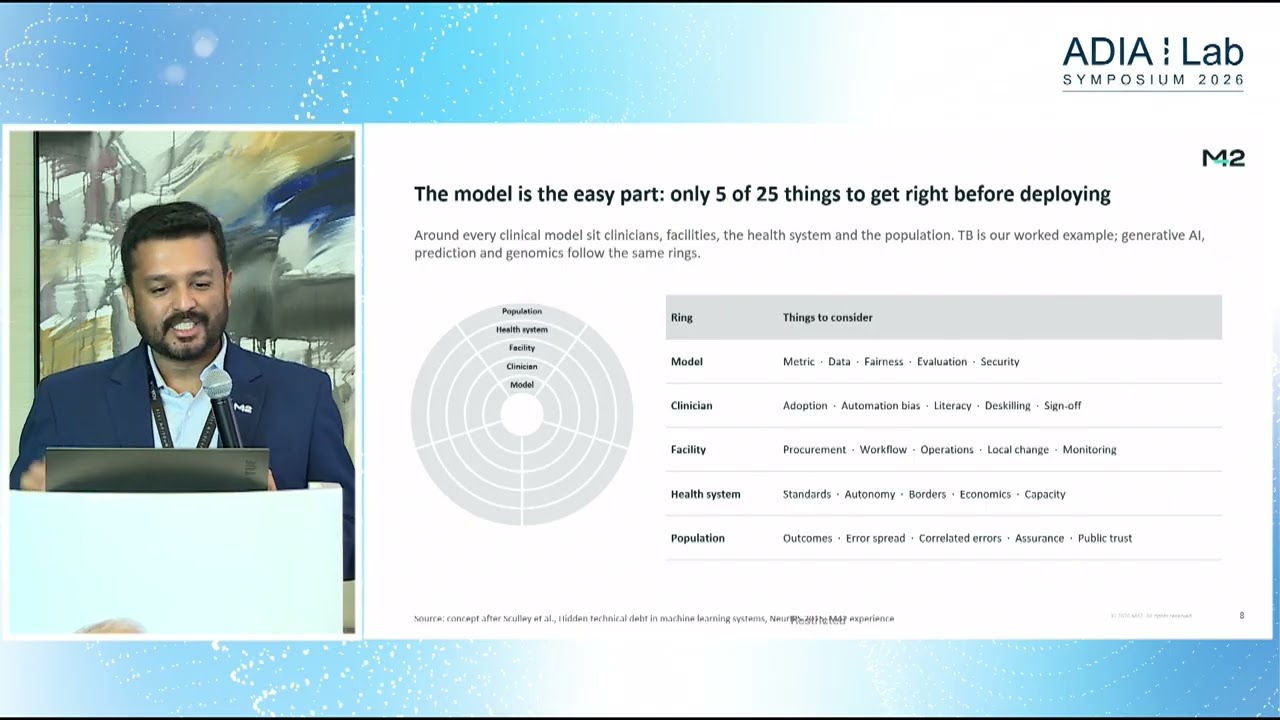
The value of the information is high: the speaker provides rare insider perspectives on real-world AI deployment, including the long timeline, regulatory complexities, and the often-overlooked need for continuous monitoring. His argumentation is solid, using a concrete case (TB screening) to illustrate each point, and he supports claims with references to published studies (e.g., performance drop when clinicians use AI, modeling bias). He also acknowledges the hype and failures, which adds credibility. However, some arguments rely on personal experience without formal evidence, and the talk is more qualitative than quantitative. The logical flow is clear, progressing from model to clinician, facility, health system, and economic layers.
Scientific Rigor, Source Quality, Title Accuracy
The talk is rigorous in that the speaker cites specific studies and regulatory frameworks (e.g., FDA-approved tools, automation bias studies, the DoH’s AI clinician framework), and he openly discusses the limitations of his own projects. The sources mentioned are relevant and credible, though no direct URLs are provided in the talk itself; the only link in the description is to the ADIA Lab symposium page, which we list as a source. The title accurately captures the content, which is entirely about real-world deployment challenges. The speaker does not oversell; he emphasizes the gap between research and practice. No comments were provided for analysis, so no public reaction trends are reported.
231 words
Title / Content Match
The title accurately reflects the content: the speaker focuses on practical deployment challenges, moving beyond model building to adoption, trust, regulation, and governance.
Quality & Reliability
8/10
The talk is built on first-hand experience deploying AI in clinical practice, with concrete cases (TB screening) and references to published studies. The speaker is a physician and AI lead at M42, lending authority. However, most claims are anecdotal or unsourced in the video, and no external evidence is provided on the spot, so a high but not perfect score is warranted.
Key Moments
Markers derived by PSI from the transcript: the creator did not define chapters.
- Introduction to M42 and the UAE's advanced health data infrastructure, including the Emirates Genome Program and Malafi health information exchange.
- Why AI is needed: overwhelming volume of medical literature, physician workload, and workforce shortage; AI as a tool to scale human attention.
- TB screening case: 500k chest X-rays per year, 99.5% normal, model achieved 80% automation but no deployment for 2 years due to regulatory and trust issues.
- Evaluation of LLMs: USMLE scores alone are insufficient; task-specific evaluation shows note-generation performance varies widely, with top USMLE scorers getting only 40% on note generation.
- Regulatory pathway: developing a standard for AI in TB screening, independent audit, and staged autonomy; continuous monitoring caught performance drop after machine upgrade.
- Facility and health system factors: procurement, governance layers (sandwich vs lasagna), and the importance of aligning with evolving global regulations.
Cited Sources
- ADIA Lab Symposium 2026 — Official event page; the talk was given at this symposium, providing context for the presentation.
Concurring Sources
- ADIA Lab Symposium 2026 — The talk was part of this symposium, indicating scholarly context.
Contribution & Novelties
This talk adds value by focusing on the post-validation phase of clinical AI, sharing specific barriers encountered (regulatory gaps, clinician mistrust, monitoring challenges) and practical solutions (staged autonomy, independent audits, task-specific evaluation). It offers a rare view from a large health organization in the UAE, showcasing how advanced infrastructure enables faster adoption. The emphasis on continuous monitoring and the need to evaluate LLMs based on real tasks rather than exam scores is particularly insightful.
Pour aller plus loin :
- Artificial intelligence in healthcare — Overview of AI applications and challenges in medicine.
- Automation bias — Cognitive bias that affects reliance on automated systems, central to the talk’s discussion on clinician trust.
- Clinical decision support system — Related to how AI tools integrate into clinical workflows.
125 words
Radar Profile
The profile is balanced, with high scores across quantity, quality, technical level, and reliability. The talk excels in practical information and real-world examples, though the lack of detailed data and reliance on anecdotal evidence prevent higher scores.